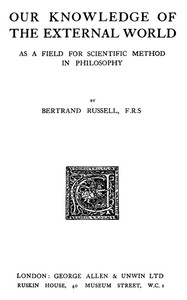
Our Knowledge of the External World as a Field for Scientific Method in Philosophy — Reading Notes

(4 User reviews)   534
In Category - Logic
Russell, Bertrand, 1872-1970 Project Gutenberg 2011 Not confirmed
Knowledge, Theory of; Logical atomism Readers of public-domain and historical texts
Project Gutenberg digital edition en

Edition facts

Words 74,426
Reading time 324 min
Text sections 8

The catalog record for Our Knowledge of the External World as a Field for Scientific Method in Philosophy — Reading Notes provides practical reading context through 74,426 words, 5 hr 24 min estimated reading time, and 8 detected text sections.

The text analysis averages about 25.1 words per sentence, while the detected sections provide another way to judge how the source is divided.

Project Gutenberg metadata also associates the work with “Knowledge, Theory of,” connecting these edition facts with the source record’s subject description.

Bertrand Russell's 1914 lectures argue for logical analysis as the method to transform philosophy into a science, using the problem of sense-data and physical space to illustrate how precise, piecemeal inquiry can replace grand speculative systems.
Share
Editorial Edition Score 4.7/5

Calculated from edition completeness, EPUB availability, text structure and catalogue metadata. Not a user rating.

How this score is calculated
  • Description quality20 pts
  • Title & short description10 pts
  • Source metadata20 pts
  • Text length15 pts
  • Chapters / structure15 pts
  • EPUB file integrity20 pts

Total of 100 points, scaled to a 2.5-5.0 range. Editions with an empty description or a missing EPUB file are not scored.

Edition quality

Read the Text

Thales said that all is water, philosophers have been ready with glib assertions about the sum-total of things; and equally glib denials have come from other philosophers ever since Thales was contradicted by Anaximander. I believe that the time has now arrived when this unsatisfactory state of things can be brought to an end. In the following course of lectures I shall try, chiefly by taking certain special problems as examples, to indicate wherein the claims of philosophers have been excessive, and why their achievements have not been greater. The problems and the method of philosophy have, I believe, been misconceived by all schools, many of its traditional problems being insoluble with our means of knowledge, while other more neglected but not less important problems can, by a more patient and more adequate method, be solved with all the precision and certainty to which the most advanced sciences have attained.

Among present-day philosophies, we may distinguish three principal types, often combined in varying proportions by a single philosopher, but in essence and tendency distinct. The first of these, which I shall call the classical tradition, descends in the main from Kant and Hegel; it represents the attempt to adapt to present needs the methods and results of the great constructive philosophers from Plato downwards. The second type, which may be called evolutionism, derived its predominance from Darwin, and must be reckoned as having had Herbert Spencer for its first philosophical representative; but in recent times it has become, chiefly through William James and M. Bergson, far bolder and far more searching in its innovations than it was in the hands of Herbert Spencer. The third type, which may be called "logical atomism" for want of a better name, has gradually crept into philosophy through the critical scrutiny of mathematics. This type of philosophy, which is the one that I wish to advocate, has not as yet many whole-hearted adherents, but the "new realism" which owes its inception to Harvard is very largely impregnated with its spirit. It represents, I believe, the same kind of advance as was introduced into physics by Galileo: the substitution of piecemeal, detailed, and verifiable results for large untested generalities recommended only by a certain appeal to imagination. But before we can understand the changes advocated by this new philosophy, we must briefly examine and criticise the other two types with which it has to contend.

A. The Classical Tradition

Twenty years ago, the classical tradition, having vanquished the opposing tradition of the English empiricists, held almost unquestioned sway in all Anglo-Saxon universities. At the present day, though it is losing ground, many of the most prominent teachers still adhere to it. In academic France, in spite of M. Bergson, it is far stronger than all its opponents combined; and in Germany it has many vigorous advocates. Nevertheless, it represents on the whole a decaying force, and it has failed to adapt itself to the temper of the age. Its advocates are, in the main, those whose extra-philosophical knowledge is literary, rather than those who have felt the inspiration of science. There are, apart from reasoned arguments, certain general intellectual forces against it--the same general forces which are breaking down the other great syntheses of the past, and making our age one of bewildered groping where our ancestors walked in the clear daylight of unquestioning certainty.

The original impulse out of which the classical tradition developed was the naïve faith of the Greek philosophers in the omnipotence of reasoning. The discovery of geometry had intoxicated them, and its _a priori_ deductive method appeared capable of universal application. They would prove, for instance, that all reality is one, that there is no such thing as change, that the world of sense is a world of mere illusion; and the strangeness of their results gave them no qualms because they believed in the correctness of their reasoning. Thus it came to be thought that by mere thinking the most surprising and important truths concerning the whole of reality could be established with a certainty which no contrary observations could shake. As the vital impulse of the early philosophers died away, its place was taken by authority and tradition, reinforced, in the Middle Ages and almost to our own day, by systematic theology. Modern philosophy, from Descartes onwards, though not bound by authority like that of the Middle Ages, still accepted more or less uncritically the Aristotelian logic. Moreover, it still believed, except in Great Britain, that _a priori_ reasoning could reveal otherwise undiscoverable secrets about the universe, and could prove reality to be quite different from what, to direct observation, it appears to be. It is this belief, rather than any particular tenets resulting from it, that I regard as the distinguishing characteristic of the classical tradition, and as hitherto the main obstacle to a scientific attitude in philosophy.

The nature of the philosophy embodied in the classical tradition may be made clearer by taking a particular exponent as an illustration. For this purpose, let us consider for a moment the doctrines of Mr Bradley, who is probably the most distinguished living representative of this school. Mr Bradley's _Appearance and Reality_ is a book consisting of two parts, the first called _Appearance_, the second _Reality_. The first part examines and condemns almost all that makes up our everyday world: things and qualities, relations, space and time, change, causation, activity, the self. All these, though in some sense facts which qualify reality, are not real as they appear. What is real is one single, indivisible, timeless whole, called the Absolute, which is in some sense spiritual, but does not consist of souls, or of thought and will as we know them. And all this is established by abstract logical reasoning professing to find self-contradictions in the categories condemned as mere appearance, and to leave no tenable alternative to the kind of Absolute which is finally affirmed to be real.

One brief example may suffice to illustrate Mr Bradley's method. The world appears to be full of many things with various relations to each other--right and left, before and after, father and son, and so on. But relations, according to Mr Bradley, are found on examination to be self-contradictory and therefore impossible. He first argues that, if there are relations, there must be qualities between which they hold. This part of his argument need not detain us. He then proceeds:

"But how the relation can stand to the qualities is, on the other side, unintelligible. If it is nothing to the qualities, then they are not related at all; and, if so, as we saw, they have ceased to be qualities, and their relation is a nonentity. But if it is to be something to them, then clearly we shall require a _new_ connecting relation. For the relation hardly can be the mere adjective of one or both of its terms; or, at least, as such it seems indefensible. And, being something itself, if it does not itself bear a relation to the terms, in what intelligible way will it succeed in being anything to them? But here again we are hurried off into the eddy of a hopeless process, since we are forced to go on finding new relations without end. The links are united by a link, and this bond of union is a link which also has two ends; and these require each a fresh link to connect them with the old. The problem is to find how the relation can stand to its qualities, and this problem is insoluble."[4]

[4] _Appearance and Reality_, pp. 32-33.

I do not propose to examine this argument in detail, or to show the exact points where, in my opinion, it is fallacious. I have quoted it only as an example of method. Most people will admit, I think, that it is calculated to produce bewilderment rather than conviction, because there is more likelihood of error in a very subtle, abstract, and difficult argument than in so patent a fact as the interrelatedness of the things in the world. To the early Greeks, to whom geometry was practically the only known science, it was possible to follow reasoning with assent even when it led to the strangest conclusions. But to us, with our methods of experiment and observation, our knowledge of the long history of _a priori_ errors refuted by empirical science, it has become natural to suspect a fallacy in any deduction of which the conclusion appears to contradict patent facts. It is easy to carry such suspicion too far, and it is very desirable, if possible, actually to discover the exact nature of the error when it exists. But there is no doubt that what we may call the empirical outlook has become part of most educated people's habit of mind; and it is this, rather than any definite argument, that has diminished the hold of the classical tradition upon students of philosophy and the instructed public generally.

The function of logic in philosophy, as I shall try to show at a later stage, is all-important; but I do not think its function is that which it has in the classical tradition. In that tradition, logic becomes constructive through negation. Where a number of alternatives seem, at first sight, to be equally possible, logic is made to condemn all of them except one, and that one is then pronounced to be realised in the actual world. Thus the world is constructed by means of logic, with little or no appeal to concrete experience. The true function of logic is, in my opinion, exactly the opposite of this. As applied to matters of experience, it is analytic rather than constructive; taken _a priori_, it shows the possibility of hitherto unsuspected alternatives more often than the impossibility of alternatives which seemed _primâ facie_ possible. Thus, while it liberates imagination as to what the world _may_ be, it refuses to legislate as to what the world _is_. This change, which has been brought about by an internal revolution in logic, has swept away the ambitious constructions of traditional metaphysics, even for those whose faith in logic is greatest; while to the many who regard logic as a chimera the paradoxical systems to which it has given rise do not seem worthy even of refutation. Thus on all sides these systems have ceased to attract, and even the philosophical world tends more and more to pass them by.

One or two of the favourite doctrines of the school we are considering may be mentioned to illustrate the nature of its claims. The universe, it tells us, is an "organic unity," like an animal or a perfect work of art. By this it means, roughly speaking, that all the different parts fit together and co-operate, and are what they are because of their place in the whole. This belief is sometimes advanced dogmatically, while at other times it is defended by certain logical arguments. If it is true, every part of the universe is a microcosm, a miniature reflection of the whole. If we knew ourselves thoroughly, according to this doctrine, we should know everything. Common sense would naturally object that there are people--say in China--with whom our relations are so indirect and trivial that we cannot infer anything important as to them from any fact about ourselves. If there are living beings in Mars or in more distant parts of the universe, the same argument becomes even stronger. But further, perhaps the whole contents of the space and time in which we live form only one of many universes, each seeming to itself complete. And thus the conception of the necessary unity of all that is resolves itself into the poverty of imagination, and a freer logic emancipates us from the strait-waistcoated benevolent institution which idealism palms off as the totality of being.

Another very important doctrine held by most, though not all, of the school we are examining is the doctrine that all reality is what is called "mental" or "spiritual," or that, at any rate, all reality is dependent for its existence upon what is mental. This view is often particularised into the form which states that the relation of knower and known is fundamental, and that nothing can exist unless it either knows or is known. Here again the same legislative function is ascribed to _a priori_ argumentation: it is thought that there are contradictions in an unknown reality. Again, if I am not mistaken, the argument is fallacious, and a better logic will show that no limits can be set to the extent and nature of the unknown. And when I speak of the unknown, I do not mean merely what we personally do not know, but what is not known to any mind. Here as elsewhere, while the older logic shut out possibilities and imprisoned imagination within the walls of the familiar, the newer logic shows rather what may happen, and refuses to decide as to what _must_ happen.

The classical tradition in philosophy is the last surviving child of two very diverse parents: the Greek belief in reason, and the mediæval belief in the tidiness of the universe. To the schoolmen, who lived amid wars, massacres, and pestilences, nothing appeared so delightful as safety and order. In their idealising dreams, it was safety and order that they sought: the universe of Thomas Aquinas or Dante is as small and neat as a Dutch interior. To us, to whom safety has become monotony, to whom the primeval savageries of nature are so remote as to become a mere pleasing condiment to our ordered routine, the world of dreams is very different from what it was amid the wars of Guelf and Ghibelline. Hence William James's protest against what he calls the "block universe" of the classical tradition; hence Nietzsche's worship of force; hence the verbal bloodthirstiness of many quiet literary men. The barbaric substratum of human nature, unsatisfied in action, finds an outlet in imagination. In philosophy, as elsewhere, this tendency is visible; and it is this, rather than formal argument, that has thrust aside the classical tradition for a philosophy which fancies itself more virile and more vital.

Evolutionism, in one form or another, is the prevailing creed of our time. It dominates our politics, our literature, and not least our philosophy. Nietzsche, pragmatism, Bergson, are phases in its philosophic development, and their popularity far beyond the circles of professional philosophers shows its consonance with the spirit of the age. It believes itself firmly based on science, a liberator of hopes, an inspirer of an invigorating faith in human power, a sure antidote to the ratiocinative authority of the Greeks and the dogmatic authority of mediæval systems. Against so fashionable and so agreeable a creed it may seem useless to raise a protest; and with much of its spirit every modern man must be in sympathy. But I think that, in the intoxication of a quick success, much that is important and vital to a true understanding of the universe has been forgotten. Something of Hellenism must be combined with the new spirit before it can emerge from the ardour of youth into the wisdom of manhood. And it is time to remember that biology is neither the only science, nor yet the model to which all other sciences must adapt themselves. Evolutionism, as I shall try to show, is not a truly scientific philosophy, either in its method or in the problems which it considers. The true scientific philosophy is something more arduous and more aloof, appealing to less mundane hopes, and requiring a severer discipline for its successful practice.

Darwin's _Origin of Species_ persuaded the world that the difference between different species of animals and plants is not the fixed, immutable difference that it appears to be. The doctrine of natural kinds, which had rendered classification easy and definite, which was enshrined in the Aristotelian tradition, and protected by its supposed necessity for orthodox dogma, was suddenly swept away for ever out of the biological world. The difference between man and the lower animals, which to our human conceit appears enormous, was shown to be a gradual achievement, involving intermediate beings who could not with certainty be placed either within or without the human family. The sun and planets had already been shown by Laplace to be very probably derived from a primitive more or less undifferentiated nebula. Thus the old fixed landmarks became wavering and indistinct, and all sharp outlines were blurred. Things and species lost their boundaries, and none could say where they began or where they ended.

But if human conceit was staggered for a moment by its kinship with the ape, it soon found a way to reassert itself, and that way is the "philosophy" of evolution. A process which led from the amoeba to man appeared to the philosophers to be obviously a progress--though whether the amoeba would agree with this opinion is not known. Hence the cycle of changes which science had shown to be the probable history of the past was welcomed as revealing a law of development towards good in the universe--an evolution or unfolding of an ideal slowly embodying itself in the actual. But such a view, though it might satisfy Spencer and those whom we may call Hegelian evolutionists, could not be accepted as adequate by the more whole-hearted votaries of change. An ideal to which the world continuously approaches is, to these minds, too dead and static to be inspiring. Not only the aspirations, but the ideal too, must change and develop with the course of evolution; there must be no fixed goal, but a continual fashioning of fresh needs by the impulse which is life and which alone gives unity to the process.

Ever since the seventeenth century, those whom William James described as the "tender-minded" have been engaged in a desperate struggle with the mechanical view of the course of nature which physical science seems to impose. A great part of the attractiveness of the classical tradition was due to the partial escape from mechanism which it provided. But now, with the influence of biology, the "tender-minded" believe that a more radical escape is possible, sweeping aside not merely the laws of physics, but the whole apparently immutable apparatus of logic, with its fixed concepts, its general principles, and its reasonings which seem able to compel even the most unwilling assent. The older kind of teleology, therefore, which regarded the End as a fixed goal, already partially visible, towards which we were gradually approaching, is rejected by M. Bergson as not allowing enough for the absolute dominion of change. After explaining why he does not accept mechanism, he proceeds:[5]

"But radical finalism is quite as unacceptable, and for the same reason. The doctrine of teleology, in its extreme form, as we find it in Leibniz for example, implies that things and beings merely realise a programme previously arranged. But if there is nothing unforeseen, no invention or creation in the universe, time is useless again. As in the mechanistic hypothesis, here again it is supposed that _all is given_. Finalism thus understood is only inverted mechanism. It springs from the same postulate, with this sole difference, that in the movement of our finite intellects along successive things, whose successiveness is reduced to a mere appearance, it holds in front of us the light with which it claims to guide us, instead of putting it behind. It substitutes the attraction of the future for the impulsion of the past. But succession remains none the less a mere appearance, as indeed does movement itself. In the doctrine of Leibniz, time is reduced to a confused perception, relative to the human standpoint, a perception which would vanish, like a rising mist, for a mind seated at the centre of things.

"Yet finalism is not, like mechanism, a doctrine with fixed rigid outlines. It admits of as many inflections as we like. The mechanistic philosophy is to be taken or left: it must be left if the least grain of dust, by straying from the path foreseen by mechanics, should show the slightest trace of spontaneity. The doctrine of final causes, on the contrary, will never be definitively refuted. If one form of it be put aside, it will take another. Its principle, which is essentially psychological, is very flexible. It is so extensible, and thereby so comprehensive, that one accepts something of it as soon as one rejects pure mechanism. The theory we shall put forward in this book will therefore necessarily partake of finalism to a certain extent."

[5] _Creative Evolution_, English translation, p. 41.

Bertrand Russell opens this series of lectures by declaring that philosophy must adopt the logical-analytic method if it is to yield objective knowledge. He presents the method as something “perfectly definite, capable of embodiment in maxims,” and contrasts it with the ambitious but ultimately subjective systems of the past. The central problem he uses to demonstrate this approach is the relation between the crude data of sense and the space, time, and matter of mathematical physics. Russell acknowledges his debt to Frege for the first complete example of this method, and to Whitehead for shaping the specific problem addressed. The lectures are not a finished system but an attempt to show the way toward a scientific philosophy.

The Logical-Analytic Method as a Tool for Precision

Russell’s preface frames the logical-analytic method as a departure from traditional philosophy. He argues that earlier methods “professed to lead to more ambitious results” but produced conclusions that many competent philosophers rejected. In contrast, logical analysis aims for results independent of the philosopher’s temperament. Russell does not dismiss the great systems of the past—he calls them “useful as aids to imagination”—but insists that philosophy must become a science. The method is presented as gradual and piecemeal, not as a leap to grand conclusions. This emphasis on precision and verifiability is a recurring theme throughout the lectures.

Compactness and the Nature of Continuity

In the excerpt on continuity, Russell introduces the mathematical concept of “compactness” as the lowest degree of continuity. A series is compact when no two terms are consecutive; between any two there are others. He uses the example of fractions: between 1/2 and 51/100 lies 101/200, and so on ad infinitum. This property, he notes, belongs not to the set of terms themselves but to their arrangement in a series. Russell distinguishes between abstract objects like fractions, where compactness is logically possible, and concrete cases like motion, where it becomes “repugnant to our habits of thought.” He then turns to the mathematical account of motion, acknowledging it may be an artificial simplification of physical reality.

The Problem of Sense-Data and Physical Objects

Russell’s central problem is the relation between sense-data—the immediate objects of perception—and the space, time, and matter posited by physics. He does not claim to solve this problem definitively but uses it to illustrate how logical analysis can clarify philosophical puzzles. The method involves breaking down complex notions into simpler constituents and examining their logical connections. Russell’s approach is cautious: he treats the mathematical account of motion as a formal statement whose physical adequacy is a separate question. This careful separation of logical possibility from empirical truth is a hallmark of his method.

The Role of Order and Series in Philosophical Analysis

Russell emphasizes that order is a concept not required for cardinal number but essential for understanding continuity. He notes that a set of terms can be arranged in multiple orders, some continuous and some not. The essence of continuity lies in the arrangement, not the terms themselves. This distinction is crucial for his analysis of space and time. By focusing on the logical properties of series, Russell aims to show how mathematical concepts can illuminate philosophical problems without overreaching into empirical claims. The discussion of compactness and motion serves as a concrete example of this method in action.

Russell’s lectures are best approached as a demonstration of method rather than a finished doctrine. Readers should attend to how he defines terms, distinguishes logical from empirical questions, and builds arguments step by step. The excerpts reveal a philosopher committed to clarity and caution, wary of sweeping claims. Whether or not one accepts his conclusions, the logical-analytic method he advocates remains a significant contribution to philosophical practice.

Reading Russell’s lectures again, I’m struck by how gently he dismantles the grand systems we cling to, leaving us with smaller, firmer truths. It feels like tidying a cluttered room and finding one good chair. That same quiet patience lives in The Categories — Reading Notes, which I keep returning to for its careful, unhurried distinctions.

Mila Jones
1 week ago

Elijah Williams
1 month ago

Grace Adams
2 weeks ago

John Clark
1 month ago

5
5 out of 5 (4 User reviews )

Add a Review

Your Rating *
There are no comments for this eBook.

Reader reflection

Before you leave, reflect on the book

Use these questions to collect your thoughts before moving on.

Your progress 0 / 10
1

What is your current status with this title?

2

How did the book work for you overall?

3

Would you encourage someone else to read it?

4

How much effort did this book require?

Related eBooks