Select works of Porphyry — Reading Companion

(4 User reviews)   649
In Category - Logic
Taylor, Thomas, 1758-1835 [Translator], Porphyry, 234?-305? Project Gutenberg 2025 Not confirmed
Odysseus, King of Ithaca (Mythological character); Soul -- Early works to 1800; Mind and body -- Early works to 1800; Vegetarianism -- Early works to 1800; Neoplatonism -- Early works to 1800 Readers of public-domain and historical texts
Project Gutenberg digital edition en

Edition facts

Words 100,028
Reading time 435 min
Text sections 17

The source record for Select works of Porphyry — Reading Companion measures this digital text at 100,028 words, 7 hr 15 min estimated reading time, and 17 detected text sections.

The text analysis averages about 29.4 words per sentence, while the detected sections provide another way to judge how the source is divided.

Project Gutenberg metadata also associates the work with “Odysseus, King of Ithaca (Mythological character),” connecting these edition facts with the source record’s subject description.

This edition collects Porphyry's treatises on vegetarianism, Homeric allegory, and the soul, translated by Thomas Taylor. The excerpts reveal a philosophical argument linking animal slaughter to human war, a Neoplatonic reading of Odysseus, and Taylor's reverential framing of Porphyry as 'the philosopher.'
Share
Editorial Edition Score 4.8/5

Calculated from edition completeness, EPUB availability, text structure and catalogue metadata. Not a user rating.

How this score is calculated
  • Description quality20 pts
  • Title & short description10 pts
  • Source metadata20 pts
  • Text length15 pts
  • Chapters / structure15 pts
  • EPUB file integrity20 pts

Total of 100 points, scaled to a 2.5-5.0 range. Editions with an empty description or a missing EPUB file are not scored.

Edition quality

Read the Text

ooked round, and saw the very bird which he had seen in his sleep. Hoping, therefore, that his dream would be fulfilled, he stood still, saw the bird fly to the altar and sit upon it, and deliver itself into the hands of the high priest. Thus the bird was sacrificed, and the altar sprinkled with blood. That, however, which happened at Cyzicus, is still more celebrated than this event. For Mithridates having besieged this city, the festival of Proserpine was then celebrated, in which it was requisite to sacrifice an ox. But the sacred herds, from which it was necessary the victim should be taken, fed opposite to the city, on the continent[23]: and one of them was already marked for this purpose. When, therefore, the hour demanded the sacrifice, the ox lowed, and swam over the sea, and the guards of the city opened the gates to it. Then the ox directly ran into the city, and stood at the altar, and was sacrificed to the Goddess. Not unreasonably, therefore, was it thought to be most pious to sacrifice many animals, since it appeared that the sacrifice of them was pleasing to the Gods.

26. But what would be the condition of a city, if all the citizens were of this opinion, [viz. that they should abstain from destroying animals?] For how would they repel their enemies, when they were attacked by them, if they were careful in the extreme not to kill any one of them? In this case, indeed, they must be immediately destroyed. And it would be too prolix to narrate other difficulties and inconveniences, which would necessarily take place. That it is not, however, impious to slay and feed on animals, is evident from this, that Pythagoras himself, though those prior to him permitted the athletæ to drink milk, and to eat cheese, irrigated with water; but others, posterior to him, rejecting this diet, fed them with dry figs; yet he, abrogating the ancient custom, allowed them to feed on flesh, and found that such a diet greatly increased their strength. Some also relate, that the Pythagoreans themselves did not spare animals when they sacrificed to the gods. Such, therefore, are the arguments of Clodius, Heraclides Ponticus, Hermachus the Epicurean, and the Stoics and Peripatetics, [against abstinence from animal food]: among which also are comprehended the arguments which were sent to us by you, O Castricius. As, however, I intend to oppose these opinions, and those of the multitude, I may reasonably premise what follows.

27. In the first place, therefore, it must be known that my discourse does not bring with it an exhortation to every description of men. For it is not directed to those who are occupied in sordid mechanical arts, nor to those who are engaged in athletic exercises; neither to soldiers, nor sailors, nor rhetoricians, nor to those who lead an active life. But I write to the man who considers what he is, whence he came, and whither he ought to tend, and who, in what pertains to nutriment, and other necessary concerns, is different from those who propose to themselves other kinds of life; for to none but such as these do I direct my discourse. For, neither in this common life can there be one and the same exhortation to the sleeper, who endeavours to obtain sleep through the whole of life, and who, for this purpose, procures from all places things of a soporiferous nature, as there is to him who is anxious to repel sleep, and to dispose every thing about him to a vigilant condition. But to the former it is necessary to recommend intoxication, surfeiting, and satiety, and to exhort him to choose a dark house, and

A bed luxuriant, broad, and soft,—

as the poets say; and that he should procure for himself all such things as are of a soporiferous nature, and which are effective of sluggishness and oblivion, whether they are odours, or ointments, or are liquid or solid medicines. And to the latter it is requisite to advise the use of a drink sober and without wine, food of an attenuated nature, and almost approaching to fasting; a house lucid, and participating of a subtle air and wind, and to urge him to be strenuously excited by solicitude and thought, and to prepare for himself a small and hard bed. But, whether we are naturally adapted to this, I mean to a vigilant life, so as to grant as little as possible to sleep, since we do not dwell among those who are perpetually vigilant, or whether we are designed to be in a soporiferous state of existence, is the business of another discussion, and is a subject which requires very extended demonstrations.

28. To the man, however, who once suspects the enchantments attending our journey through the present life, and belonging to the place in which we dwell; who also perceives himself to be naturally vigilant, and considers the somniferous nature of the region which he inhabits;—to this man addressing ourselves, we prescribe food consentaneous to his suspicion and knowledge of this terrene abode, and exhort him to suffer the somnolent to be stretched on their beds, dissolved in sleep. For it is requisite to be cautious, lest as those who look on the blear-eyed contract an ophthalmy, and as we gape when present with those who are gaping, so we should be filled with drowsiness and sleep, when the region which we inhabit is cold, and adapted to fill the eyes with rheum, as being of a marshy nature, and drawing down all those that dwell in it to a somniferous and oblivious condition. If, therefore, legislators had ordained laws for cities, with a view to a contemplative and intellectual life, it would certainly be requisite to be obedient to those laws, and to comply with what they instituted concerning food. But if they established their laws, looking to a life according to nature, and which is said to rank as a medium, [between the irrational and the intellectual life,] and to what the vulgar admit, who conceive externals, and things which pertain to the body to be good or evil, why should any one, adducing their laws, endeavour to subvert a life, which is more excellent than every law which is written and ordained for the multitude, and which is especially conformable to an unwritten and divine law? For such is the truth of the case.

29. The contemplation which procures for us felicity, does not consist, as same one may think it does, in a multitude of discussions and disciplines; nor does it receive any increase by a quantity of words. For if this were the case, nothing would prevent those from being happy by whom all disciplines are collected together [and comprehended]. Now, however, every discipline by no means gives completion to this contemplation, nor even the disciplines which pertain to truly existing beings, unless there is a conformity to them of our nature[24] and life. For since there are, as it is said, in every purpose three[25] ends, the end with us is to obtain the contemplation of real being, the attainment of it procuring, as much as it is possible for us, a conjunction of the contemplator with the object of contemplation. For the reascent of the soul is not to any thing else than true being itself, nor is its conjunction with any other thing. But intellect is truly-existing being; so that the end is to live according to intellect. Hence such discussions and exoteric disciplines as impede our purification, do not give completion to our felicity. If, therefore, felicity consisted in literary attainments, this end might be obtained by those who pay no attention to their food and their actions. But since for this purpose it is requisite to exchange the life which the multitude lead for another, and to become purified both in words and deeds, let us consider what reasonings and what works will enable us to obtain this end.

30. Shall we say, therefore, that they will be such as separate us from sensibles, and the passions which pertain to them, and which elevate us as much as possible to an intellectual, unimaginative, and impassive life; but that the contraries to these are foreign, and deserve to be rejected? And this by so much the more, as they separate us from a life according to intellect. But, I think, it must be admitted, that we should follow the object to which intellect attracts us. For we resemble those who enter into, or depart from a foreign region, not only because we are banished from our intimate associates, but in consequence of dwelling in a foreign land, we are filled with barbaric passions, and manners, and legal institutes, and to all these have a great propensity. Hence, he who wishes to return to his proper kindred and associates, should not only with alacrity begin the journey, but, in order that he may be properly received, should meditate how he may divest himself of every thing of a foreign nature which he has assumed, and should recall to his memory such things as he has forgotten, and without which he cannot be admitted by his kindred and friends. After the same manner, also, it is necessary, if we intend to return to things which are truly our own, that we should divest ourselves of every thing of a mortal nature which we have assumed, together with an adhering affection towards it, and which is the cause of our descent [into this terrestrial region;] and that we should excite our recollection of that blessed and eternal essence, and should hasten our return to the nature which is without colour and without quality, earnestly endeavouring to accomplish two things; one, that we may cast aside every thing material and mortal; but the other, that we may properly return, and be again conversant with our true kindred, ascending to them in a way contrary to that in which we descended hither. For we were intellectual natures, and we still are essences purified from all sense and irrationality; but we are complicated with sensibles, through our incapability of eternally associating with the intelligible, and through the power of being conversant with terrestrial concerns. For all the powers which energize in conjunction with sense and body, are injured, in consequence of the soul not abiding in the intelligible; (just as the earth, when in a bad condition, though it frequently receives the seed of wheat, yet produces nothing but tares), and this is through a certain depravity of the soul, which does not indeed destroy its essence from the generation of irrationality, but through this is conjoined with a mortal nature, and is drawn down from its own proper to a foreign condition of being.

31. So that, if we are desirous of returning to those natures with which we formerly associated, we must endeavour to the utmost of our power to withdraw ourselves from sense and imagination, and the irrationality with which they are attended, and also from the passions which subsist about them, as far as the necessity of our condition in this life will permit. But such things as pertain to intellect should be distinctly arranged, procuring for it peace and quiet from the war with the irrational part; that we may not only be auditors of intellect and intelligibles, but may as much as possible enjoy the contemplation of them, and, being established in an incorporeal nature, may truly live through intellect; and not falsely in conjunction with things allied to bodies. We must therefore divest ourselves of our manifold garments, both of this visible and fleshly vestment, and of those with which we are internally clothed, and which are proximate to our cutaneous habiliments; and we must enter the stadium naked and unclothed, striving for [the most glorious of all prizes] the Olympia of the soul. The first thing, however, and without which we cannot contend, is to divest ourselves of our garments. But since of these some are external and others internal, thus also with respect to the denudation, one kind is through things which are apparent, but another through such as are more unapparent. Thus, for instance, not to eat, or not to receive what is offered to us, belongs to things which are immediately obvious; but not to desire is a thing more obscure; so that, together with deeds, we must also withdraw ourselves from an adhering affection and passion towards them. For what benefit shall we derive by abstaining from deeds, when at the same time we tenaciously adhere to the causes from which the deeds proceed?

32. But this departure [from sense, imagination, and irrationality,] may be effected by violence, and also by persuasion and by reason, through the wasting away, and, as it may be said, oblivion and death of the passions; which, indeed, is the best kind of departure, since it is accomplished without oppressing that from which we are divulsed. For, in sensibles, a divulsion by force is not effected without either a laceration of a part, or a vestige of avulsion. But this separation is introduced by a continual negligence of the passions. And this negligence is produced by an abstinence from those sensible perceptions which excite the passions, and by a persevering attention to intelligibles. And among these passions or perturbations, those which arise from food are to be enumerated.

33. We should therefore abstain, no less than from other things, from certain food, viz. such as is naturally adapted to excite the passive part of our soul, concerning which it will be requisite to consider as follows: There are two fountains whose streams irrigate the bond by which the soul is bound to the body; and from which the soul being filled as with deadly potions, becomes oblivious of the proper objects of her contemplation. These fountains are pleasure and pain; of which sense indeed is preparative, and the perception which is according to sense, together with the imaginations, opinions, and recollections which accompany the senses. But from these, the passions being excited, and the whole of the irrational nature becoming fattened, the soul is drawn downward, and abandons its proper love of true being. As much as possible, therefore, we must separate ourselves from these. But the separation must be effected by an avoidance of the passions which subsist through the senses and the irrational part. But the senses are employed either on objects of the sight, or of the hearing, or of the taste, or the smell, or the touch; for sense is as it were the metropolis of that foreign colony of passions which we contain. Let us, therefore, consider how much fuel of the passions enters into us through each of the senses. For this is effected partly by the view of the contests of horses and the athlete, or those whose bodies are contorted in dancing; and partly from the survey of beautiful women. For these, ensnaring the irrational nature, attack and subjugate it by all-various deceptions.

34. For the soul, being agitated with Bacchic fury through all these by the irrational part, is made to leap, to exclaim and vociferate, the external tumult being inflamed by the internal, and which was first enkindled by sense. But the excitations through the ears, and which are of a passive nature, are produced by certain noises and sounds, by indecent language and defamation, so that many through these being exiled from reason, are furiously agitated, and some, becoming effeminate, exhibit all-various convolutions of the body. And who is ignorant how much the use of fumigations, and the exhalations of sweet odours, with which lovers supply the objects of their love, fatten the irrational part of the soul? But what occasion is there to speak of the passions produced through the taste? For here, especially, there is a complication of a twofold bond; one which is fattened by the passions excited by the taste; and the other, which we render heavy and powerful, by the introduction of foreign bodies [_i.e._ of bodies different from our own]. For, as a certain physician said, those are not the only poisons which are prepared by the medical art; but those likewise which we daily assume for food, both in what we eat, and what we drink, and a thing of a much more deadly nature is imparted to the soul through these, than from the poisons which are compounded for the purpose of destroying the body. And as to the touch, it does all but transmute the soul into the body, and produces in it certain inarticulate sounds, such as frequently take place in inanimate bodies. And from all these, recollections, imaginations, and opinions being collected together, excite a swarm of passions, viz. of fear, desire, anger, love, voluptuousness[26], pain, emulation, solicitude, and disease, and cause the soul to be full of similar perturbations.

35. Hence, to be purified from all these is most difficult, and requires a great contest, and we must bestow much labour both by night and by day to be liberated from an attention to them, and this, because we are necessarily complicated with sense. Whence, also, as much as possible, we should withdraw ourselves from those places in which we may, though unwillingly, meet with this hostile crowd. From experience, also, we should avoid a contest with it, and even a victory over it, and the want of exercise from inexperience.

36. For we learn, that this conduct was adopted by some of the celebrated ancient Pythagoreans and wise men; some of whom dwelt in the most solitary places; but others in temples and sacred groves, from which, though they were in cities, all tumult and the multitude were expelled. But Plato chose to reside in the Academy, a place not only solitary and remote from the city, but which was also said to be insalubrious. Others have not spared even their eyes, through a desire of not being divulsed from the inward contemplation [of reality]. If some one, however, at the same time that he is conversant with men, and while he is filling his senses with the passions pertaining to them, should fancy that he can remain impassive, he is ignorant that he both deceives himself and those who are persuaded by him, nor does he see that we are enslaved to many passions, through not alienating ourselves from the multitude. For he did not speak vainly, and in such a way as to falsify the nature of [the Coryphæan] philosophers, who said of them, “These, therefore, from their youth, neither know the way to the forum, nor where the court of justice or senate-house is situated, or any common place of assembly belonging to the city.” They likewise neither hear nor see laws, or decrees, whether orally promulgated or written. And as to the ardent endeavours of their companions to obtain magistracies, the associations of these, their banquets and wanton feastings, accompanied by pipers, these they do not even dream of accomplishing. But whether any thing in the city has happened well or ill, or what evil has befallen any one from his progenitors, whether male or female, these are more concealed from such a one, than, as it is said, how many measures called choes the sea contains. And besides this, he is even ignorant that he is ignorant[27] of all these particulars. For he does not abstain from them for the sake of renown, but, in reality, his body only dwells, and is conversant in the city; but his reasoning power considering all these as trifling and of no value, “he is borne away,” according to Pindar, “on all sides, and does not apply himself to any thing which is near.”

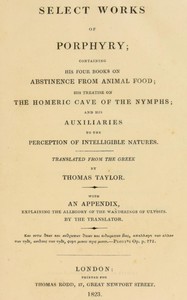
Thomas Taylor's 1823 translation presents Porphyry as a philosopher whose works were praised by later Neoplatonists for their 'conceptions adapted to sanctity.' The volume opens with a biographical introduction that emphasizes Porphyry's role as the editor of Plotinus's writings, comparing him to 'a Mercurial chain let down for the benefit of mortals.' This framing sets the tone for treatises that blend ethical argument, allegorical interpretation, and metaphysical ascent.

The excerpts show Porphyry drawing on historical sources like Dicæarchus to argue that early humans lived peacefully without animal food, and that 'together with the slaughter of animals, war and injustice were introduced.' The reasoning is tightly woven: dietary practice is presented as a root cause of social violence, not merely a personal choice.

The Argument from Historical Progression

In the first book on abstinence, Porphyry reconstructs a three-stage history of human diet: the primitive 'life from the fruits of the earth,' then a pastoral phase where animals were tamed or attacked, and finally agriculture. He cites Dicæarchus to claim that the earliest period was peaceful and 'abstinence from animal food contributed' to that blessed state. The logic is causal: 'together with injustice towards animals, war was introduced among men.' This is not a vague moral plea but a specific historical claim, supported by reference to Lycurgus's Spartan reforms, which minimized meat-eating and, in Porphyry's view, reduced crime. The argumentative structure is cumulative, moving from ancient testimony to political example.

Lycurgus as a Case Study in Dietary Legislation

Porphyry devotes a sustained passage to the Lacedæmonian lawgiver Lycurgus, who 'so arranged his polity, as to render food of this kind requisite in the smallest degree.' The details are concrete: each citizen's allotment was measured in barley and liquid fruits, not in herds or money. Iron currency of great weight and little value replaced gold and silver, making theft impractical. Porphyry reports that Lycurgus laughed upon seeing evenly stacked grain heaps, remarking that Laconia seemed 'to belong to many brothers.' The effect of these reforms, Porphyry claims, was that 'many species of injustice were exterminated.' The passage functions as a historical proof that reducing meat-eating correlates with reduced crime—a key piece of evidence in his larger argument.

Taylor's Translator's Voice and the Homeric Appendix

Thomas Taylor's presence is felt throughout the volume, not only in the introduction but in an appendix 'explaining the allegory of the wanderings of Ulysses.' The excerpts do not include this appendix, but its inclusion signals a Neoplatonic reading of Homer as allegory for the soul's journey. Taylor's dedication to the Reverend William John Jolliffe uses the language of 'testimony of great esteem' and 'tribute of the warmest gratitude,' placing the work in a patronage network. His translation choices—such as rendering Porphyry's Greek into a formal, periodic English—shape the philosophical tone. Readers should note that Taylor is not a neutral conduit; his own Platonic commitments color the presentation.

Diction and the Rhetoric of Abstinence

Porphyry's vocabulary in the excerpts is notably concrete and evaluative. He speaks of 'the audacity of those' who deny the link between meat-eating and injustice, and describes the slaughter of animals as an act of 'audacity' itself. The word 'exterminated' appears twice in relation to injustice—once for Lycurgan Sparta, once for the primitive age—suggesting a totalizing view of moral reform. The phrase 'the mother of injustice' is attributed to opponents and then inverted: history shows that slaughter, not abstinence, breeds war. This rhetorical move—turning a common accusation on its head—is characteristic of Porphyry's dialectical style. The prose is dense with subordinate clauses and cited authorities, creating an impression of scholarly weight.

The Neoplatonic Framework of the Soul

The volume's third treatise, 'Auxiliaries to the Perception of Intelligible Natures,' is not excerpted here, but its title points to the Neoplatonic ascent that frames the entire collection. The epigraph from Plotinus—'the life of gods and of divine and happy men is a liberation from other things here, a flight of alone to alone'—sets a metaphysical goal. Porphyry's ethical arguments about diet are thus nested within a larger project of purifying the soul for intellectual vision. The Homeric cave of the nymphs, interpreted as an image of the cosmos, reinforces this: the physical world is a cave from which the soul must ascend. Readers should approach the abstinence treatise not as a standalone ethical work but as part of a systematic philosophy of liberation.

This edition rewards attention to the interplay between Porphyry's arguments and Taylor's interpretive frame. The historical claims about diet and war, the allegorical reading of Homer, and the metaphysical ascent are all woven together. Readers interested in the rhetorical construction of philosophical authority will find much to examine in how Porphyry cites ancient sources and how Taylor presents him as a 'Mercurial chain' between Plotinus and the modern world.

I’ve been carrying these old Taylor translations around for years now, and the way he sees Porphyry as a quiet guide—insisting that how we treat animals shapes how we treat each other—still lingers. It reminds me of hours spent with A System of Logic, Ratiocinative and Inductive (Vol. 1 of 2) — Reading Companion, where reasoning feels less like a weapon and more like a slow, careful clearing of the mind. Different centuries, same patient hush.

Ella Williams
4 weeks ago

Alexander Taylor
1 week ago

Scarlett Torres
1 week ago

Victoria Mitchell
1 week ago

4
4 out of 5 (4 User reviews )

Add a Review

Your Rating *
There are no comments for this eBook.

Reader reflection

Record your reading impressions

A brief reflection can help important ideas stay with you longer.

Your progress 0 / 10
1

How far have you progressed with this book?

2

Did this book hold your interest?

3

Would you recommend this book to another reader?

4

Did the language feel accessible?

Related eBooks