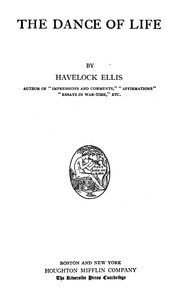
The Dance of Life — Story, Setting & Ideas

(2 User reviews)   637
Ellis, Havelock, 1859-1939 Project Gutenberg 2021 Not confirmed
Philosophy; Ethics; Conduct of life; English essays -- 20th century Readers of public-domain and historical texts
Project Gutenberg digital edition en

Edition facts

Words 111,224
Reading time 484 min
Text sections 17

The Dance of Life — Story, Setting & Ideas can be approached with a clearer sense of reading commitment from its source measurements: 111,224 words, 8 hr 4 min estimated reading time, and 17 detected text sections.

The text analysis averages about 24.2 words per sentence, while the detected sections provide another way to judge how the source is divided.

Project Gutenberg metadata also associates the work with “Philosophy,” connecting these edition facts with the source record’s subject description.

Ellis frames life as an art, arguing that religious and scientific impulses can harmonize. The preface reveals his deliberate incompleteness, inviting readers to co-create meaning. Excerpts show a personal, essayistic voice drawing on Rodin, Lange, and an Australian bush anecdote.
Share
Editorial Edition Score 4.8/5

Calculated from edition completeness, EPUB availability, text structure and catalogue metadata. Not a user rating.

How this score is calculated
  • Description quality20 pts
  • Title & short description10 pts
  • Source metadata20 pts
  • Text length15 pts
  • Chapters / structure15 pts
  • EPUB file integrity20 pts

Total of 100 points, scaled to a 2.5-5.0 range. Editions with an empty description or a missing EPUB file are not scored.

Edition quality

Read the Text

there was no atmosphere for him to live in and he was stifled. But Malherbe, who worshipped Number and Measure as devoutly as Descartes, was born half a century before him. That silent, colossal, ferocious Norman—vividly brought before us by Tallement des Réaux, to whom, rather than to Saint-Simon, we owe the real picture of seventeenth-century France—was possessed by the genius of destruction, for he had the natural instinct of the Viking, and he swept all the lovely Romantic spirit of old France so completely away that it has scarcely ever revived since until the days of Verlaine. But he had the Norman classico-mathematical architectonic spirit—he might have said, like Descartes, as truly as it ever can be said in literature, _Omnia apud me mathematica fiunt_—and he introduced into the world a new rule of Order. Given a Malherbe, a Descartes could hardly fail to follow, a French Academy must come into existence almost at the same time as the “Discours de la Méthode,” and Le Nôtre must already be drawing the geometrical designs of the gardens of Versailles. Descartes, it should be remembered, could not have worked without support; he was a man of timid and yielding character, though he had once been a soldier, not of the heroic temper of Roger Bacon. If Descartes could have been put back into Roger Bacon’s place, he would have thought many of Bacon’s thoughts. But we should never have known it. He nervously burnt one of his works when he heard of Galileo’s condemnation, and it was fortunate that the Church was slow to recognise how terrible a Bolshevist had entered the spiritual world with this man, and never realised that his books must be placed on the Index until he was already dead.

So it is to-day. We, too, witness a classico-mathematical Renaissance. It is bringing us a new vision of the universe, but also a new vision of human life. That is why it is necessary to insist upon life as a dance. This is not a mere metaphor. The dance is the rule of number and of rhythm and of measure and of order, of the controlling influence of form, of the subordination of the parts to the whole. That is what a dance is. And these same properties also make up the classic spirit, not only in life, but, still more clearly and definitely, in the universe itself. We are strictly correct when we regard not only life but the universe as a dance. For the universe is made up of a certain number of elements, less than a hundred, and the “periodic law” of these elements is metrical. They are ranged, that is to say, not haphazard, not in groups, but by number, and those of like quality appear at fixed and regular intervals. Thus our world is, even fundamentally, a dance, a single metrical stanza in a poem which will be for ever hidden from us, except in so far as the philosophers, who are to-day even here applying the methods of mathematics, may believe that they have imparted to it the character of objective knowledge.

I call this movement of to-day, as that of the seventeenth century, classico-mathematical. And I regard the dance (without prejudice to a distinction made later in this volume) as essentially its symbol. This is not to belittle the Romantic elements of the world, which are equally of its essence. But the vast exuberant energies and immeasurable possibilities of the first day may perhaps be best estimated when we have reached their final outcome on the sixth day of creation.

However that may be, the analogy of the two historical periods in question remains, and I believe that we may consider it holds good to the extent that the strictly mathematical elements of the later period are not the earliest to appear, but that we are in the presence of a process that has been in subtle movement in many fields for half a century. If it is significant that Descartes appeared a few years after Malherbe, it is equally significant that Einstein was immediately preceded by the Russian ballet. We gaze in admiration at the artist who sits at the organ, but we have been blowing the bellows; and the great performer’s music would have been inaudible had it not been for us.

This is the spirit in which I have written. We are all engaged—not merely one or two prominent persons here and there—in creating the spiritual world. I have never written but with the thought that the reader, even though he may not know it, is already on my side. Only so could I write with that sincerity and simplicity without which it would not seem to me worth while to write at all. That may be seen in the saying which I set on the forefront of my earliest book, “The New Spirit”: he who carries farthest his most intimate feelings is simply the first in file of a great number of other men, and one becomes typical by being to the utmost degree one’s self. That saying I chose with much deliberation and complete conviction because it went to the root of my book. On the surface it obviously referred to the great figures I was there concerned with, representing what I regarded—by no means in the poor sense of mere modernity—as the New Spirit in life. They had all gone to the depths of their own souls and thence brought to the surface and expressed—audaciously or beautifully, pungently or poignantly—intimate impulses and emotions which, shocking as they may have seemed at the time, are now seen to be those of an innumerable company of their fellow men and women. But it was also a book of personal affirmations. Beneath the obvious meaning of that motto on the title-page lay the more private meaning that I was myself setting forth secret impulses which might some day be found to express the emotions also of others. In the thirty-five years that have since passed, the saying has often recurred to my mind, and if I have sought in vain to make it mine I find no adequate justification for the work of my life.

And now, as I said at the outset, I am even prepared to think that that is the function of all books that are real books. There are other classes of so-called books: there is the class of history books and the class of forensic books, that is to say, the books of facts and the books of argument. No one would wish to belittle either kind. But when we think of a book proper, in the sense that a Bible means a book, we mean more than this. We mean, that is to say, a revelation of something that had remained latent, unconscious, perhaps even more or less intentionally repressed, within the writer’s own soul, which is, ultimately, the soul of mankind. These books are apt to repel; nothing, indeed, is so likely to shock us at first as the manifest revelation of ourselves. Therefore, such books may have to knock again and again at the closed door of our hearts. “Who is there?” we carelessly cry, and we cannot open the door; we bid the importunate stranger, whatever he may be, to go away; until, as in the apologue of the Persian mystic, at last we seem to hear the voice outside saying: “It is thyself.”

II. THE ART OF DANCING 36

III. THE ART OF THINKING 68

IV. THE ART OF WRITING 141

V. THE ART OF RELIGION 191

VI. THE ART OF MORALS 244

CHAPTER I INTRODUCTION

IT has always been difficult for Man to realise that his life is all an art. It has been more difficult to conceive it so than to act it so. For that is always how he has more or less acted it. At the beginning, indeed, the primitive philosopher whose business it was to account for the origin of things usually came to the conclusion that the whole universe was a work of art, created by some Supreme Artist, in the way of artists, out of material that was practically nothing, even out of his own excretions, a method which, as children sometimes instinctively feel, is a kind of creative art. The most familiar to us of these primitive philosophical statements—and really a statement that is as typical as any—is that of the Hebrews in the first chapter of their Book of Genesis. We read there how the whole cosmos was fashioned out of nothing, in a measurable period of time by the art of one Jehovah, who proceeded methodically by first forming it in the rough, and gradually working in the details, the finest and most delicate last, just as a sculptor might fashion a statue. We may find many statements of the like kind even as far away as the Pacific.[1] And—also even at the same distance—the artist and the craftsman, who resembled the divine creator of the world by making the most beautiful and useful things for Mankind, himself also partook of the same divine nature. Thus, in Samoa, as also in Tonga, the carpenter, who built canoes, occupied a high and almost sacred position, approaching that of the priest. Even among ourselves, with our Roman traditions, the name Pontiff, or Bridge-Builder, remains that of an imposing and hieratic personage.

But that is only the primitive view of the world. When Man developed, when he became more scientific and more moralistic, however much his practice remained essentially that of the artist, his conception became much less so. He was learning to discover the mystery of measurement; he was approaching the beginnings of geometry and mathematics; he was at the same time becoming warlike. So he saw things in straight lines, more rigidly; he formulated laws and commandments. It was, Einstein assures us, the right way. But it was, at all events in the first place, most unfavourable to the view of life as an art. It remains so even to-day.

Yet there are always some who, deliberately or by instinct, have perceived the immense significance in life of the conception of art. That is especially so as regards the finest thinkers of the two countries which, so far as we may divine,—however difficult it may here be to speak positively and by demonstration,—have had the finest civilisations, China and Greece. The wisest and most recognisably greatest practical philosophers of both these lands have believed that the whole of life, even government, is an art of definitely like kind with the other arts, such as that of music or the dance. We may, for instance, recall to memory one of the most typical of Greeks. Of Protagoras, calumniated by Plato,—though, it is interesting to observe that Plato’s own transcendental doctrine of Ideas has been regarded as an effort to escape from the solvent influence of Protagoras’ logic,—it is possible for the modern historian of philosophy to say that “the greatness of this man can scarcely be measured.” It was with measurement that his most famous saying was concerned: “Man is the measure of all things, of those which exist and of those which have no existence.” It was by his insistence on Man as the active creator of life and knowledge, the artist of the world, moulding it to his own measure, that Protagoras is interesting to us to-day. He recognised that there are no absolute criteria by which to judge actions. He was the father of relativism and of phenomenalism, probably the initiator of the modern doctrine that the definitions of geometry are only approximately true abstractions from empirical experiences. We need not, and probably should not, suppose that in undermining dogmatism he was setting up an individual subjectivism. It was the function of Man in the world, rather than of the individual, that he had in mind when he enunciated his great principle, and it was with the reduction of human activity and conduct to art that he was mainly concerned. His projects for the art of living began with speech, and he was a pioneer in the arts of language, the initiator of modern grammar. He wrote treatises on many special arts, as well as the general treatise “On the Art” among the pseudo-Hippocratic writings,—if we may with Gomperz attribute it to him,—which embodies the spirit of modern positive science.[2]

Hippias, the philosopher of Elis, a contemporary of Protagoras, and like him commonly classed among the “Sophists,” cultivated the largest ideal of life as an art which embraced all arts, common to all mankind as a fellowship of brothers, and at one with natural law which transcends the convention of human laws. Plato made fun of him, and that was not hard to do, for a philosopher who conceived the art of living as so large could not possibly at every point adequately play at it. But at this distance it is his ideal that mainly concerns us, and he really was highly accomplished, even a pioneer, in many of the multifarious activities he undertook. He was a remarkable mathematician; he was an astronomer and geometer; he was a copious poet in the most diverse modes, and, moreover, wrote on phonetics, rhythm, music, and mnemonics; he discussed the theories of sculpture and painting; he was both mythologist and ethnologist, as well as a student of chronology; he had mastered many of the artistic crafts. On one occasion, it is said, he appeared at the Olympic gathering in garments which, from the sandals on his feet to the girdle round his waist and the rings on his fingers, had been made by his own hands. Such a being of kaleidoscopic versatility, Gomperz remarks, we call contemptuously a Jack-of-all-trades. We believe in subordinating a man to his work. But other ages have judged differently. The fellow citizens of Hippias thought him worthy to be their ambassador to the Peloponnesus. In another age of immense human activity, the Renaissance, the vast-ranging energies of Leo Alberti were honoured, and in yet a later like age, Diderot—Pantophile as Voltaire called him—displayed a like fiery energy of wide-ranging interests, although it was no longer possible to attain the same level of wide-ranging accomplishment. Of course the work of Hippias was of unequal value, but some of it was of firm quality and he shrank from no labour. He seems to have possessed a gracious modesty, quite unlike the conceited pomposity Plato was pleased to attribute to him. He attached more importance than was common among the Greeks to devotion to truth, and he was cosmopolitan in spirit. He was famous for his distinction between Convention and Nature, and Plato put into his mouth the words: “All of you who are here present I reckon to be kinsmen and friends and fellow citizens, and by nature, not by law; for by nature like is akin to like, whereas law is the tyrant of mankind, and often compels us to do many things that are against nature.” Hippias was in the line of those whose supreme ideal is totality of existence. Ulysses, as Benn remarks, was in Greek myth the representative of the ideal, and its supreme representative in real life has in modern times been Goethe.[3]

BUT, in actual fact, is life essentially an art? Let us look at the matter more closely, and see what life is like, as people have lived it. This is the more necessary to do since, to-day at all events, there are simple-minded people—well-meaning honest people whom we should not ignore—who pooh-pooh such an idea. They point to the eccentric individuals in our Western civilisation who make a little idol they call “Art,” and fall down and worship it, sing incomprehensible chants in its honour, and spend most of their time in pouring contempt on the people who refuse to recognise that this worship of “Art” is the one thing needed for what they may or may not call the “moral uplift” of the age they live in. We must avoid the error of the good simple-minded folk in whose eyes these “Arty” people loom so large. They are not large, they are merely the morbid symptoms of a social disease; they are the fantastic reaction of a society which as a whole has ceased to move along the true course of any real and living art. For that has nothing to do with the eccentricities of a small religious sect worshipping in a Little Bethel; it is the large movement of the common life of a community, indeed simply the outward and visible form of that life.

Thus the whole conception of art has been so narrowed and so debased among us that, on the one hand, the use of the word in its large and natural sense seems either unintelligible or eccentric, while, on the other hand, even if accepted, it still remains so unfamiliar that its immense significance for our whole vision of life in the world is scarcely at first seen. This is not altogether due to our natural obtusity, or to the absence of a due elimination of subnormal stocks among us, however much we may be pleased to attribute to that dysgenic factor. It seems largely inevitable. That is to say that, so far as we in our modern civilisation are concerned, it is the outcome of the social process of two thousand years, the result of the breakup of the classic tradition of thought into various parts which under post-classic influences have been pursued separately.[4] Religion or the desire for the salvation of our souls, “Art” or the desire for beautification, Science or the search for the reasons of things—these conations of the mind, which are really three aspects of the same profound impulse, have been allowed to furrow each its own narrow separate channel, in alienation from the others, and so they have all been impeded in their greater function of fertilising life.

It is interesting to observe, I may note in passing, how totally new an aspect a phenomenon may take on when transformed from some other channel into that of art. We may take, for instance, that remarkable phenomenon called Napoleon, as impressive an individualistic manifestation as we could well find in human history during recent centuries, and consider two contemporary, almost simultaneous, estimates of it. A distinguished English writer, Mr. H. G. Wells, in a notable and even famous book, his “Outline of History,” sets down a judgment of Napoleon throughout a whole chapter. Now Mr. Wells moves in the ethico-religious channel. He wakes up every morning, it is said, with a rule for the guidance of life; some of his critics say that it is every morning a new rule, and others that the rule is neither ethical nor religious; but we are here concerned only with the channel and not with the direction of the stream. In the “Outline” Mr. Wells pronounces his ethico-religious anathema of Napoleon, “this dark little archaic personage, hard, compact, capable, unscrupulous, imitative, and neatly vulgar.” The “archaic”—the old-fashioned, outworn—element attributed to Napoleon, is accentuated again later, for Mr. Wells has an extremely low opinion (hardly justifiable, one may remark in passing) of primitive man. Napoleon was “a reminder of ancient evils, a thing like the bacterium of some pestilence”; “the figure he makes in history is one of almost incredible self-conceit, of vanity, greed, and cunning, of callous contempt and disregard of all who trusted him.” There is no figure, Mr. Wells asserts, so completely antithetical to the figure of Jesus of Nazareth. He was “a scoundrel, bright and complete.”

Ellis opens his preface by confessing that the book was planned years ago and that its central idea feels innate, possibly seeded in youth by F. A. Lange. He defends his slowness by citing Rodin’s remark that “slowness is beauty,” and notes that in the dance of life, a civilization’s beauty is inversely related to its pace. Crucially, he admits the book is incomplete—deliberately so—because an artist may achieve more by leaving work unfinished, allowing the spectator to become a co-worker. This frank, personal stance sets the tone for a work that values process over polish.

A Preface That Refuses Finality

Ellis’s preface is not a conventional apology but a manifesto for incompleteness. He states that a book need not be “finished, rounded, polished” as originally planned; ideals change with age. By not finishing every detail, the artist “may succeed in making the spectator his co-worker.” This is a direct invitation to the reader: the text is a tool, not a monument. Ellis also warns against “complete consistency,” calling it a part of method. The preface thus functions as a key to reading the entire work—expect gaps, expect the author to change his mind, and expect to supply some of the meaning yourself.

Harmony of Religious and Scientific Impulses

In the excerpted chapter, Ellis argues that religious and scientific impulses are not opposed but can reinforce each other. He describes a “new inward harmony” that proceeds from a psychic centre at one with both self and Not-Self, imparting confidence to the intellect. He claims this harmony is not merely historical but a “living fact to-day,” verifiable in personal experience. To illustrate, he recounts a ride through the Australian bush with a settler who, though unchurched, experienced moments of ecstatic union with nature—a humble, modern analogue of Moses meeting God on a mountain. This anecdote grounds the abstract argument in concrete, unpretentious experience.

The Burden of Traditions and Conventions

Ellis contrasts the natural, harmonious expression of impulses among primitive peoples and simple folk with the distortion caused by “the burden of traditions, of conventions, of castes.” He vividly describes how, when the religious impulse first germinates in a young soul, “the ghouls of the Churches” seize the victim and fetter him to a dead theological creed. The scientific impulse suffers similarly, though less dramatically. This critique is not anti-religious but anti-institutional: Ellis values the raw impulse over the ossified system. The reader should watch for this tension throughout—between spontaneous experience and the dead weight of inherited forms.

Ellis’s Method: Personal Experience as Evidence

Ellis repeatedly grounds his claims in personal experience. He writes “it appears to me, therefore, on the basis of personal experience” and calls the harmony of impulses “a verifiable fact of experience.” The Australian bush story is offered as evidence that such harmony is possible even among “uncultivated persons.” This method is both a strength and a limitation: it makes the argument intimate and concrete, but also subjective. Ellis does not claim universal validity; he invites readers to test the process in their own lives. The excerpts suggest that the book as a whole will proceed by essayistic reflection rather than systematic proof, weaving together autobiography, anecdote, and philosophical argument.

Because Ellis deliberately leaves his work incomplete, the reader should approach The Dance of Life as a series of provocations rather than a finished system. Pay attention to the personal anecdotes—they are not decorative but central to his method. Notice where he returns to the metaphor of dance and slowness, and how he balances critique of institutions with affirmation of individual experience. The book rewards a patient, co-creative reading.

I recall Ellis saying life is a dance improvised between belief and doubt, and that unfinished preface stays with me like a half-remembered tune. There is a similar quiet honesty in The Prince — Key Ideas to Explore, though its steps are more guarded. Both leave room for the reader’s own reasoning, a kind of patient companionship across centuries.

Dylan Baker
2 weeks ago

Alexander Adams
3 weeks ago

5
5 out of 5 (2 User reviews )

Add a Review

Your Rating *
There are no comments for this eBook.

Reader reflection

Record your reading impressions

A brief reflection can help important ideas stay with you longer.

Your progress 0 / 10
1

What is your current status with this title?

2

What was your overall reaction to the book?

3

Would you recommend this book to another reader?

4

How much effort did this book require?

Related eBooks