1

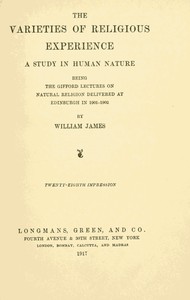
The Varieties of Religious Experience: A Study in Human Nature — Key Ideas to Explore
(0 User reviews)
340
Project Gutenberg
1996
Not confirmed
Religion; Psychology, Religious; Philosophy and religion; Conversion; Experience (Religion)
Readers of public-domain and historical texts
Project Gutenberg digital edition
en
Edition facts
Words
189,866
Reading time
826 min
Text sections
37
This digital edition of The Varieties of Religious Experience: A Study in Human Nature — Key Ideas to Explore is described by source-level measurements including 189,866 words, 13 hr 46 min estimated reading time, and 37 detected text sections.
The text analysis averages about 23.6 words per sentence, while the detected sections provide another way to judge how the source is divided.
Project Gutenberg metadata also associates the work with “Religion,” connecting these edition facts with the source record’s subject description.
Source:
Project Gutenberg record #621
William James's Gifford Lectures examine religious experience through psychological and philosophical lenses, using vivid case studies of ascetics, mystics, and converts to explore the varieties of human spirituality.
Read the complete public-domain text at its original source.
Read on Project GutenbergWilliam James opens The Varieties of Religious Experience by framing his inquiry as a descriptive study of "man's religious appetites," deliberately postponing metaphysical conclusions. The work, originally twenty Gifford Lectures delivered in 1901–1902, proceeds through concrete examples rather than abstract formulas. James warns that early readers may find the extreme cases—such as the ascetic Henry Suso's self-inflicted torments—unsettling, but he promises that later lectures will integrate these impulses with common sense. This tension between pathological and healthy expressions of religion drives the narrative voice, which shifts from clinical detachment to empathetic engagement.
The Lecturer's Voice and Method
James adopts a conversational yet rigorous tone, frequently addressing the reader directly. In the preface, he explains that the unexpected growth of psychological material forced him to postpone the metaphysical half of his original plan. This candor establishes a sense of intellectual honesty. He describes loading the lectures with "concrete examples" chosen from "the extremer expressions of the religious temperament," signaling his method of using outliers to illuminate general principles. The voice is that of a philosopher-psychologist who values particulars over formulas, yet remains aware of the risk of caricature. He asks for patience, promising that later sections will provide correctives. This self-aware, almost apologetic stance is unusual in academic writing and gives the text a personal, exploratory quality.
Asceticism as a Test Case
James's treatment of asceticism exemplifies his approach. He presents the case of Henry Suso in graphic detail: eight years of sleeping on a narrow bench in bonds, twenty-five winters without warmth, no baths for decades, and a refusal to scratch his own body. James calls the case "distinctly pathological" but does not dismiss it. Instead, he uses it to explore the logic of self-mortification. He contrasts Suso with the founder of the Sacred Heart order, who described "two unassuageable fevers, one for the holy communion, the other for suffering." James then pivots to the institutional virtues of chastity, obedience, and poverty, noting that obedience—so alien to modern individualism—"evidently corresponds to a profound interior need of many persons." This movement from extreme individual cases to broader social patterns is characteristic of James's method.
Shifts in Pace and Perspective
The narrative pace varies markedly across the lectures. Early sections move slowly, establishing definitions and delimiting the topic. In the asceticism excerpt, the rhythm becomes almost breathless as James piles up specific tortures: "He practiced during a long time such rigid poverty... he would neither scratch nor touch any part of his body." Then the pace abruptly slows for analytical commentary. James often interjects personal reflections, as when he confesses that the value of obedience "to myself it seems something of a mystery." These shifts create a dynamic reading experience, alternating between vivid testimony and cool analysis. The effect is to keep the reader off balance, never settling into a single mode. James uses this technique to mirror his central argument: that religious phenomena resist simple categorization and demand multiple interpretive lenses.
Readers approaching The Varieties of Religious Experience should attend to James's deliberate juxtaposition of extreme cases with ordinary ones. He does not endorse asceticism or mysticism wholesale, but treats them as data for understanding human nature. The lectures reward those who follow his winding path from pathology to philosophy, trusting that the later synthesis will illuminate the earlier fragments. James's own voice—curious, humble, and occasionally baffled—serves as a model for how to study religion without reducing it.
Reading about James's mystics, I remembered my grandfather's quiet prayers at dawn—not arguments, but presence. Another book gave me that same hush, A Book of Jewish Thoughts — A Reader’s Guide, where ordinary grief turned into something shared. Both volumes feel like old friends who don't explain, just sit beside you, holding the room still.
There are no reviews for this eBook.
There are no comments for this eBook.
Reader reflection
How did this book work for you?
Your answers remain private and are stored only in this browser.
Your progress
0
/
10
2
Did this book hold your interest?
3
Would you encourage someone else to read it?
4
How demanding did the text feel?
5
How closely did the book connect with your experience?
6
Could you apply anything you learned?
7
Did the book deliver what you hoped for?
8
What did you think about the pace?
9
What did this book teach you most?
10


![Cover of A Theological-Political Treatise [Part III] — Reading Companion](https://holji.com/storage/media/covers/pg991.jpg)
![Cover of A Theological-Political Treatise [Part IV] — Key Ideas to Explore](https://holji.com/storage/media/covers/pg992.jpg)