1

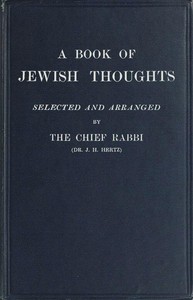
A Book of Jewish Thoughts — A Reader’s Guide
(0 User reviews)
1135
Project Gutenberg
2018
Not confirmed
Judaism -- Prayers and devotions; Jewish literature; Judaism -- Quotations, maxims, etc.; Jews -- Quotations; Jews -- Public opinion; Fasts and feasts -- Judaism -- Meditations; Jewish ethics; Jews -- Civilization
Readers of public-domain and historical texts
Project Gutenberg digital edition
en
Edition facts
Words
79,352
Reading time
346 min
Text sections
19
The catalog record for A Book of Jewish Thoughts — A Reader’s Guide provides practical reading context through 79,352 words, 5 hr 46 min estimated reading time, and 19 detected text sections.
The text analysis averages about 16.5 words per sentence, while the detected sections provide another way to judge how the source is divided.
Project Gutenberg metadata also associates the work with “Judaism -- Prayers and devotions,” connecting these edition facts with the source record’s subject description.
Source:
Project Gutenberg record #57218
An anthology of Jewish prayers, meditations, and quotations compiled by Chief Rabbi Joseph H. Hertz, arranged in five thematic parts spanning liturgy, ethics, and non-Jewish tributes, with a focus on spiritual reflection and historical memory.
Read the complete public-domain text at its original source.
Read on Project GutenbergJoseph H. Hertz’s A Book of Jewish Thoughts (1920) is an anthology that weaves together prayers, ethical maxims, and tributes from Jewish and non-Jewish sources. The editor’s prefatory note reveals the volume originated as a pocket book for Jewish soldiers during World War I, later expanded into a library edition. The work is structured in five parts: ‘I am an Hebrew,’ ‘The People of the Book,’ ‘The Testimony of the Nations,’ ‘The Voice of Prayer,’ and ‘The Voice of Wisdom.’ This arrangement moves from personal Jewish identity to global recognition, then to liturgical seasons and philosophical reflections.
From Soldier’s Companion to Anthology
The editor’s prefatory note explains that the nucleus of this collection was produced three years before the 1920 edition for Jewish sailors and soldiers. Hertz states that for many of them, it became ‘a re-discovery of the imperishable wealth of Israel’s heritage.’ The expanded version retains this practical, devotional purpose while broadening its scope. The dedication ‘to the sacred memory of the sons of Israel who fell in the Great War’ anchors the work in historical loss. The anthology’s structure—moving from personal identity to universal testimony—mirrors a journey from individual faith to collective witness. The inclusion of non-Jewish tributes in Part III suggests an apologetic or ecumenical intent, presenting Judaism as recognized by outsiders.
Voices of Prayer and Meditation
The fourth part, ‘The Voice of Prayer,’ includes liturgical texts and poetic supplications. A morning prayer from the Daily Prayer Book asks: ‘Lead me not into sin or temptation or contempt. Let not evil desire rule over me.’ The medieval poet Solomon ibn Gabirol’s hymn ‘At the Dawn I Seek Thee’ uses parallel structure and a refrain-like repetition of ‘morning’ and ‘eventime.’ Bachya ibn Pakudah’s meditation (1040) adopts a humble tone: ‘If I recite my wants, it is not to remind Thee of them, but only so that I may understand better how great is my dependence upon Thee.’ These selections emphasize submission and trust rather than petition.
Theological Concision in the Adon Olam Commentary
In a commentary on the hymn ‘Adon Olam,’ I. Abrahams (1906) distills Jewish dogmatics into a few sentences: ‘In the first four lines we have a picture of God, the eternal Lord, existing before the creation of the world.’ He contrasts Judaism’s created world with Aristotle’s eternal one, and explains that God is both transcendent—‘apart from, outside of, His world’—and immanent, dwelling ‘within the human soul.’ Abrahams notes that the hymn’s ‘charm’ lies in associating dogma with simple spiritual thoughts. The commentary itself is a model of concise theological exposition, using parallelism and antithesis to clarify concepts like transcendence and immanence.
Readers approaching A Book of Jewish Thoughts will find a work that balances liturgical devotion with intellectual reflection. The anthology’s five-part structure invites both sequential reading and topical browsing. Pay attention to the shifts in voice—from the intimate first-person prayers to the analytical commentary on the Adon Olam. The inclusion of non-Jewish tributes in Part III offers a counterpoint to the internal Jewish perspectives. This edition preserves the original 1920 pagination and includes transcriber’s notes for expanded abbreviations and corrections.
I often set A Book of Jewish Thoughts beside Lecky’s History of European Morals From Augustus to Charlemagne (Vol. 1 of 2) — Inside the Classic, not for argument, but for the hush they share—one tracing duty through centuries, the other through prayer. Both whisper of conscience shaping hearts, and I find that kinship comforting, like two old friends nodding across my shelf.
There are no reviews for this eBook.
There are no comments for this eBook.
Reader reflection
Take a moment to reflect on this book
Create a short personal record of your experience with this book.
Your progress
0
/
10
2
What was your overall reaction to the book?
3
Would you recommend this book to another reader?
4
How much effort did this book require?
5
How did the pace of the book feel?
6
Was the book easy to understand?
7
How much did the book move you?
8
Did the book deliver what you hoped for?
9
What changed or sharpened your thinking?
10


![Cover of A Theological-Political Treatise [Part III] — Reading Companion](https://holji.com/storage/media/covers/pg991.jpg)
![Cover of A Theological-Political Treatise [Part IV] — Key Ideas to Explore](https://holji.com/storage/media/covers/pg992.jpg)