1

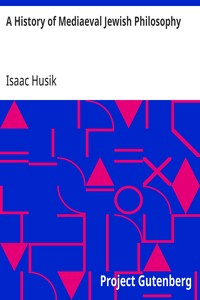
A History of Mediaeval Jewish Philosophy — A Closer Reading
(0 User reviews)
439
Project Gutenberg
2009
Not confirmed
Philosophy, Jewish; Philosophy, Medieval
Readers of public-domain and historical texts
Project Gutenberg digital edition
en
Edition facts
Words
205,876
Reading time
896 min
Text sections
25
A History of Mediaeval Jewish Philosophy — A Closer Reading can be approached with a clearer sense of reading commitment from its source measurements: 205,876 words, 14 hr 56 min estimated reading time, and 25 detected text sections.
The text analysis averages about 20.1 words per sentence, while the detected sections provide another way to judge how the source is divided.
Project Gutenberg metadata also associates the work with “Philosophy, Jewish,” connecting these edition facts with the source record’s subject description.
Source:
Project Gutenberg record #27821
Isaac Husik's 1916 study examines the language and argumentative structure of medieval Jewish philosophers, tracing shifts in pace from dense syllogistic reasoning to more fluid exposition, as seen in Ibn Daud's treatment of the soul.
Read the complete public-domain text at its original source.
Read on Project GutenbergIsaac Husik's A History of Mediaeval Jewish Philosophy (1916) opens with a frank acknowledgment of the field's neglect in English, noting that neither the Jewish Encyclopedia nor the eleventh edition of the Encyclopedia Britannica carried an article on Jewish philosophy. The preface sets a deliberate, scholarly tone, contrasting Anglo-American preference for 'positive facts' with the need for philosophical self-examination. This concern with audience and method recurs throughout the work, as Husik navigates between technical exposition and accessible narrative.
Argumentative Texture and Syllogistic Density
The excerpts reveal a text built around tightly reasoned arguments, often employing syllogistic forms and logical distinctions. In the discussion of Ibn Daud on the soul, Husik presents a chain of reasoning: the pre-existence of the soul is rejected because 'the same soul would then be wise and ignorant, good and bad, which is impossible.' The prose moves through conditional statements ('if it did, it was either...'), negations, and cumulative objections. This density mirrors the medieval philosophers' own methods, creating a pace that demands careful reading. Husik frequently uses phrases like 'we have thus three stages' to structure complex ideas, but the overall rhythm is one of sustained, logical pressure rather than rhetorical flourish.
Shifts in Pace: From Abstract Argument to Historical Commentary
Husik varies his pace by alternating between close philosophical analysis and broader historical or interpretive remarks. After a dense passage on the hylic, actual, and acquired intellect, he steps back to observe: 'The reader will see that the problem of the rational soul gave Ibn Daud much concern and trouble.' This shift from exposition to commentary provides a momentary respite, but Husik quickly returns to the argument, noting that 'the arguments against it seemed rather strong.' Similarly, the preface moves from a general lament about English-language resources to a specific justification for the book, then to a list of scholarly debts. These transitions prevent monotony, though the dominant mode remains analytical.
Voice and the Role of the Narrator
Husik's narrative voice is that of a guide who is both learned and self-aware. He uses first-person plural ('we are called upon to examine our foundations') and direct address ('the reader will see') to create a sense of shared inquiry. Yet he also maintains critical distance, as when he notes that a biblical verse 'would not have stood in his way, had he had reason to favor the doctrine of pre-existence.' This combination of empathy and skepticism characterizes his approach. The prose is formal but not stiff, with occasional asides that lighten the tone—such as the remark that 'of books there is none' in English on the subject. These touches humanize the narrator without undermining scholarly authority.
Husik's history rewards readers who attend to its argumentative structure as much as its content. The interplay between syllogistic density and explanatory commentary, between the philosopher's voice and the historian's, shapes the reading experience. Those approaching the work should be prepared for sustained logical engagement, but also for moments of reflection that illuminate both the medieval thinkers and Husik's own scholarly commitments.
I remember sitting with Husik's slow-moving sentences, feeling the weight of Ibn Daud's proofs settle like dust on a windowsill. Years later, another slim volume stirred that same quiet hush—Evolution and Ethics, and Other Essays — Key Ideas to Explore—where moral feeling slips between scientific claims, unhurried, almost reluctant to speak.
There are no reviews for this eBook.
There are no comments for this eBook.
Reader reflection
What was your reading experience?
Capture what you thought, learned, and would like to remember.
Your progress
0
/
10
2
How much did you enjoy the reading experience?
3
Would you pass this book on to a friend?
4
How much effort did this book require?
5
How well did it match your expectations?
6
Which part made the strongest impression?
7
Could you apply anything you learned?
8
Could you see yourself revisiting this book?
9
Which lesson or insight stayed with you?
10
![Cover of A Theological-Political Treatise [Part III] — Reading Companion](https://holji.com/storage/media/covers/pg991.jpg)
![Cover of A Theological-Political Treatise [Part IV] — Key Ideas to Explore](https://holji.com/storage/media/covers/pg992.jpg)