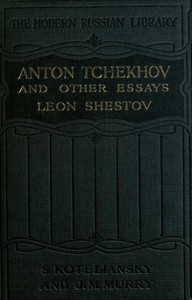
Anton Tchekhov, and Other Essays — Background and Themes
Edition facts
This digital edition of Anton Tchekhov, and Other Essays — Background and Themes is described by source-level measurements including 54,850 words, 3 hr 59 min estimated reading time, and 5 detected text sections.
The text analysis averages about 22.4 words per sentence, while the detected sections provide another way to judge how the source is divided.
Project Gutenberg metadata also associates the work with “Philosophy,” connecting these edition facts with the source record’s subject description.
Calculated from edition completeness, EPUB availability, text structure and catalogue metadata. Not a user rating.
How this score is calculated
- Description quality20 pts
- Title & short description10 pts
- Source metadata20 pts
- Text length15 pts
- Chapters / structure15 pts
- EPUB file integrity20 pts
Total of 100 points, scaled to a 2.5-5.0 range. Editions with an empty description or a missing EPUB file are not scored.
Read the Text
There were great men and great philosophers. It may be that this cruelly conscious world will henceforward recognise no man as great unless he has greatly sought: for to seek and not to think is the essence of philosophy. To have greatly sought, I say, should be the measure of man's greatness in the strange world of which there will be only a tense, sorrowful, disillusioned remnant when this grim ordeal is over. It should be so: and we, who are, according to our strength, faithful to humanity, must also strive according to our strength to make it so. We are not, and we shall not be, great men: but we have the elements of greatness. We have an impulse to honesty, to think honestly, to see honestly, and to speak the truth to ourselves in the lonely hours. It is only an impulse, which, in these barren, bitter, years, so quickly withers and dies. It is almost that we dare not be honest now. Our hearts are dead: we cannot wake the old wounds again. And yet if anything of this generation that suffered is to remain, if we are to hand any spark of the fire which once burned so brightly, if we are to be human still, then we must still be honest at whatever cost. We--and I speak of that generation which was hardly man when the war burst upon it, which was ardent and generous and dreamed dreams of devotion to an ideal of art or love or life--are maimed and broken for ever. Let us not deceive ourselves. The dead voices will never be silent in our ears to remind us of that which we once were, and that which we have lost. We shall die as we shall live, lonely and haunted by memories that will grow stranger, more beautiful, more terrible, and more tormenting as the years go on, and at the last we shall not know which was the dream--the years of plenty or the barren years that descended like a storm in the night and swept our youth away.
Yet something remains. Not those lying things that they who cannot feel how icy cold is sudden and senseless death to all-daring youth, din in our ears. We shall not be inspired by the memory of heroism. We shall be shattered by the thought of splendid and wonderful lives that were vilely cast away. What remains is that we should be honest as we shall be pitiful. We shall never again be drunk with hope: let us never be blind with fear. There can be in the lap of destiny now no worse thing which may befall us. We can afford to be honest now.
We can afford to be honest: but we need to learn how, or to increase our knowledge. The Russian writers will help us in this; and not the great Russians only, but the lesser also. For a century of bitter necessity has taught that nation that the spirit is mightier than the flesh, until those eager qualities of soul that a century of social ease has almost killed in us are in them well-nigh an instinct. Let us look among ourselves if we can find a Wordsworth, a Shelley, a Coleridge, or a Byron to lift this struggle to the stars as they did the French Revolution. There is none.--It will be said: 'But that was a great fight for freedom. Humanity itself marched forward with the Revolutionary armies.' But if the future of mankind is not in issue now, if we are fighting for the victory of no precious and passionate idea, why is no voice of true poetry uplifted in protest? There is no third way. Either this is the greatest struggle for right, or the greatest crime, that has ever been. The unmistakable voice of poetry should be certain either in protest or enthusiasm: it is silent or it is trivial. And the cause must be that the keen edge of the soul of those century-old poets which cut through false patriotism so surely is in us dulled and blunted. We must learn honesty again: not the laborious and meagre honesty of those who weigh advantage against advantage in the ledger of their minds, but the honesty that cries aloud in instant and passionate anger against the lie and the half-truth, and by an instinct knows the authentic thrill of contact with the living human soul.
The Russians, and not least the lesser Russians, may teach us this thing once more. Among these lesser, Leon Shestov holds an honourable place. He is hardly what we should call a philosopher, hardly again what we would understand by an essayist. The Russians, great and small alike, are hardly ever what we understand by the terms which we victims of tradition apply to them. In a hundred years they have accomplished an evolution which has with us slowly unrolled in a thousand. The very foundations of their achievement are new and laid within the memory of man. Where we have sharply divided art from art, and from science and philosophy, and given to each a name, the Russians have still the sense of a living connection between all the great activities of the human soul. From us this connection is too often concealed by the tyranny of names. We have come to believe, or at least it costs us great pains not to believe, that the name is a particular reality, which to confuse with another name is a crime. Whereas in truth the energies of the human soul are not divided from each other by any such impassable barriers: they flow into each other indistinguishably, modify, control, support, and decide each other. In their large unity they are real; isolated, they seem to be poised uneasily between the real and the unreal, and become deceptive, barren half-truths. Plato, who first discovered the miraculous hierarchy of names, though he was sometimes drunk with the new wine of his discovery, never forgot that the unity of the human soul was the final outcome of its diversity; and those who read aright his most perfect of all books--_The Republic_--know that it is a parable which fore-shadows the complete harmony of all the soul's activities.
Not the least of Shestov's merits is that he is alive to this truth in its twofold working. He is aware of himself as a soul seeking an answer to its own question; and he is aware of other souls on the same quest. As in his own case he knows that he has in him something truer than names and divisions and authorities, which will live in spite of them, so towards others he remembers that all that they wrote or thought or said is precious and permanent in so far as it is the manifestation of the undivided soul seeking an answer to its question. To know a man's work for this, to have divined the direct relation between his utterance and his living soul, is criticism: to make that relation between one's own soul and one's speech direct and true is creation. In essence they are the same: creation is a man's lonely attempt to fix an intimacy with his own strange and secret soul, criticism is the satisfaction of the impulse of loneliness to find friends and secret sharers among the souls that are or have been. As creation drives a man to the knowledge of his own intolerable secrets, so it drives him to find others with whom he may whisper of the things which he has found. Other criticism than this is, in the final issue, only the criminal and mad desire to enforce material order in a realm where all is spiritual and vague and true. It is only the jealous protest of the small soul against the great, of the slave against the free.
Against this smallness and jealousy Shestov has set his face. To have done so does not make him a great writer; but it does make him a real one. He is honest and he is not deceived. But honesty, unless a man is big enough to bear it, and often even when he is big enough to bear it, may make him afraid. Where angels fear to tread, fools rush in: but though the folly of the fool is condemned, some one must enter, lest a rich kingdom be lost to the human spirit. Perhaps Shestov will seem at times too fearful. Then we must remember that Shestov is Russian in another sense than that I have tried to make explicit above. He is a citizen of a country where the human spirit has at all times been so highly prized that the name of thinker has been a key to unlock not merely the mind but the heart also. The Russians not only respect, but they love a man who has thought and sought for humanity, and, I think, their love but seldom stops 'this side idolatry.' They will exalt a philosopher to a god; they are even able to make of materialism a religion. Because they are so loyal to the human spirit they will load it with chains, believing that they are garlands. And that is why dogmatism has never come so fully into its own as in Russia.
When Shestov began to write nearly twenty years ago, Karl Marx was enthroned and infallible. The fear of such tyrannies has never departed from Shestov. He has fought against them so long and so persistently--even in this book one must always remember that he is face to face with an enemy of which we English have no real conception--that he is at times almost unnerved by the fear that he too may be made an authority and a rule. I do not think that this ultimate hesitation, if understood rightly, diminishes in any way from the interest of his writings: but it does suggest that there may be awaiting him a certain paralysis of endeavour. There is indeed no absolute truth of which we need take account other than the living personality, and absolute truths are valuable only in so far as they are seen to be necessary manifestations of this mysterious reality. Nevertheless it is in the nature of man, if not to live by absolute truths, at least to live by enunciating them; and to hesitate to satisfy this imperious need is to have resigned a certain measure of one's own creative strength. We may trust to the men of insight who will follow us to read our dogmatisms, our momentary angers, and our unshakable convictions, in terms of our personalities, if these shall be found worthy of their curiosity or their love. And it seems to me that Shestov would have gained in strength if he could have more firmly believed that there would surely be other Shestovs who would read him according to his own intention. But this, I also know, is a counsel of perfection: the courage which he has not would not have been acquired by any intellectual process, and its possession would have deprived him of the courage which he has. As dogmatism in Russia enjoys a supremacy of which we can hardly form an idea, so a continual challenge to its claims demands in the challenger a courage which it is hard for us rightly to appreciate.
I have not written this foreword in order to prejudice the issue. Shestov will, no doubt, be judged by English readers according to English standards, and I wish no more than to suggest that his greatest quality is one which has become rare among us, and that his peculiarities are due to Russian conditions which have long since ceased to obtain in England. The Russians have much to teach us, and the only way we shall learn, or even know, what we should accept and what reject, is to take count as much as we can of the Russian realities. And the first of these and the last is that in Russia the things of the spirit are held in honour above all others. Because of this the Russian soul is tormented by problems to which we have long been dead, and to which we need to be alive again. J. M. M.
_Postscript._--Leon Shestov is fifty years old. He was born at Kiev, and studied at the university there. His first book was written in 1898. As a writer of small production, he has made his way to recognition slowly: but now he occupies a sure position as one of the most delicate and individual of modern Russian critics. The essays contained in this volume are taken from the fourth and fifth works in the following list:--
1898. _Shakespeare and his Critic, Brandes._
1900. _Good in the teaching of Dostoevsky and Nietzsche: Philosophy and Preaching._
1903. _Dostoevsky and Nietzsche: The Philosophy of Tragedy._
1905. _The Apotheosis of Groundlessness: An Essay on Dogmatism._
1908. _Beginnings and Ends._
1912. _Great Vigils._
(CREATION FROM THE VOID)
Résigne-toi, mon cœur, dors ton sommeil de brute.
(CHARLES BAUDELAIRE.)
Tchekhov is dead; therefore we may now speak freely of him. For to speak of an artist means to disentangle and reveal the 'tendency' hidden in his works, an operation not always permissible when the subject is still living. Certainly he had a reason for hiding himself, and of course the reason was serious and important. I believe many felt it, and that it was partly on this account that we have as yet had no proper appreciation of Tchekhov. Hitherto in analysing his works the critics have confined themselves to common-place and _cliché_. Of course they knew they were wrong; but anything is better than to extort the truth from a living person. Mihailovsky alone attempted to approach closer to the source of Tchekhov's creation, and as everybody knows, turned away from it with aversion and even with disgust. Here, by the way, the deceased critic might have convinced himself once again of the extravagance of the so-called theory of 'art for art's sake.' Every artist has his definite task, his life's work, to which he devotes all his forces. A tendency is absurd when it endeavours to take the place of talent, and to cover impotence and lack of content, or when it is borrowed from the stock of ideas which happen to be in demand at the moment. 'I defend ideals, therefore every one must give me his sympathies.' Such pretences we often see made in literature, and the notorious controversy concerning 'art for art's sake' was evidently maintained upon the double meaning given to the word 'tendency' by its opponents. Some wished to believe that a writer can be saved by the nobility of his tendency; others feared that a tendency would bind them to the performance of alien tasks. Much ado about nothing: ready-made ideas will never endow mediocrity with talent; on the contrary, an original writer will at all costs set himself his own task. And Tchekhov had his _own_ business, though there were critics who said that he was the servant of art for its own sake, and even compared him to a bird, carelessly flying. To define his tendency in a word, I would say that Tchekhov was the poet of hopelessness. Stubbornly, sadly, monotonously, during all the years of his literary activity, nearly a quarter of a century long, Tchekhov was doing one thing alone: by one means or another he was killing human hopes. Herein, I hold, lies the essence of his creation. Hitherto it has been little spoken of. The reasons are quite intelligible. In ordinary language what Tchekhov was doing is called crime, and is visited by condign punishment. But how can a man of talent be punished? Even Mihailovsky, who more than once in his lifetime gave an example of merciless severity, did not raise his hand against Tchekhov. He warned his readers and pointed out the 'evil fire' which he had noticed in Tchekhov's eyes. But he went no further. Tchekhov's immense talent overcame the strict and rigorous critic. It may be, however, that Mihailovsky's own position in literature had more than a little to do with the comparative mildness of his sentence. The younger generation had listened to him uninterruptedly for thirty years, and his word had been law. But afterwards every one was bored with eternally repeating: 'Aristides is just, Aristides is right.' The younger generation began to desire to live and to speak in its own way, and finally the old master was ostracised. There is the same custom in literature as in Terra del Fuego. The young, growing men kill and eat the old. Mihailovsky struggled with all his might, but he no longer felt the strength of conviction that comes from the sense of right. Inwardly, he felt that the young were right, not because they knew the truth--what truth did the economic materialists know?--but because they were young and had their lives before them. The rising star shines always brighter than the setting, and the old must of their own will yield themselves up to be devoured by the young. Mihailovsky felt this, and perhaps it was this which undermined his former assurance and the firmness of his opinion of old. True, he was still like Gretchen's mother in Goethe: he did not take rich gifts from chance without having previously consulted his confessor. Tchekhov's talent too was taken to the priest, by whom it was evidently rejected as suspect; but Mihailovsky no longer had the courage to set himself against public opinion. The younger generation prized Tchekhov for his talent, his immense talent, and it was plain they would riot disown him. What remained for Mihailovsky He attempted, as I say, to warn them. But no one listened to him, and Tchekhov became one of the most beloved of Russian writers.
Yet the just Aristides was right this time too, as he was right when he gave his warning against Dostoevsky. Now that Tchekhov is no more, we may speak openly. Take Tchekhov's stories, each one separately, or better still, all together; look at him at work. He is constantly, as it were, in ambush, to watch and waylay human hopes. He will not miss a single one of them, not one of them will escape its fate. Art, science, love, inspiration, ideals--choose out all the words with which humanity is wont, or has been in the past, to be consoled or to be amused--Tchekhov has only to touch them and they instantly wither and die. And Tchekhov himself faded, withered and died before our eyes. Only his wonderful art did not die--his art to kill by a mere touch, a breath, a glance, everything whereby men live and wherein they take their pride. And in this art he was constantly perfecting himself, and he attained to a virtuosity beyond the reach of any of his rivals in European literature. Maupassant often had to strain every effort to overcome his victim. The victim often escaped from Maupassant, though crushed and broken, yet with his life. In Tchekhov's hands, nothing escaped death.
I must remind my reader, though it is a matter of general knowledge, that in his earlier work Tchekhov is most unlike the Tchekhov to whom we became accustomed in late years. The young Tchekhov is gay and careless, perhaps even like a flying bird. He published his work in the comic papers. But in 1888 and 1889, when he was only twenty-seven and twenty-eight years old, there appeared _The Tedious Story_ and the drama _Ivanov,_ two pieces of work which laid the foundations of a new creation. Obviously a sharp and sudden change had taken place in him, which was completely reflected in his works. There is no detailed biography of Tchekhov, and probably will never be, because there is no such thing as a full biography--I, at all events, cannot name one. Generally biographies tell us everything except what it is important to know. Perhaps in the future it will be revealed to us with the fullest details who was Tchekhov's tailor; but we shall never know what happened to Tchekhov in the time which elapsed between the completion of his story _The Steppe_ and the appearance of his first drama. If we would know, we must rely upon his works and our own insight.
_Ivanov_ and _The Tedious Story_ seem to me the most autobiographical of all his works. In them almost every line is a sob; and it is hard to suppose that a man could sob so, looking only at another's grief. And it is plain that his grief is a new one, unexpected as though it had fallen from the sky. Here it is, it will endure for ever, and he does not know how to fight against it.
Shestov's introduction frames the great Russian novelists—Tolstoi, Dostoevsky, and Chekhov—as philosophers who made explicit in their works the intimate connection between philosophy and life. He asserts they were preoccupied with whether life is worth living, assuming that to live means to live wholly, without suppressing deep passions or denying life. Shestov argues that they failed to find a pattern accommodating all human potentialities, yet none fainted by the way. This collection of essays, translated by Koteliansky and Murry, applies that lens to Chekhov's 'creation from the void,' Dostoevsky's prophetic gift, and the 'penultimate words' of writers like Ibsen and Turgenev.
The Anguish of the Swan Song
Shestov draws a striking contrast between the conscious ideals of Turgenev and Ibsen and the darker motives that emerge in their final works. He notes that Turgenev's essay Hamlet and Don Quixote concludes with 'Everything passes, good deeds remain,' yet in his Prose Poems an utterly different motive is heard: 'one infinite, inextinguishable anguish for a life wasted in vain.' Shestov deliberately uses the word senilia rather than 'swan songs,' invoking Plato's claim that swans sing better at death, rejoicing in the god they serve. For Ibsen and Turgenev, their last songs were better than all that had gone before, containing 'a bottomless depth awful to the eye.' The source of this anguish, Shestov argues, is not regret for lost youth or health, but for having sacrificed the person for the artist—Ibsen's Professor Rubek renounces his art because he gave up Irene, and Turgenev cannot away with memories of 'the Russian girl' he described but never touched.
The Illusion of Divine Appointment
Shestov examines how writers like Gogol and Ibsen eventually lost the belief that God had chosen them for a particular task. He observes that Gogol burnt his best work before death, and Ibsen, in his last drama, renounced his literary activity despite the fame, respect, and riches it brought. Shestov quotes Ibsen's confession that he had to sacrifice the man for the artist, calling this 'the greatest vulgarity' if said by a common mortal, but on the lips of the author of Brand and Emperor and Galilean, it acquires 'an unexpected and mysterious meaning.' The pattern Shestov identifies is that 'with years all illusions vanish,' including the illusion that God chooses certain men for particular purposes. He invokes the human law: 'Forswear not the prison nor the beggar's wallet!'—a warning against denying one's essential humanity for the sake of a role.
The Intimate Connection Between Philosophy and Life
Shestov's introduction establishes his core argument: Russian thought is chiefly manifested in the great novelists, who attacked fearlessly the fundamental problem of philosophy—whether life is worth living. He praises them for emphasizing 'the intimate connection between philosophy and life,' a relation professional philosophers often neglect. The essay on Chekhov, titled 'Creation from the Void,' suggests that Shestov sees Chekhov's work as emerging from a nihilistic starting point, while 'The Gift of Prophecy' addresses Dostoevsky's ability to foresee human depths. Shestov's own method is to treat literary works as philosophical statements, drawing on the writers' final productions to reveal tensions between their conscious beliefs and the darker truths that surface at the end. The collection thus offers not a systematic philosophy but a series of meditations on the cost of artistic creation and the inevitability of confronting life's ultimate questions.
Readers approaching Shestov's essays should attend to his method of juxtaposing a writer's earlier ideals with their later, more anguished expressions. He does not offer biographical summaries but rather philosophical readings that treat the works as evidence of a struggle between conscious belief and unconscious truth. The translations by Koteliansky and Murry preserve Shestov's dense, allusive style, which rewards careful attention to his recurring motifs—the swan song, the sacrifice of the man for the artist, and the illusion of divine appointment.
That rainy afternoon, Shestov’s essay on Chekhov kept circling the same quiet ache—how the light of conscious ideals often falls on a life already half-spent. I put the book down, stared at the wet window, and somehow reached for the Eryxias — Reading Companion instead. It felt less like searching, more like the rain had simply washed one thought into another.
Camila King
3 weeks agoDavid Williams
1 month agoJoseph Martinez
1 week agoSebastian Thomas
1 month agoTake a moment to reflect on this book
Create a short personal record of your experience with this book.
Mia Robinson
2 weeks ago