1

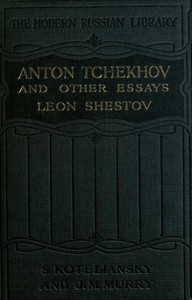
Anton Tchekhov, and Other Essays — Background and Themes
(0 User reviews)
718
Project Gutenberg
2018
Not confirmed
Philosophy; Russian literature -- History and criticism; Chekhov, Anton Pavlovich, 1860-1904; Dostoyevsky, Fyodor, 1821-1881
Readers of public-domain and historical texts
Project Gutenberg digital edition
en
Edition facts
Words
54,850
Reading time
239 min
Text sections
5
This digital edition of Anton Tchekhov, and Other Essays — Background and Themes is described by source-level measurements including 54,850 words, 3 hr 59 min estimated reading time, and 5 detected text sections.
The text analysis averages about 22.4 words per sentence, while the detected sections provide another way to judge how the source is divided.
Project Gutenberg metadata also associates the work with “Philosophy,” connecting these edition facts with the source record’s subject description.
Source:
Project Gutenberg record #56758
Shestov's essays on Chekhov, Dostoevsky, and Ibsen examine how these writers confronted the question 'Is life worth living?' through their works, revealing a tension between conscious ideals and the anguish of wasted life in their final creations.
Read the complete public-domain text at its original source.
Read on Project GutenbergShestov's introduction frames the great Russian novelists—Tolstoi, Dostoevsky, and Chekhov—as philosophers who made explicit in their works the intimate connection between philosophy and life. He asserts they were preoccupied with whether life is worth living, assuming that to live means to live wholly, without suppressing deep passions or denying life. Shestov argues that they failed to find a pattern accommodating all human potentialities, yet none fainted by the way. This collection of essays, translated by Koteliansky and Murry, applies that lens to Chekhov's 'creation from the void,' Dostoevsky's prophetic gift, and the 'penultimate words' of writers like Ibsen and Turgenev.
The Anguish of the Swan Song
Shestov draws a striking contrast between the conscious ideals of Turgenev and Ibsen and the darker motives that emerge in their final works. He notes that Turgenev's essay Hamlet and Don Quixote concludes with 'Everything passes, good deeds remain,' yet in his Prose Poems an utterly different motive is heard: 'one infinite, inextinguishable anguish for a life wasted in vain.' Shestov deliberately uses the word senilia rather than 'swan songs,' invoking Plato's claim that swans sing better at death, rejoicing in the god they serve. For Ibsen and Turgenev, their last songs were better than all that had gone before, containing 'a bottomless depth awful to the eye.' The source of this anguish, Shestov argues, is not regret for lost youth or health, but for having sacrificed the person for the artist—Ibsen's Professor Rubek renounces his art because he gave up Irene, and Turgenev cannot away with memories of 'the Russian girl' he described but never touched.
The Illusion of Divine Appointment
Shestov examines how writers like Gogol and Ibsen eventually lost the belief that God had chosen them for a particular task. He observes that Gogol burnt his best work before death, and Ibsen, in his last drama, renounced his literary activity despite the fame, respect, and riches it brought. Shestov quotes Ibsen's confession that he had to sacrifice the man for the artist, calling this 'the greatest vulgarity' if said by a common mortal, but on the lips of the author of Brand and Emperor and Galilean, it acquires 'an unexpected and mysterious meaning.' The pattern Shestov identifies is that 'with years all illusions vanish,' including the illusion that God chooses certain men for particular purposes. He invokes the human law: 'Forswear not the prison nor the beggar's wallet!'—a warning against denying one's essential humanity for the sake of a role.
The Intimate Connection Between Philosophy and Life
Shestov's introduction establishes his core argument: Russian thought is chiefly manifested in the great novelists, who attacked fearlessly the fundamental problem of philosophy—whether life is worth living. He praises them for emphasizing 'the intimate connection between philosophy and life,' a relation professional philosophers often neglect. The essay on Chekhov, titled 'Creation from the Void,' suggests that Shestov sees Chekhov's work as emerging from a nihilistic starting point, while 'The Gift of Prophecy' addresses Dostoevsky's ability to foresee human depths. Shestov's own method is to treat literary works as philosophical statements, drawing on the writers' final productions to reveal tensions between their conscious beliefs and the darker truths that surface at the end. The collection thus offers not a systematic philosophy but a series of meditations on the cost of artistic creation and the inevitability of confronting life's ultimate questions.
Readers approaching Shestov's essays should attend to his method of juxtaposing a writer's earlier ideals with their later, more anguished expressions. He does not offer biographical summaries but rather philosophical readings that treat the works as evidence of a struggle between conscious belief and unconscious truth. The translations by Koteliansky and Murry preserve Shestov's dense, allusive style, which rewards careful attention to his recurring motifs—the swan song, the sacrifice of the man for the artist, and the illusion of divine appointment.
That rainy afternoon, Shestov’s essay on Chekhov kept circling the same quiet ache—how the light of conscious ideals often falls on a life already half-spent. I put the book down, stared at the wet window, and somehow reached for the Eryxias — Reading Companion instead. It felt less like searching, more like the rain had simply washed one thought into another.
There are no reviews for this eBook.
There are no comments for this eBook.
Reader reflection
Take a moment to reflect on this book
Create a short personal record of your experience with this book.
Your progress
0
/
10
2
How much did you enjoy the reading experience?
3
Would you recommend this book to another reader?
4
How easy was the book to follow?
5
Which element worked best for you?
6
How much did the book move you?
7
How distinctive were its ideas or approach?
8
How understandable was the text?
9
In one sentence, what did you learn?
10


![Cover of A Theological-Political Treatise [Part III] — Reading Companion](https://holji.com/storage/media/covers/pg991.jpg)
![Cover of A Theological-Political Treatise [Part IV] — Key Ideas to Explore](https://holji.com/storage/media/covers/pg992.jpg)