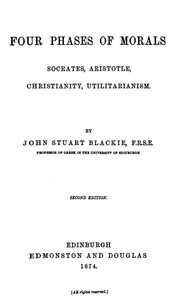
Four Phases of Morals: Socrates, Aristotle, Christianity, Utilitarianism — Context and Discussion
Edition facts
Before opening Four Phases of Morals: Socrates, Aristotle, Christianity, Utilitarianism — Context and Discussion, the edition data offers a quick orientation: 103,321 words, 7 hr 30 min estimated reading time, and 12 detected text sections.
The text analysis averages about 40.3 words per sentence, while the detected sections provide another way to judge how the source is divided.
Project Gutenberg metadata also associates the work with “Aristotle, 384 BC-322 BC,” connecting these edition facts with the source record’s subject description.
Calculated from edition completeness, EPUB availability, text structure and catalogue metadata. Not a user rating.
How this score is calculated
- Description quality20 pts
- Title & short description10 pts
- Source metadata20 pts
- Text length15 pts
- Chapters / structure15 pts
- EPUB file integrity20 pts
Total of 100 points, scaled to a 2.5-5.0 range. Editions with an empty description or a missing EPUB file are not scored.
Read the Text
common sense and keen eye for the practical, he would joyfully recognise all the wonderful material progress of which England and America make their boast, he would not the less feel himself constrained to utter an emphatic warning against the danger of estimating our national grandeur by the visible pomp of gigantic machinery and complex apparatus rather than by the invisible power of noble purpose and lofty design.
Such was the attitude of Socrates to the great teachers who since Thales downwards had preceded him in leading the intellectual advance of the most intellectual people of the ancient world. He stood forward as a teacher of moral science, as a preacher and philosophical missionary also; for in morals, the separation of theory from practice is an inconsistency of which only a feeble and imperfect nature is capable. Who, then, and of what quality, were his antagonists in the great regenerative work which he undertook? Not so much the physical philosophers, who might still pursue their researches or pamper their imaginations in their own speculative corners without disturbing the busy world, except in so far as they now and then might come into collision with theological orthodoxy, but the great untrained mass of the people themselves, and the pretentious array of a class of men who put themselves forward as their instructors,--the famous SOPHISTS. The word Sophists signifies professors of wisdom, in which sense Lucian calls our Saviour τὸν ἀνεσκολοπισμένον ἐκεῖνον σοφιστήν--_that crucified Sophist_--because He came forward as a public instructor professing to teach men wisdom. But as wisdom is a vague word (in fact σοφός in Greek signifies _clever_, and even {22} _cunning_ as often as _wise_), we must consult the circumstances of time and place to know what it exactly meant in any particular instance. The generation immediately preceding Socrates, when the Sophists first became prominent, was the era of the great Persian wars, and of the notable uprising of national spirit and of popular power which that memorable struggle called forth. How fiercely the strife between the old aristocratic and the new democratic element in Greek society had been raging in the immediately preceding epoch, the poems of Theognis may serve sufficiently to indicate; and now that by the battle of Salamis the political importance of the middle and sub-middle classes had been blazoned forth before universal Greece in glowing characters, the democracy in great commercial cities like Athens at once started into an attitude of hitherto unsuspected significance. New aspirations had been created, new pretensions were put forth, and new guides were required for a large class of people who felt themselves as it were suddenly shooting up from pupilage into majority. Now what guides had a people, circumstanced as the Athenians then, were, to look to for direction? The Church in those days--if we may call it a Church--was not a teaching body; its moral efficacy was exercised through sacred ceremonial and pious hymns; its intellectual agency was almost null. And though gymnastics and music, including a certain amount of the most popular literary culture, were common, there were no institutions like our Universities, for the severe and systematic discipline of the thinking faculties. A cry went up from the heart of the people for prophets to enlighten them; but there were no schools {23} of the prophets. This state of things was the natural soil from which a class of self-constituted popular teachers would grow up; and these teachers were the Sophists. And if we ask further in detail what they taught, the answer will be furnished from the same sources that explain their existence. As the democracy brought them into existence, the demand of the democracy would be the measure of the kind and quality of the article which they were expected to supply; and the article which a democracy demands for the use of its public spokesmen is always the same,--a certain practical knowledge and shrewdness in the conduct of affairs, a certain ready sympathy with, popular prejudices and passions, a certain superficial dexterity in argument, and above all, a fluent and effective style of popular oratory. To supply these wants the acceptable teachers of the people would require to profess a knowledge of the great leading principles of law, a familiarity with political forms and the best methods of controlling masses of men into habits or fits of co-operation, a practical command of logic, so as to be able to turn the point of an argument, or entangle in a net of subtleties an inexperienced jury, and, as the crowning accomplishment, a faculty of speech, alert and unscrupulous, which might never lack a shift to give plausibility to a bad case, and should ever be ready to confound, overwhelm, and dazzle where it was hopeless to refute. Now it is easy to perceive that the lessons delivered by the professors of this wisdom, however acceptable to clever and ambitious young gentlemen eager to enter upon the arena of public life, could not, in the nature of the case, be conceived in any very exalted tone of morals or be framed so as to inculcate the formation {24} of any strictly honourable rules of conduct. The Sophists were mere tradesmen; they were paid for the furnishing of a certain article, and they had to supply that article, of the quality and in the way and manner which might be most agreeable to those on whose patronage they depended. They were therefore, as Socrates constantly pointed out, the slaves of the parties by whom they were paid; and if what their employers wanted was the show of wisdom rather than the substance, a ready command of words and arguments in preference to an earnest and severe search after truth, it was not to be expected that the majority of them would give themselves much concern to inculcate a severer wisdom. Tradesmen are seldom found acting upon principles which have a direct tendency to frighten customers from their shops. Not that there was anything necessarily bad or immoral in the profession or teaching of a Sophist; some of them, evidently, such as Protagoras and Prodicus, even on the witness of their great adversary Plato, were very proper and respectable gentlemen; few of them, perhaps, grossly immoral; and with those of them who, like Gorgias of Leontium, confined themselves strictly to the teaching of the rules of pure rhetoric and elocution, no fault could justly be found any more than with Quinctilian among the later Romans, or Principal Campbell of Aberdeen among ourselves. But it is plain, from the very nature of the case, that the Sophists, so far as they went a step beyond the province of strict rhetoric, were placed in a position which rendered their moral and philosophical teaching a matter of just concern to all who were interested in the education of the youth of Athens, and in the {25} character of her public men. Besides, among an impressible and excitable people like the Athenians, fond of display, and ambitious of popularity, the mere methodized art of talking, apart from any solid knowledge, and without any high moral inspiration, was a very dangerous engine to put into the hand of ambitious young politicians. And the fact unquestionably is, according to the concurrent testimony of Xenophon, Plato, Isocrates, Aristotle,--in fact, of all antiquity,--that these public teachers generally did dispense very shallow and often very dangerous doctrine. They were the natural birth of an age of movement and innovation; and in such an age, along with much that may operate as a healthy stimulant to progressive thought, there is always present a drastic admixture of the merely analytic, sceptical, and destructive element, a negative force, strong to impugn the validity of ancient foundations, but weak to establish anything equally stable and effective in their place. By the negative and sceptical teachings of these men, Socrates found the youth of Athens shaken from their old moorings, and tossing about amid seas of perplexing doubt on the one hand, and unprincipled libertinism on the other. Every great principle of social order and human right that formerly had been received from venerated tradition, and believed by the co-operation of a healthy instinct with a hoary authority, was now denied; and the field was waiting for the appearance of a great constructive prophet, who should bring people back through steps of scientific reasoning to a living faith in those maxims of immutable morality which they had originally inherited with the blood from their fathers’ veins and the milk from their mothers’ breasts. {26} Such a great prophet now appeared, and his name was Socrates.[26.1]
We have now clearly before us the battle-field in which Socrates had to appear, and the opponents with whom he had to contend; we see also the cause for which he had to fight. This was nothing {27} less than the establishment of a firm philosophy of human life, a sure guide for human conduct, and a strong regulator of society. The way now lies open to inquire what special doctrine he taught in order to achieve victory in this struggle; and a careful perusal of Xenophon’s book, which we regard as the {28} only safe authority in the matter, leads to a generalized statement of the Socratic moral philosophy, comprised in the following two propositions:--
(I.) Man is naturally a sympathetic and a social animal. He has, no doubt, strong, self-preserving, self-asserting, and self-advancing instincts, which, if left without counteraction, would naturally lead to isolation or mutual hostility, and ultimate extermination; but these instincts of isolated individualism are met by yet stronger instincts of sympathy, love, and fellowship, in the ascendency of which the true humanity of man as distinguished from tigerhood and spiderhood consists.
(II.) Man is naturally a reasoning animal, and is only then truly a man when his passions are tempered and his conduct regulated by reason. The function of reason is the recognition and the realization of truth; truth recognised in speculation is science; {29} truth realized in action is a moral life and a well-ordered society.
These two propositions may appear to many persons now-a-days to contain nothing that is not very vague and very cheap; nevertheless, when looked into accurately and followed out unconditionally, they lead to most important practical consequences; in fact, while their consistent assertion under all circumstances necessarily leads up to a noble and a heroic life, their habitual denial as necessarily leads down to a base and a brutish life. Let us look at them therefore sharply in detail.
The first proposition, as the reader will readily perceive, is levelled directly against the selfish theory of morals which was advocated with more or less openness by many of the Greek Sophists, and was prominently put forth in this country, as is generally known, at the time of the great Civil War, by the celebrated Thomas Hobbes of Malmesbury. That stout speculator, in his treatise on “the Philosophical Elements of a True Citizen,” lays it down with a distinctness which admits of no qualification, that “all society is either for gain or for glory; that is, not so much for love of our fellows as for love of ourselves;” and again, a few pages further on in the same treatise, he puts forth the famous dictum that “the natural state of man is a war of all men against all men.” Against such a one-sided, unhuman, unworthy, and altogether false assertion, Socrates comes armed, not only with the whole force of a sympathetic, a social, and a benevolent nature, but with that healthy instinct and practical good sense, which in him was prophetic not so much of his immediate disciple Plato as of his great successor Aristotle. {30} In one of the conversations of the _Memorabilia_ of which the subject is φιλία--a much wider word, let it be well noted, than the English “friendship,”--Critobulus, one of the young followers of the philosopher, is introduced as lamenting over the difficulty of making friends; and the views of Socrates follow in reply. We extract the whole passage:--
“What perplexes you, my young friend, said Socrates, seems to be that you have frequently seen even the best men, and of the most noble quality, quarrelling with one another, and fanning themselves into hostility, even more fierce than that which divides the most worthless members of society. Just so, said Critobulus, and not only this, but the best-ordered societies, and those States which seem to possess the most delicate sense of public honour, are often found to plunge into the most unjustifiable wars. Where, then, shall we find a place for social sympathy and true friendship? If the bad by their very nature cannot know what love means, if betwixt the bad and the good there can be no fellowship any more than betwixt fire and water, and if finally the good, who practise virtue most severely, in the ambitious contests of human life are still found for the most part envying one another and hating one another, among what class of men, I ask, are fellowship and good faith possible? But, said Socrates, this is by no means such a simple matter as you seem to think. Nature here as elsewhere has two sides. There is naturally implanted in men a social and sympathetic element; for they naturally need one another, and feel for one another, and help one another by co-operation; and alongside of this there exists also an element of hostility; for wherever a {31} great number of persons find their affections fixed on the same object, which they cannot all enjoy, opposition and war in reference to that object will naturally ensue. Hence strife and wrath and the passion for aggrandizement, and feelings of envy and dislike toward those who in the great competition of life are more successful than ourselves. Nevertheless, so strong is the sympathetic principle in nature, that it penetrates through all these barriers, and joins in bonds of brotherhood all the noble and the good.”
This passage deserves special prominence in every estimate of the philosophy of Socrates, not only on account of its own strong practical good sense--a leading quality of the philosopher’s mind--but on account of the complement which it supplies to the other part of his doctrine, that virtue is practical reason. How true this doctrine of rational morality is, and how comprehensive, we shall endeavour to show immediately; but in the first place, before applying reason to the actions of a social being, we must postulate the existence of a sympathetic instinct, without whose impulsive and attractive power reason could never be induced to exercise itself in any social direction. To prove to a man who has no love in his nature that he ought to love his neighbour, and that without such love no society is possible (a proof by the way which Hobbes leads very triumphantly), is all very well as a piece of reasoning; but it could lead to no practical consequences if the person to whom it was addressed was root and branch made up of pure selfishness. It would be like arguing to a tiger that it should become a lamb. In all moral questions, therefore, the motive powers must be supposed {32} as a fact; they belong to the nature of a moral being as steam belongs to a steam-engine; and therefore Socrates, whose whole teaching breathes the earnest conviction of the great truth that moral philosophy has no meaning as a theory, but exists only as a fact, is everywhere exhibited as a great lover of men. Love of his kind, indeed, was the main inspiration of his life, as in fact it must be that of all men who aspire to the noble position of social reformation in any shape; therefore it was that he was seen constantly in the streets and in the market-places, and in the public shops, and the _ateliers_ of the sculptors, and in festal and convivial celebrations of all kinds; therefore it was that he professed himself on all occasions μάλα ἐρωτικός--a passionate admirer of everything beautiful and excellent whether in man or woman; and from this quick and ready sympathy with all human excellence it was that, while he spoke the truth on all occasions without fear, there was so little generally of harshness in his reproof; nay, he would carry his human forbearance and sympathetic complaisance so far on occasions as to visit a beautiful ἑταῖρα, and converse with her on the philosophy of dress, and the most scientific manner of spreading the net and baiting the hook for her admirers.[32.1] How incongruous would it not be to figure John Calvin or any modern theological doctor relaxing his gravity in this region so far; and yet Socrates was as veritable a saint as Calvin, only the men were constitutionally not only different, but adverse; besides, Socrates was a Greek, and, so far as impressibility by mere physical beauty is concerned, this {33} implies much. What the modern Protestant theologian would have thought it a sin to look at in the ancient philosopher might have excited an innocent and pious admiration. But the tolerant universality of large human sympathy in Socrates, however difficult it may be for some men to understand, was in fact much less an anomaly in a severe moralist than the selfish theory of Hobbes is in a man pretending to be a man at all. To explain such a perverse phenomenon we must bear in mind that the love of singularity in some minds is greater than the love of truth; that some men of great intellectual capacity are deficient in some of the finer instincts that stir heroic breasts, and fail to recognise in others what they have no experience of in themselves; that in the common characters whom one meets in daily life an essentially selfish motive can often be traced beneath the gracious surface, where to the public eye only benevolence, philanthropy, humility, and self-denial shine out with genial radiance; that the scientific mind has a peculiar pleasure in tracking out such inconsistencies; that the speculative mind in its eagerness to embrace various phenomena under one law is apt to run a-muck against Nature, delighting, as she does sometimes, more in the compromise of various principles than in the triumph of one; and finally, that men trained principally in the political and legal world often have a tendency to transfer the selfish principles which are most considered in their domain to other spheres of the social system, where more free scope is given to the exercise of the benevolent and unselfish propensities. These considerations may perhaps account for the genesis of such an incomplete moralist as Hobbes,--it is only {34} the common instance of a meagre plant growing up in a bad climate. Socrates, on the other hand, surprises and puzzles us by his sheer redundancy of ethical sensibility; as a tropical vegetation seems sometimes to smother with the exuberance of green life the sober demands of an eye educated in a temperate climate.
John Stuart Blackie’s Four Phases of Morals (1871) moves through its four subjects not as a linear history but as a series of distinct moral portraits, each built around a central figure or system. The work originated as a lecture series at the Royal Institution, and the oral structure persists: each phase is self-contained, with its own rhetorical arc, yet Blackie signals a “unity of thought and tendency” across them. The excerpts reveal a method of contrasting character sketches—most notably the detailed portrait of the “great-minded man” in the Aristotle section—with broader ethical analysis. Blackie’s prose shifts between abstract principle and concrete behavioral description, often using physical traits (slow movements, deep voice) to embody moral qualities. This editorial note attends to the work’s structural choices and recurring imagery, particularly the way Blackie stages moral exemplars as visible, almost theatrical figures.
The Lecture Frame as Moral Theater
Blackie’s dedication to Sir Henry Holland acknowledges that the four lectures were originally limited in number, giving the book an “incomplete and fragmentary aspect.” Yet the structure is deliberate: each phase is a self-standing performance. The Socrates section opens with a dramatic claim—the Delphic oracle and a “great utilitarian authority” both call Socrates the wisest of Greeks—immediately establishing a contest of authorities. The Aristotle excerpt, by contrast, reads like a character catalogue: a list of traits defining the “great-minded man,” each introduced with “he will” or “he is.” This shift from narrative to taxonomic description marks a change in rhetorical mode. Blackie uses the lecture format to create a sense of direct address, as if the reader is in the audience, watching moral types being displayed.
Recurring Images of Scale and Movement
Throughout the excerpts, Blackie returns to images of size, speed, and posture. The great-minded man is “slow in his movements,” with a “deep” voice and “weighty” discourse; he is contrasted with the “conceited man” who “parades himself in showy dress” and “puts himself into attitudes.” This visual vocabulary turns moral philosophy into a kind of physical theater. In the Socrates section, the phrase “world-wide significance” sets a global scale, while the Aristotle passage repeatedly measures the great-minded man against “small men and small things.” The movement is from the grand to the minute: the great-minded man “will not remember trifles” and is “not anxious about small matters.” This binary of large versus small recurs as a structural motif, organizing moral worth by scale of concern.
The Great-Minded Man as a Composite Portrait
The Aristotle excerpt offers the most sustained descriptive passage in the provided text. Blackie builds the great-minded man through a series of negations and affirmations: he is “more concerned for truth than for opinion,” “not much given to wonder,” “not apt to store up a grudge.” The portrait is cumulative, each trait adding a layer. Blackie also defines the figure by its extremes—the “man of low self-estimate” and the “conceited man”—creating a triadic structure typical of Aristotelian ethics. Notably, the description includes a behavioral detail: the great-minded man “uses a little humorous self-concealment or self-misrepresentation when he speaks in mixed company.” This specificity grounds the abstract ideal in social practice. The passage functions as a moral typology, but Blackie’s prose gives it the texture of a character sketch from a novel.
Movement Between Phases: Contrast as Argument
Blackie does not merely present four separate systems; he arranges them to highlight contrasts. The dedication hints at a “unity of thought” beneath the surface, but the excerpts show how each phase gains definition through juxtaposition. Socrates is introduced via oracular authority; Aristotle is defined by internal character structure; Christianity and Utilitarianism are not excerpted here, but their presence in the title sets up a progression from ancient to modern, from individual virtue to systematic ethics. The movement between phases is not chronological alone—it is rhetorical. Blackie shifts from the dramatic (Socrates) to the analytical (Aristotle), implying that moral philosophy itself moves from exemplary lives to abstract principles. This structural choice invites the reader to compare not just doctrines but modes of presentation.
Readers approaching Four Phases of Morals should attend to Blackie’s method of building moral arguments through character and contrast rather than abstract deduction. The work rewards attention to its rhetorical architecture—the way each lecture sets a scene, populates it with a moral type, and then moves to the next. The excerpts suggest that Blackie is as interested in how moral ideas are embodied and performed as in their logical content. This is a book to be read with an eye for the concrete: the slow walk, the deep voice, the ironic smile. These details are not decoration; they are the argument.
I remember sitting with my grandfather’s old lecture notes, the same way I once lingered over a worn copy of Landmarks of Scientific Socialism: "Anti-Duehring" — Text and Context. Both books felt like quiet rooms where ideas moved slowly, and I was just a visitor, grateful for the stillness they left behind.
Record your reading impressions
A brief reflection can help important ideas stay with you longer.
Emma Brown
1 week ago