1

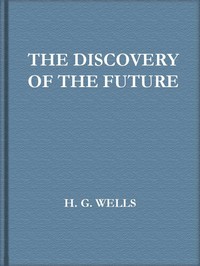
The Discovery of the Future — A Reader’s Guide
(0 User reviews)
2335
Project Gutenberg
2014
Not confirmed
History -- Philosophy; Time; Civilization -- Philosophy; Forecasting
Readers of public-domain and historical texts
Project Gutenberg digital edition
en
Edition facts
Words
12,773
Reading time
56 min
Text sections
3
The catalog record for The Discovery of the Future — A Reader’s Guide provides practical reading context through 12,773 words, 56 min estimated reading time, and 3 detected text sections.
The text analysis averages about 28.8 words per sentence, while the detected sections provide another way to judge how the source is divided.
Project Gutenberg metadata also associates the work with “History -- Philosophy,” connecting these edition facts with the source record’s subject description.
Source:
Project Gutenberg record #44867
In this 1902 lecture, H. G. Wells contrasts retrospective and constructive minds, arguing for an inductive science of the future based on historical forces rather than great individuals.
Read the complete public-domain text at its original source.
Read on Project GutenbergH. G. Wells opens his 1902 lecture by drawing a sharp distinction between two types of mind: the retrospective, which interprets the present through the past, and the constructive, which sees the present as material for the future. He aligns the former with legal thinking and the latter with creative, masterful attitudes. This binary framework structures his entire argument for a predictive science of human affairs.
Wells does not claim to predict specific events. Instead, he advocates for an inductive approach to the future, one that treats human societies as subject to general laws akin to those of the physical sciences. The excerpts show him wrestling with the role of exceptional individuals—Cæsar, Napoleon—and ultimately dismissing their causal importance in favor of underlying forces.
Two Minds, Two Times
Wells’s central dichotomy is between the retrospective and the constructive types. The retrospective mind, he writes, “interprets the things of the present … entirely with relation to the past.” The constructive mind, by contrast, “interprets the things of the present … entirely in relation to things designed or foreseen.” He associates the former with legal training—respect for precedent—and the latter with legislation and creation. This is not merely a psychological observation; it is a methodological foundation. Wells uses it to argue that a future-oriented mindset is both modern and necessary for any systematic attempt to know what is to come.
The Sand Heap and the Great Man
Wells confronts a major objection to predicting human affairs: the apparent power of exceptional individuals. He poses the question directly: does an exceptional man like Napoleon “persuade and convince and compel and take entire possession of the sand heap”? His answer is a firm no. Wells declares himself “a rather extreme case” of the view that great men are mere instruments of larger forces. He imagines swapping Julius Cæsar, Napoleon, and others at birth and concludes it would cause “no serious dislocation of the course of destiny.” This deterministic stance is crucial to his project: if individuals do not fundamentally alter history, then general laws can be discerned.
The Limits and Scope of Prophecy
Even as Wells argues for an inductive future science, he acknowledges limits. He admits we cannot foresee the birth of geniuses, and that prophecy in human affairs is “conditional.” Yet he insists that the ultimate consequences of even the greatest individuals will fall within a sufficiently broad inductive net. The future, for Wells, is not a blank but a domain of probabilities shaped by persistent forces. His lecture thus balances bold ambition with careful qualification, aiming to establish a method rather than deliver predictions.
Readers should note that Wells’s argument is built on a series of analogies—sand heaps, pen-nibs, drills—that reveal his materialist bent. The lecture is a philosophical manifesto, not a practical guide. Those interested in Wells’s later science fiction will find here the intellectual scaffolding for his visions of future societies. The text rewards attention to its rhetorical structure: each paragraph advances a claim, then anticipates an objection.
Wells’s insistence on looking forward rather than backward put me in mind of an old afternoon spent with Shakspere and Montaigne An Endeavour to Explain the Tendency of 'Hamlet' from Allusions in Contemporary Works — Background and Themes, where the past felt just as restless, like a room’s dim light rearranging itself into questions I hadn’t thought to ask.
There are no reviews for this eBook.
There are no comments for this eBook.
Reader reflection
Take a moment to reflect on this book
Create a short personal record of your experience with this book.
Your progress
0
/
10
2
How much did you enjoy the reading experience?
3
Would you recommend this book to another reader?
4
How easy was the book to follow?
5
How valuable was this book for your own interests?
6
How closely did the book connect with your experience?
7
What did you think about the pace?
8
How distinctive were its ideas or approach?
9
What did this book teach you most?
10
![Cover of A Theological-Political Treatise [Part III] — Reading Companion](https://holji.com/storage/media/covers/pg991.jpg)
![Cover of A Theological-Political Treatise [Part IV] — Key Ideas to Explore](https://holji.com/storage/media/covers/pg992.jpg)