The Kingdom of God is Within You; What is Art? — A Closer Reading
Edition facts
This digital edition of The Kingdom of God is Within You; What is Art? — A Closer Reading is described by source-level measurements including 197,629 words, 14 hr 20 min estimated reading time, and 18 detected text sections.
The text analysis averages about 31.3 words per sentence, while the detected sections provide another way to judge how the source is divided.
Project Gutenberg metadata also associates the work with “Christianity -- Controversial literature,” connecting these edition facts with the source record’s subject description.
Calculated from edition completeness, EPUB availability, text structure and catalogue metadata. Not a user rating.
How this score is calculated
- Description quality20 pts
- Title & short description10 pts
- Source metadata20 pts
- Text length15 pts
- Chapters / structure15 pts
- EPUB file integrity20 pts
Total of 100 points, scaled to a 2.5-5.0 range. Editions with an empty description or a missing EPUB file are not scored.
Read the Text
n friendly terms. Having arrived at this conclusion, he wrote, offering to the Society the following proclamation, which at that time, in 1838, was signed by many of its members:--
"_Declaration of Sentiments adopted by the Peace Convention, held in Boston, September 18, 19, and 20, 1838_:--
"Assembled in Convention, from various sections of the American Union, for the promotion of Peace on earth and Good-will among men, We, the undersigned, regard it as due to ourselves, to the cause which we love, to the country in which we live, and to the world, to publish a Declaration, expressive of the principles we cherish, the purposes we aim to accomplish, and the measures we shall adopt to carry forward the work of peaceful, universal reformation.
"We cannot acknowledge allegiance to any human government; neither can we oppose any such government by a resort to physical force. We recognize but one King and Lawgiver, one Judge and Ruler of mankind. We are bound by the laws of a Kingdom which is not of this world; the subjects of which are forbidden to fight; in which Mercy and Truth are met together, and Righteousness and Peace have kissed each other; which has no state lines, no national partitions, no geographical boundaries; in which there is no distinction of rank or division of caste, or inequality of sex; the officers of which are Peace, its exactors Righteousness, its walls Salvation, and its gates Praise; and which is destined to break in pieces and consume all other kingdoms. Our country is the world, our countrymen are all mankind. We love the land of our nativity only as we love all other lands. The interests, rights, liberties of American citizens are no more dear to us than are those of the whole human race. Hence, we can allow no appeal to patriotism to revenge any national insult or injury; the Principle of Peace, under whose stainless banner we rally, came not to destroy, but to save, even the worst of enemies. He has left us an example, that we should follow His steps. God commendeth his love toward us, in that while we were yet sinners, Christ died for us.
"We conceive that if a nation has no right to defend itself against foreign enemies, or to punish its invaders, no individual possesses that right in his own case. The unit cannot be of greater importance than the aggregate. If one man may take life, to obtain or defend his rights, the same license must necessarily be granted to communities, states, and nations. If _he_ may use a dagger or a pistol, _they_ may employ cannon, bombshells, land and naval forces. The means of self-preservation must be in proportion to the magnitude of interests at stake, and the number of lives exposed to destruction. But if a rapacious and bloodthirsty soldiery, thronging these shores from abroad, with intent to commit rapine and destroy life, may not be resisted by the people or magistracy, then ought no resistance to be offered to domestic troubles of the public peace or of private security. No obligation can rest upon Americans to regard foreigners as more sacred in their persons than themselves, or to give them a monopoly of wrong-doing with impunity.
"The dogma, that all the governments of the world are approvingly ordained of God, and that the powers that be in the United States, in Russia, in Turkey, are in accordance with His will, is not less absurd than impious. It makes the impartial Author of human freedom and equality unequal and tyrannical. It cannot be affirmed that the powers that be, in any nation, are actuated by the spirit or guided by the example of Christ, in the treatment of enemies; therefore, they cannot be agreeable to the will of God; and therefore their overthrow, by a spiritual regeneration of their subjects, is inevitable.
"We register our testimony not only against all wars, whether offensive or defensive, but all preparations for war; against every naval ship, every arsenal, every fortification; against the militia system and a standing army; against all military chieftains and soldiers; against all monuments commemorative of victory over a fallen foe, all trophies won in battle, all celebrations in honor of military or naval exploits; against all appropriations for the defense of a nation by force and army, on the part of any legislative body; against every edict of government requiring of its subjects military service. Hence we deem it unlawful to bear arms, or to hold a military office.
"As every human government is upheld by physical strength, and its laws are enforced virtually at the point of the bayonet, we cannot hold any office which imposes upon its incumbent the obligation to compel men to do right, on pain of imprisonment or death. We therefore voluntarily exclude ourselves from every legislative and judicial body, and repudiate all human politics, worldly honors, and stations of authority. If we cannot occupy a seat in the legislature or on the bench, neither can we elect _others_ to act as our substitutes in any such capacity.
"It follows that we cannot sue any man at law, to compel him by force to restore anything which he may have wrongfully taken from us or others; but if he has seized our coat, we shall surrender up our cloak, rather than subject him to punishment.
"We believe that the penal code of the old covenant, 'An eye for an eye, and a tooth for a tooth,' has been abrogated by Jesus Christ; and that under the new covenant, the forgiveness instead of the punishment of enemies has been enjoined upon all His disciples, in all cases whatsoever. To extort money from enemies, or set them upon a pillory, or cast them into prison, or hang them upon gallows, is obviously not to forgive, but to take retribution. 'Vengeance is mine, I will repay, saith the Lord.'
"The history of mankind is crowded with evidences proving that physical coercion is not adapted to moral regeneration; that the sinful disposition of men can be subdued only by love; that evil can be exterminated from the earth only by goodness; that it is not safe to rely upon an arm of flesh, upon man whose breath is in his nostrils, to preserve us from harm; that there is great security in being gentle, harmless, long-suffering, and abundant in mercy; that it is only the meek who shall inherit the earth, for the violent who resort to the sword are destined to perish with the sword. Hence, as a measure of sound policy--of safety to property, life, and liberty--of public quietude and private enjoyment--as well as on the ground of allegiance to Him who is King of kings and Lord of lords, we cordially adopt the non-resistance principle; being confident that it provides for all possible consequences, will insure all things needful to us, is armed with omnipotent power, and must ultimately triumph over every assailing force.
"We advocate no jacobinical doctrine. The spirit of jacobinism is the spirit of retaliation, violence, and murder. It neither fears God nor regards man. We would be filled with the spirit of Jesus Christ. If we abide by our principles, it is impossible for us to be disorderly, or plot treason, or participate in any evil work; we shall submit to every ordinance of man, for the Lord's sake; obey all the requirements of government, except such as we deem contrary to the commands of the gospel; and in no case resist the operation of law, except by meekly submitting to the penalty of disobedience.
"But while we shall adhere to the doctrine of non-resistance and passive submission, we purpose, in a moral and spiritual sense, to speak and act boldly in the cause of God; to assail iniquity in high places and in low places; to apply our principles to all existing civil, political, legal, and ecclesiastical institutions; and to hasten the time when the kingdoms of this world will have become the kingdoms of our Lord and of His Christ, and He shall reign forever.
"It appears to us a self-evident truth, that, whatever the gospel is designed to destroy at any period of the world, being contrary to it, ought now to be abandoned. If, then, the time is predicted when swords shall be beaten into plowshares, and spears into pruning-hooks, and men shall not learn the art of war any more, it follows that all who manufacture, sell, or wield those deadly weapons do thus array themselves against the peaceful dominion of the Son of God on earth.
"Having thus briefly stated our principles and purposes, we proceed to specify the measures we propose to adopt in carrying our object into effect.
"We expect to prevail through the foolishness of preaching,--striving to commend ourselves unto every man's conscience, in the sight of God. From the press we shall promulgate our sentiments as widely as practicable. We shall endeavor to secure the coöperation of all persons, of whatever name or sect. The triumphant progress of the cause of Temperance and of Abolition in our land, through the instrumentality of benevolent and voluntary associations, encourages us to combine our own means and efforts for the promotion of a still greater cause. Hence, we shall employ lecturers, circulate tracts and publications, form societies, and petition our state and national governments, in relation to the subject of Universal Peace. It will be our leading object to devise ways and means for effecting a radical change in the views, feelings, and practices of society, respecting the sinfulness of war and the treatment of enemies.
"In entering upon the great work before us, we are not unmindful that, in its prosecution, we may be called to test our sincerity even as in a fiery ordeal. It may subject us to insult, outrage, suffering, yea, even death itself. We anticipate no small amount of misconception, misrepresentation, calumny. Tumults may arise against us. The ungodly and violent, the proud and pharisaical, the ambitious and tyrannical, principalities and powers, and spiritual wickedness in high places, may contrive to crush us. So they treated the Messiah, whose example we are humbly striving to imitate. If we suffer with Him we know that we shall reign with Him. We shall not be afraid of their terror, neither be troubled. Our confidence is in the Lord Almighty, not in man. Having withdrawn from human protection, what can sustain us but that faith which overcomes the world? We shall not think it strange concerning the fiery trial which is to try us, as though some strange thing had happened unto us; but rejoice, inasmuch as we are partakers of Christ's sufferings. Wherefore, we commit the keeping of our souls to God, in well-doing, as unto a faithful Creator. For every one that forsakes house, or brethren, or sisters, or father, or mother, or wife, or children, or lands, for Christ's sake, shall receive a hundredfold, and shall inherit everlasting life.
"Firmly relying upon the certain and universal triumph of the sentiments contained in this declaration, however formidable may be the opposition arrayed against them--in solemn testimony of our faith in their divine origin--we hereby affix our signatures to it, commending it to the reason and conscience of mankind, giving ourselves no anxiety as to what may befall us, and resolving in the strength of the Lord God calmly and meekly to abide the issue."
Later on, Garrison founded a Non-resistance Society and started a periodical entitled _The Non-resistant_, wherein the full significance and consequences of the doctrine were plainly set forth, as has been stated in the proclamation. I gained, subsequently, further information concerning the fate of this society and the periodical from a biography of William Lloyd Garrison, written by his sons.
Neither the periodical nor the society enjoyed a long life. The majority of Garrison's associates in the work of liberating the slaves, apprehensive lest the too radical views expressed in the _The Non-resistant_ might alienate men from the practical business of the abolition of slavery, renounced the doctrine of non-resistance as expressed in the declaration, and both periodical and society passed out of existence.
One would suppose that this declaration of Garrison, formulating, as it did, an important profession of faith in terms both energetic and eloquent, would have made a deeper impression on men, and have become a subject for universal consideration. On the contrary, not only is it unknown in Europe, but even among those Americans who honor the memory of Garrison there are but few who are familiar with this.
A similar fate befell another American champion of the same doctrine, Adin Ballou, who died recently, and who for fifty years had preached in favor of non-resistance to evil. How little is known in regard to the question of non-resistance may be gathered from the fact that the younger Garrison (who has written an excellent biography of his father in four large volumes), in answer to my inquiry whether any society for the defense of the principles of non-resistance was yet alive and possessed adherents, wrote me that, so far as he knew, the society had dissolved and its members were no longer interested, while at this very time Adin Ballou, who had shared Garrison's labors, and who had devoted fifty years of his life to the teaching of the doctrine of non-resistance, both by pen and by tongue, was still living in Hopedale, Massachusetts. Afterward I received a letter from Wilson, a disciple and co-worker of Ballou, and subsequently I entered into correspondence with Ballou himself. I wrote to him, and he sent me his works, from one of which I made the following extract:--"Jesus Christ is my Lord and Master," says Ballou in one of his articles, written to show the inconsistency of Christians who believe in the right of defensive and offensive warfare. "I have covenanted to forsake all and follow Him, through good and evil report, until death. But I am nevertheless a Democratic Republican citizen of the United States, implicitly sworn to bear true allegiance to my country, and to support its Constitution, if need be, with my life. Jesus Christ requires me to do unto others as I would that others should do unto me. The Constitution of the United States requires me to do unto twenty-seven hundred thousand slaves" (they had slaves then; now they could easily be replaced by workmen) "the very contrary of what I would have them do unto me--viz., assist to keep in a grievous bondage.... But I am quite easy. I vote on. I help govern on. I am willing to hold any office I may be elected to under the Constitution. And I am still a Christian. I profess on. I find difficulty in keeping covenant both with Christ and the Constitution.
"Jesus Christ forbids me to resist evil-doers by taking 'eye for eye, tooth for tooth, blood and life for life.' My government requires the very reverse, and depends, for its own self-preservation, on the halter, the musket, and the sword, seasonably employed against its domestic and foreign enemies.
"In the maintenance and use of this expensive life-destroying apparatus we can exemplify the virtues _of forgiving our injuries, loving our enemies, blessing them that curse us, and doing good to those that hate us_. For this reason we have regular Christian chaplains to pray for us and call down the smiles of God on our holy murders.
"I see it all" (that is, the contradiction between profession and life), "and yet I insist that I am as good a Christian as ever. I fellowship all; I vote on; I help govern on; I profess on; _and I glory in being at once a devoted Christian and a no less devoted adherent to the existing government_. I will not give in to those miserable non-resistant notions. I will not throw away my political influence, and leave unprincipled men to carry on government alone.
"The Constitution says--'Congress shall have power to declare war, grant letters of marque and reprisal,' and I agree to this, I indorse it. I swear to help carry it through. I vote for men to hold office who are sworn to support all this. What, then, am I less a Christian? Is not war a Christian service? Is it not perfectly Christian to murder hundreds of thousands of fellow human beings; to ravish defenseless females, sack and burn cities, and enact all the other cruelties of war? Out upon these new-fangled scruples! This is the very way to forgive injuries, and love our enemies! If we only do it all in true love nothing can be more Christian than wholesale murder!"
In another pamphlet, entitled "How many does it take?" he says--"One man must not kill. If he does, it is murder; two, ten, one hundred men, acting on their responsibility, must not kill. If they do, it is still murder. But a state or nation may kill as many as they please, and it is no murder. It is just, necessary, commendable, and right. Only get people enough to agree to it, and the butchery of myriads of human beings is perfectly innocent. But how many does it take? This is the question. Just so with theft, robbery, burglary, and all other crimes. Man-stealing is a great crime in one man, or a very few men only. But a whole nation can commit it, and the act becomes not only innocent, but highly honorable."
The following is, in substance, a catechism of Ballou, compiled for the use of his congregation:--
THE CATECHISM OF NON-RESISTANCE.[1]
[1] From the Russian version, which Count Tolstoï calls a free translation made with some omissions. After diligent search and inquiry I have been unable to find this catechism among Ballou's works.--TR.
_Q._ Whence comes the word non-resistance?
_A._ From the utterance: "But I say unto you, That ye resist not evil."--Matthew v. 39.
_Q._ What does this word denote?
_A._ It denotes a lofty Christian virtue, commanded by Christ.
_Q._ Are we to understand the word non-resistance in its broad sense, that is, as meaning that one should offer no resistance to evil whatsoever?
_A._ No; it should be understood literally as Christ taught it--that is, not to return evil for evil. Evil should be resisted by all lawful means, but not by evil.
_Q._ From what does it appear that Christ gave that meaning to non-resistance?
_A._ From the words which he used on that occasion. He said: "Ye have heard that it hath been said, An eye for an eye, and a tooth for a tooth. But I say unto you, That ye resist not evil: but whosoever shall smite thee on thy right cheek, turn to him the other also. And if any man will sue thee at the law, and take away thy coat, let him have thy cloke also."
_Q._ Whom did he mean by the words: "Ye have heard that it hath been said"?
_A._ The patriarchs and the prophets, and that which they spoke and which is contained in the Old Testament, that the Jews generally call the Law and Prophets.
_Q._ To what laws did Christ allude in the words: "Ye have heard"?
_A._ To those in which Noah, Moses, and other prophets grant the use of personal violence against those who commit it, for the purpose of punishing and destroying evil deeds.
_Q._ Mention such commandments.
_A._ "Whoso sheddeth man's blood, by man shall his blood be shed."--Genesis ix. 6.
"He that smiteth a man, so that he die, shall be surely put to death. And if any mischief follow, then thou shalt give life for life, eye for eye, tooth for tooth, hand for hand, foot for foot, burning for burning, wound for wound, stripe for stripe."--Exodus xxi. 12, 23, 24, 25.
"And he that killeth any man shall surely be put to death. And if a man cause a blemish in his neighbor; as he hath done, so shall it be done to him; breach for breach, eye for eye, tooth for tooth."--Leviticus xxiv. 17, 19, 20.
"And the judges shall make diligent inquisition: and, behold, if the witness be a false witness, and hath testified falsely against his brother; then shall ye do unto him, as he had thought to have done unto his brother. And thine eye shall not pity; but life shall go for life, eye for eye, tooth for tooth, hand for hand, foot for foot."--Deuteronomy xix. 18, 19, 21.
These are the injunctions of which Jesus speaks.
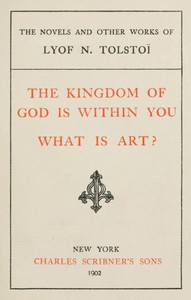
This volume pairs two works that approach the same moral conviction from different angles. In The Kingdom of God is Within You, Tolstoy argues that Christ's teaching of non-resistance to evil is not a minor precept but the very foundation of Christianity, and that the state's reliance on violence is incompatible with that teaching. In What is Art?, he turns to aesthetics, rejecting definitions that treat art as the expression of beauty or mysterious ideas, and instead insists that art's function is to transmit feelings that unite people. The translation of the first treatise is by Mrs. Aline Delano; the second is translated by Aylmer Maude.
The Orel Incident and the Machinery of Denial
In the excerpt from The Kingdom of God is Within You, Tolstoy describes a specific event: a landowner in Orel has a peasant flogged and exiled to Siberia. The narrator observes the reactions of those involved—the landowner, the judge, the soldiers, the passengers on a train—and notes that everyone knows the act is wicked, yet no one stops it. The officials justify it by the needs of the existing order; the soldiers obey because they believe higher authorities are infallible. Tolstoy dissects this shared bad faith: each participant finds a reason to continue, from self-interest to a belief in the system's immutability. The passage is notable for its close attention to physical discomfort—the soldiers who “turned away frowning” and the passengers with “wandering eyes”—as evidence of a conscience that is felt but not acted upon.
The Economic Roots of Obedience
Tolstoy does not stop at moral condemnation; he traces the mechanism that keeps the system running. The landowner benefits from his thousands of dessiatins; the judge earns fifty times more than a laborer; the governor, procureur, and senator depend on salaries of several thousands. These material stakes, he argues, make it “pleasant and desirable” for those in power to believe the existing order is necessary and immutable. The lower classes, meanwhile, are not presented as innocent—they too participate, but their obedience is enforced by a different kind of dependence. This analysis anticipates later critiques of ideology, grounding the failure to resist evil not in ignorance but in economic interest and institutional inertia.
Art as a Counterforce to Division
In What is Art?, Tolstoy takes up the question of how people might be united rather than divided. He rejects definitions that make art a matter of pleasure, beauty, or the expression of mysterious ideas. Instead, he proposes that art is the transmission of feeling: the artist experiences an emotion and then, through external signs, infects the audience with that same feeling. The value of art depends on the quality of the feeling transmitted—whether it unites people in love and brotherhood or divides them through pride and sensuality. This theory is directly continuous with the moral argument of the first treatise: if the state divides people through violence and self-interest, art should be the activity that reconnects them on a shared emotional ground.
Readers coming to these texts for the first time may find it useful to read the two treatises as a single argument: the diagnosis of social evil in The Kingdom of God is Within You and the proposed cure through art in What is Art?. The excerpts show Tolstoy at his most forensic, tracking the psychology of complicity and the economics of obedience. The translations, by different hands, preserve the directness of his prose. Note that the second treatise is more polemical and includes extended critiques of other aesthetic theories; the first is more expository, building its case from scriptural interpretation and contemporary examples.
There’s something humbling about sitting with Tolstoy’s certainty, his insistence that art is only true when it binds us together. It makes me think of my old, dog-eared copy of The World's Greatest Books — Volume 14 — Philosophy and Economics — Story, Setting & Ideas, which somehow holds the same quiet weight of a previous reader’s penciled notes, a reminder of all the strangers who have shared these very questions before me.
-
Jeffrey Victor Miller - 1 month ago
This combined volume brings together two of Tolstoy's most powerful essays. 'The Kingdom of God Is Within You' is a passionate call for nonviolent resistance, and 'What Is Art?' challenges conventional aesthetics. Together, they reveal Tolstoy's deep moral and artistic convictions. His ideas are profoundly relevant today, making this a must-read for anyone interested in social change. -
Jennifer Mueller - 1 month ago
Tolstoy's ideas are bold and his critiques of the church and art are thought-provoking. However, the essays are somewhat repetitive and reflect a utopian Christianity that may not resonate with all readers. That said, 'The Kingdom of God' offers a compelling argument against state violence. Overall, a valuable but demanding read. -
Cristina William Odonnell - 4 weeks ago
Tolstoy's radical pacifism and his narrow definition of art are hard to swallow. The writing is didactic and at times preachy, with little room for nuance. His religious fervor overshadows the philosophical insights, making the text feel dated. I struggled to finish this volume and would not recommend it to modern readers.
What was your reading experience?
Capture what you thought, learned, and would like to remember.
Amelia Sanchez
3 weeks ago