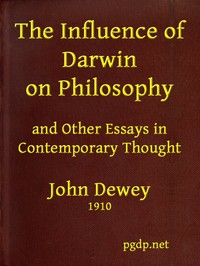
The Influence of Darwin on Philosophy, and other essays in contemporary thought — Key Ideas to Explore
Edition facts
Before opening The Influence of Darwin on Philosophy, and other essays in contemporary thought — Key Ideas to Explore, the edition data offers a quick orientation: 73,692 words, 5 hr 21 min estimated reading time, and 17 detected text sections.
The text analysis averages about 26.5 words per sentence, while the detected sections provide another way to judge how the source is divided.
Project Gutenberg metadata also associates the work with “Philosophy,” connecting these edition facts with the source record’s subject description.
Calculated from edition completeness, EPUB availability, text structure and catalogue metadata. Not a user rating.
How this score is calculated
- Description quality20 pts
- Title & short description10 pts
- Source metadata20 pts
- Text length15 pts
- Chapters / structure15 pts
- EPUB file integrity20 pts
Total of 100 points, scaled to a 2.5-5.0 range. Editions with an empty description or a missing EPUB file are not scored.
Read the Text
lassic philosophy of nature and of knowledge. The beginnings of the revolution are in the physical science of the sixteenth and seventeenth centuries. When Galileo said: “It is my opinion that the earth is very noble and admirable by reason of so many and so different alterations and generations which are incessantly made therein,” he expressed the changed temper that was coming over the world; the transfer of interest from the permanent to the changing. When Descartes said: “The nature of physical things is much more easily conceived when they are beheld coming gradually into existence, than when they are only considered as produced at once in a finished and perfect state,” the modern world became self-conscious of the logic that was henceforth to control it, the logic of which Darwin’s “Origin of Species” is the latest scientific achievement. Without the methods of Copernicus, Kepler, Galileo, and their successors in astronomy, physics, and chemistry, Darwin would have been helpless in the organic sciences. But prior to Darwin the impact of the new scientific method upon life, mind, and politics, had been arrested, because between these ideal or moral interests and the inorganic world intervened the kingdom of plants and animals. The gates of the garden of life were barred to the new ideas; and only through this garden was there access to mind and politics. The influence of Darwin upon philosophy resides in his having conquered the phenomena of life for the principle of transition, and thereby freed the new logic for application to mind and morals and life. When he said of species what Galileo had said of the earth, _e pur si muove_, he emancipated, once for all, genetic and experimental ideas as an organon of asking questions and looking for explanations.
The exact bearings upon philosophy of the new logical outlook are, of course, as yet, uncertain and inchoate. We live in the twilight of intellectual transition. One must add the rashness of the prophet to the stubbornness of the partizan to venture a systematic exposition of the influence upon philosophy of the Darwinian method. At best, we can but inquire as to its general bearing--the effect upon mental temper and complexion, upon that body of half-conscious, half-instinctive intellectual aversions and preferences which determine, after all, our more deliberate intellectual enterprises. In this vague inquiry there happens to exist as a kind of touchstone a problem of long historic currency that has also been much discussed in Darwinian literature. I refer to the old problem of design _versus_ chance, mind _versus_ matter, as the causal explanation, first or final, of things.
As we have already seen, the classic notion of species carried with it the idea of purpose. In all living forms, a specific type is present directing the earlier stages of growth to the realization of its own perfection. Since this purposive regulative principle is not visible to the senses, it follows that it must be an ideal or rational force. Since, however, the perfect form is gradually approximated through the sensible changes, it also follows that in and through a sensible realm a rational ideal force is working out its own ultimate manifestation. These inferences were extended to nature: (_a_) She does nothing in vain; but all for an ulterior purpose. (_b_) Within natural sensible events there is therefore contained a spiritual causal force, which as spiritual escapes perception, but is apprehended by an enlightened reason. (_c_) The manifestation of this principle brings about a subordination of matter and sense to its own realization, and this ultimate fulfilment is the goal of nature and of man. The design argument thus operated in two directions. Purposefulness accounted for the intelligibility of nature and the possibility of science, while the absolute or cosmic character of this purposefulness gave sanction and worth to the moral and religious endeavors of man. Science was underpinned and morals authorized by one and the same principle, and their mutual agreement was eternally guaranteed.
This philosophy remained, in spite of sceptical and polemic outbursts, the official and the regnant philosophy of Europe for over two thousand years. The expulsion of fixed first and final causes from astronomy, physics, and chemistry had indeed given the doctrine something of a shock. But, on the other hand, increased acquaintance with the details of plant and animal life operated as a counterbalance and perhaps even strengthened the argument from design. The marvelous adaptations of organisms to their environment, of organs to the organism, of unlike parts of a complex organ--like the eye--to the organ itself; the foreshadowing by lower forms of the higher; the preparation in earlier stages of growth for organs that only later had their functioning--these things were increasingly recognized with the progress of botany, zoology, paleontology, and embryology. Together, they added such prestige to the design argument that by the late eighteenth century it was, as approved by the sciences of organic life, the central point of theistic and idealistic philosophy.
The Darwinian principle of natural selection cut straight under this philosophy. If all organic adaptations are due simply to constant variation and the elimination of those variations which are harmful in the struggle for existence that is brought about by excessive reproduction, there is no call for a prior intelligent causal force to plan and preordain them. Hostile critics charged Darwin with materialism and with making chance the cause of the universe.
Some naturalists, like Asa Gray, favored the Darwinian principle and attempted to reconcile it with design. Gray held to what may be called design on the installment plan. If we conceive the “stream of variations” to be itself intended, we may suppose that each successive variation was designed from the first to be selected. In that case, variation, struggle, and selection simply define the mechanism of “secondary causes” through which the “first cause” acts; and the doctrine of design is none the worse off because we know more of its _modus operandi_.
Darwin could not accept this mediating proposal. He admits or rather he asserts that it is “impossible to conceive this immense and wonderful universe including man with his capacity of looking far backwards and far into futurity as the result of blind chance or necessity.”[3] But nevertheless he holds that since variations are in useless as well as useful directions, and since the latter are sifted out simply by the stress of the conditions of struggle for existence, the design argument as applied to living beings is unjustifiable; and its lack of support there deprives it of scientific value as applied to nature in general. If the variations of the pigeon, which under artificial selection give the pouter pigeon, are not preordained for the sake of the breeder, by what logic do we argue that variations resulting in natural species are pre-designed?[4]
So much for some of the more obvious facts of the discussion of design _versus_ chance, as causal principles of nature and of life as a whole. We brought up this discussion, you recall, as a crucial instance. What does our touchstone indicate as to the bearing of Darwinian ideas upon philosophy? In the first place, the new logic outlaws, flanks, dismisses--what you will--one type of problems and substitutes for it another type. Philosophy forswears inquiry after absolute origins and absolute finalities in order to explore specific values and the specific conditions that generate them.
Darwin concluded that the impossibility of assigning the world to chance as a whole and to design in its parts indicated the insolubility of the question. Two radically different reasons, however, may be given as to why a problem is insoluble. One reason is that the problem is too high for intelligence; the other is that the question in its very asking makes assumptions that render the question meaningless. The latter alternative is unerringly pointed to in the celebrated case of design _versus_ chance. Once admit that the sole verifiable or fruitful object of knowledge is the particular set of changes that generate the object of study together with the consequences that then flow from it, and no intelligible question can be asked about what, by assumption, lies outside. To assert--as is often asserted--that specific values of particular truth, social bonds and forms of beauty, if they can be shown to be generated by concretely knowable conditions, are meaningless and in vain; to assert that they are justified only when they and their particular causes and effects have all at once been gathered up into some inclusive first cause and some exhaustive final goal, is intellectual atavism. Such argumentation is reversion to the logic that explained the extinction of fire by water through the formal essence of aqueousness and the quenching of thirst by water through the final cause of aqueousness. Whether used in the case of the special event or that of life as a whole, such logic only abstracts some aspect of the existing course of events in order to reduplicate it as a petrified eternal principle by which to explain the very changes of which it is the formalization.
When Henry Sidgwick casually remarked in a letter that as he grew older his interest in what or who made the world was altered into interest in what kind of a world it is anyway, his voicing of a common experience of our own day illustrates also the nature of that intellectual transformation effected by the Darwinian logic. Interest shifts from the wholesale essence back of special changes to the question of how special changes serve and defeat concrete purposes; shifts from an intelligence that shaped things once for all to the particular intelligences which things are even now shaping; shifts from an ultimate goal of good to the direct increments of justice and happiness that intelligent administration of existent conditions may beget and that present carelessness or stupidity will destroy or forego.
In the second place, the classic type of logic inevitably set philosophy upon proving that life _must_ have certain qualities and values--no matter how experience presents the matter--because of some remote cause and eventual goal. The duty of wholesale justification inevitably accompanies all thinking that makes the meaning of special occurrences depend upon something that once and for all lies behind them. The habit of derogating from present meanings and uses prevents our looking the facts of experience in the face; it prevents serious acknowledgment of the evils they present and serious concern with the goods they promise but do not as yet fulfil. It turns thought to the business of finding a wholesale transcendent remedy for the one and guarantee for the other. One is reminded of the way many moralists and theologians greeted Herbert Spencer’s recognition of an unknowable energy from which welled up the phenomenal physical processes without and the conscious operations within. Merely because Spencer labeled his unknowable energy “God,” this faded piece of metaphysical goods was greeted as an important and grateful concession to the reality of the spiritual realm. Were it not for the deep hold of the habit of seeking justification for ideal values in the remote and transcendent, surely this reference of them to an unknowable absolute would be despised in comparison with the demonstrations of experience that knowable energies are daily generating about us precious values.
The displacing of this wholesale type of philosophy will doubtless not arrive by sheer logical disproof, but rather by growing recognition of its futility. Were it a thousand times true that opium produces sleep because of its dormitive energy, yet the inducing of sleep in the tired, and the recovery to waking life of the poisoned, would not be thereby one least step forwarded. And were it a thousand times dialectically demonstrated that life as a whole is regulated by a transcendent principle to a final inclusive goal, none the less truth and error, health and disease, good and evil, hope and fear in the concrete, would remain just what and where they now are. To improve our education, to ameliorate our manners, to advance our politics, we must have recourse to specific conditions of generation.
Finally, the new logic introduces responsibility into the intellectual life. To idealize and rationalize the universe at large is after all a confession of inability to master the courses of things that specifically concern us. As long as mankind suffered from this impotency, it naturally shifted a burden of responsibility that it could not carry over to the more competent shoulders of the transcendent cause. But if insight into specific conditions of value and into specific consequences of ideas is possible, philosophy must in time become a method of locating and interpreting the more serious of the conflicts that occur in life, and a method of projecting ways for dealing with them: a method of moral and political diagnosis and prognosis.
The claim to formulate _a priori_ the legislative constitution of the universe is by its nature a claim that may lead to elaborate dialectic developments. But it is also one that removes these very conclusions from subjection to experimental test, for, by definition, these results make no differences in the detailed course of events. But a philosophy that humbles its pretensions to the work of projecting hypotheses for the education and conduct of mind, individual and social, is thereby subjected to test by the way in which the ideas it propounds work out in practice. In having modesty forced upon it, philosophy also acquires responsibility.
Doubtless I seem to have violated the implied promise of my earlier remarks and to have turned both prophet and partizan. But in anticipating the direction of the transformations in philosophy to be wrought by the Darwinian genetic and experimental logic, I do not profess to speak for any save those who yield themselves consciously or unconsciously to this logic. No one can fairly deny that at present there are two effects of the Darwinian mode of thinking. On the one hand, there are making many sincere and vital efforts to revise our traditional philosophic conceptions in accordance with its demands. On the other hand, there is as definitely a recrudescence of absolutistic philosophies; an assertion of a type of philosophic knowing distinct from that of the sciences, one which opens to us another kind of reality from that to which the sciences give access; an appeal through experience to something that essentially goes beyond experience. This reaction affects popular creeds and religious movements as well as technical philosophies. The very conquest of the biological sciences by the new ideas has led many to proclaim an explicit and rigid separation of philosophy from science.
Old ideas give way slowly; for they are more than abstract logical forms and categories. They are habits, predispositions, deeply engrained attitudes of aversion and preference. Moreover, the conviction persists--though history shows it to be a hallucination--that all the questions that the human mind has asked are questions that can be answered in terms of the alternatives that the questions themselves present. But in fact intellectual progress usually occurs through sheer abandonment of questions together with both of the alternatives they assume--an abandonment that results from their decreasing vitality and a change of urgent interest. We do not solve them: we get over them. Old questions are solved by disappearing, evaporating, while new questions corresponding to the changed attitude of endeavor and preference take their place. Doubtless the greatest dissolvent in contemporary thought of old questions, the greatest precipitant of new methods, new intentions, new problems, is the one effected by the scientific revolution that found its climax in the “Origin of Species.”
NATURE AND ITS GOOD: A CONVERSATION[5]
A group of people are scattered near one another, on the sands of an ocean beach; wraps, baskets, etc., testify to a day’s outing. Above the hum of the varied conversations are heard the mock sobs of one of the party.
_Various voices._ What’s the matter, Eaton?
_Eaton._ Matter enough. I was watching a beautiful wave; its lines were perfect; at its crest, the light glinting through its infinitely varied and delicate curves of foam made a picture more ravishing than any dream. And now it has gone; it will never come back. So I weep.
_Grimes._ That’s right, Eaton; give it to them. Of course well-fed and well-read persons--with their possessions of wealth and of knowledge both gained at the expense of others--finally get bored; then they wax sentimental over their boredom and are worried about “Nature” and its relation to life. Not everybody takes it out that way, of course; some take motor cars and champagne for that tired feeling. But the rest--those who aren’t in that class financially, or who consider themselves too refined for that kind of relief--seek a new sensation in speculating why that brute old world out there will not stand for what you call spiritual and ideal values--for short, your egotisms.
The fact is that the whole discussion is only a symptom of the leisure class disease. If you had to work to the limit and beyond, to keep soul and body together, and, more than that, to keep alive the soul of your family in its body, you would know the difference between your artificial problems and the genuine problem of life. Your philosophic problems about the relation of “the universe to moral and spiritual good” exist only in the sentimentalism that generates them. The genuine question is why social arrangements will not permit the amply sufficient body of natural resources to sustain all men and women in security and decent comfort, with a margin for the cultivation of their human instincts of sociability, love of knowledge and of art.
As I read Plato, philosophy began with some sense of its essentially political basis and mission--a recognition that its problems were those of the organization of a just social order. But it soon got lost in dreams of another world; and even those of you philosophers who pride yourselves on being so advanced that you no longer believe in “another world,” are still living and thinking with reference to it. You may not call it supernatural; but when you talk about a realm of spiritual or ideal values in general, and ask about its relation to Nature in general, you have only changed the labels on the bottles, not the contents in them. For what makes anything transcendental--that is, in common language, supernatural--is simply and only aloofness from practical affairs--which affairs in their ultimate analysis are the business of making a living.
_Eaton._ Yes; Grimes has about hit off the point of my little parable--in one of its aspects at least. In matters of daily life you say a man is “off,” more or less insane, when he deliberately goes on looking for a certain kind of result from conditions which he has already found to be such that they cannot possibly yield it. If he keeps on looking, and then goes about mourning because stage money won’t buy beefsteaks, or because he cannot keep himself warm by burning the sea-sands here, you dismiss him as a fool or a hysteric. If you would condescend to reason with him at all, you would tell him to look for the conditions that will yield the results; to occupy himself with some of the countless goods of life for which, by intelligently directed search, adequate means may be found.
Well, before lunch, Moore was reiterating the old tale. “Modern science has completely transformed our conceptions of Nature. It has stripped the universe bare not only of all the moral values which it wore alike to antique pagan and to our medieval ancestors, but also of any regard, any preference, for such values. They are mere incidents, transitory accidents, in her everlasting redistribution of matter in motion; like the rise and fall of the wave I lament, or like a single musical note that a screeching, rumbling railway train might happen to emit.” This is a one-sided view; but suppose it were all so, what is the moral? Surely, to change our standpoint, our angle of vision; to stop looking for results among conditions that we know will not yield them; to turn our gaze to the goods, the values that exist actually and indubitably in experience; and consider by what natural conditions these particular values may be strengthened and widened.
John Dewey's 1910 collection opens with a preface that frames the essays as part of a "philosophy of transition and reconstruction," a phrase that echoes through the volume. The work is structured as a series of independent essays, yet Dewey insists they share a unity of spirit—a pragmatic phase of a broader intellectual movement. The excerpts reveal a distinctive voice: Dewey often adopts a dialogic form, as in the extended exchange between a "Pupil" and "Teacher" that probes the nature of truth and judgment. This back-and-forth, with its numbered objections and replies, gives the text a performative, almost Socratic quality, testing ideas through confrontation rather than monologue.
The Dialogic Engine
The most striking structural feature in the excerpts is the sustained dialogue between Pupil and Teacher. The Pupil raises objections—"Nevertheless, the pragmatist is always appealing to the judgments of others"—and the Teacher replies with patient reframing. This format is not merely pedagogical; it enacts Dewey's central claim that judgment arises from "conditions of need for a survey and statement." The dialogue moves through nine objections, each circling back to the nature of satisfaction and the human factor in inquiry. Dewey uses the form to dramatize how philosophical positions are tested through exchange, not static assertion. The repetition of "Nevertheless" and "Reply" creates a rhythm of challenge and response, mirroring the pragmatic method of hypothesis and experiment.
Recurring Images of Movement
Across the excerpts, Dewey relies on a consistent set of images: transition, reconstruction, and the contrast between static and dynamic. The preface speaks of "transition and reconstruction" as the defining character of contemporary thought. The German critic's definition of pragmatism is dismissed as a filing-cabinet pigeonhole—a static classification that misses the "vital phases" of change. Later, the Teacher accuses the intellectualist of "going around in the same old circle," while pragmatism insists on "working hypotheses" that are "provisional" and subject to testing. These images of motion—circles, transitions, testing—underscore Dewey's argument that truth is not a fixed property but a process of co-adaptation between human purpose and environment.
The Human Factor and Its Consequences
Dewey repeatedly returns to what he calls the "human factor"—the role of want, purpose, and realization in judgment. In the dialogue, the Teacher insists that ignoring this factor leads to "irresponsible" assertions, while acknowledging it forces beliefs to be "tried out, through acting upon them." This is not a call to subjectivism; Dewey argues that the human factor must "work itself out in co-operation with the environmental factor." The excerpts show him carefully distinguishing his position from mere personal satisfaction: the pragmatic criterion is not "whatever works to please me" but a co-adaptation that yields both correspondence and satisfaction. The language of "testing" and "consequences" recurs as a practical discipline against dogma.
From Epistemology to Method
Dewey's essays move from abstract epistemological debate to a concrete redefinition of philosophy's task. The preface notes that the essays belong to the "pragmatic phase" of a newer movement, but Dewey resists labeling, preferring to see pragmatism as "part and parcel of a general movement of intellectual reconstruction." In the dialogue, the Teacher shifts the ground from a theory of truth to a theory about judgments and meanings, of which truth is a corollary. This reorientation is central: philosophy becomes a method of inquiry rather than a system of fixed truths. The excerpts show Dewey arguing that beliefs should be held as "working hypotheses" until tested, and that even so-called truths may become provisional as new modes of testing develop.
Readers approaching this collection should attend to the interplay between essay form and dialogic structure. Dewey's arguments are not delivered as finished doctrines but as invitations to test ideas through action and exchange. The recurring images of transition and reconstruction are not decorative; they are the conceptual engine of the work. To read these essays is to watch a philosopher thinking in motion, refusing to let any claim settle into dogma.
I opened Dewey’s essays the other evening, and that old feeling crept back—how ideas endure not as monuments but as slow rivers wearing stone. His talk of reconstruction made me reach for a quieter volume, Christianity and Greek Philosophy or, the relation between spontaneous and reflective thought in Greece and the positive teaching of Christ and His Apostles — Context and Discussion, where the same erosion happens, only older, gentler.
There are no reviews for this eBook.
What was your reading experience?
Capture what you thought, learned, and would like to remember.