1

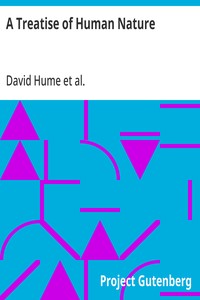
A Treatise of Human Nature Being an Attempt to Introduce the Experimental Method Into Moral Subjects; and Dialogues Concerning Natural Religion — Inside the Classic
(0 User reviews)
2705
Project Gutenberg
2020
Not confirmed
Ethics; Emotions; Knowledge, Theory of; Philosophy, English
Readers of public-domain and historical texts
Project Gutenberg digital edition
en
Edition facts
Words
171,974
Reading time
748 min
Text sections
14
The catalog record for A Treatise of Human Nature Being an Attempt to Introduce the Experimental Method Into Moral Subjects; and Dialogues Concerning Natural Religion — Inside the Classic provides practical reading context through 171,974 words, 12 hr 28 min estimated reading time, and 14 detected text sections.
The text analysis averages about 27.7 words per sentence, while the detected sections provide another way to judge how the source is divided.
Project Gutenberg metadata also associates the work with “Ethics,” connecting these edition facts with the source record’s subject description.
Source:
Project Gutenberg record #62856
Green's editorial introductions to Hume's Treatise examine the philosopher's theory of ideas, general names, and predication, focusing on the tension between impression and thought. The analysis traces how Hume's account of individuality and abstraction shapes his empirical method, with close attention to the role of custom and the imagination in forming general propositions.
Read the complete public-domain text at its original source.
Read on Project GutenbergThomas Hill Green's introductions to Hume's Treatise open with a pointed editorial decision: to treat the Treatise as the definitive expression of Hume's philosophy, despite Hume's later preference for the Inquiries. Green justifies this by arguing that the Treatise reveals the underlying structure of Hume's thought more fully than the revised works. The introductions are not a neutral summary but a critical engagement, dissecting Hume's arguments on ideas, general names, and the nature of predication. Green's method is to move from Hume's own wording to its logical consequences, often exposing what he sees as equivocations or gaps.
The Structure of the Editorial Project
The edition is organized into continuous introductions rather than scattered footnotes, a deliberate choice to present explanation and criticism as a unified argument. Green alone wrote the introductions to Volumes I and II, while Grose handled Volume III and text revision. The editors aimed to avoid the 'inconveniences' of commentary on philosophical writers by keeping footnotes almost entirely to references, distinguished from Hume's own notes. This structural decision shapes how the reader encounters Hume: the introductions frame the Treatise as a coherent system to be evaluated, not merely annotated. The paragraph numbering follows Nettleship's edition, and Green's marginal notes are placed as captions above relevant paragraphs, creating a layered reading experience where editorial commentary visually precedes Hume's text.
Recurring Images: Custom, Imagination, and the Sleeping Custom
Green repeatedly returns to the image of 'sleeping custom' to describe how the mind moves from a particular idea to a general application. In his analysis of general names, he quotes Hume's notion that if a predicate like 'grey-haired' were attached to 'the horse,' the 'sleeping custom' of applying the name without reference to colour would 'return upon me and correct me.' This metaphor of awakening recurs as a way to explain how the mind regulates general statements. Green also emphasizes the imagination's freedom to combine but not invent—a constraint that ties all ideas back to impressions. The interplay between custom as a passive habit and imagination as an active faculty becomes a central image in Green's critique of Hume's theory of abstraction.
Movement Between Scenes: From Feeling to Thought
Green traces a critical movement in Hume's philosophy: the step 'from feeling to thought' that Hume allegedly ignored. He argues that Hume equivocates between the 'singleness of a feeling in time' and the 'individuality of the object of thought as a complex of relations.' This movement is not just conceptual but structural in Green's exposition—he shifts between analyzing Hume's account of impressions and ideas, then to general names, then to predication. The excerpts show Green moving from a discussion of the predicate in propositions to the nature of the subject, then to the role of individuality. This back-and-forth mirrors the dialectical style of the introductions, where each concept is tested against the next, and Hume's own transitions are scrutinized for consistency.
Green's Use of Hume's Own Examples
Green frequently anchors his critique in concrete examples drawn from Hume, such as the 'horse' and 'grey-haired' case. He uses these to illustrate how Hume's theory of general names works in practice—and where it fails. For instance, when a predicate like 'four-footed' is applied to 'the horse,' custom does not correct it, but with 'grey-haired' it does. Green seizes on this asymmetry to question whether the subject can represent a set of qualities as the predicate does. He also invokes Locke's definition of knowledge as 'perception of relation between ideas,' noting that Hume's account of the subject must involve 'other qualities' beyond those in the predicate. These examples are not decorative; they are the evidence for Green's argument that Hume's doctrine of individuality undermines predication itself.
Green's introductions demand careful reading: they are not a guide but a philosophical argument in their own right. Readers should attend to how Green structures his critique around specific passages from Hume, and note that his editorial decisions—such as the placement of marginal notes—shape the interpretive experience. The introductions are best approached as a companion that questions Hume's assumptions rather than simply explaining them, making them valuable for those interested in the history of philosophical commentary as much as in Hume's own work.
The rain kept time with Hume’s pages, his careful doubts about how impressions blend into thought. I kept drifting, though, to a softer worry—whether our certainties are ever truly ours. That afternoon, I found myself reaching instead for The Problems of Philosophy — Context and Discussion, its questions gentler, more patient, like a warm hand on a cold window.
There are no reviews for this eBook.
There are no comments for this eBook.
Reader reflection
Before you leave, reflect on the book
Use these questions to collect your thoughts before moving on.
Your progress
0
/
10
2
How much did you enjoy the reading experience?
3
Would you pass this book on to a friend?
4
How much effort did this book require?
5
Would this book work well in a reading group?
6
What was the strongest part of the book?
7
How useful did the reading feel?
8
How original did the book feel?
9
What did this book teach you most?
10