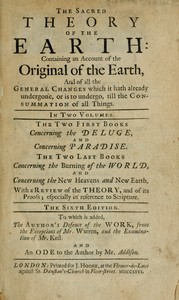
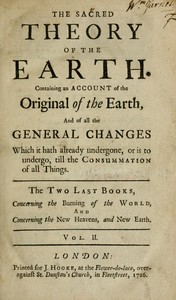
The sacred theory of the Earth, Volume 2 (of 2) — A Reader’s Guide

(1 User reviews)   417
In Category - Metaphysics
Burnet, Thomas, 1635?-1715 Project Gutenberg 2025 Not confirmed
Cosmology -- Early works to 1800; Warren, Erasmus, 1642?-1718. Geologia; Keill, John, 1671-1721. Examination of Dr. Burnet's theory of the earth; Creation -- Early works to 1800; Philosophy, Ancient -- Early works to 1800; Earth (Planet) -- Early works to 1800 Readers of public-domain and historical texts
Project Gutenberg digital edition en

Edition facts

Words 179,780
Reading time 782 min
Text sections 22

Before opening The sacred theory of the Earth, Volume 2 (of 2) — A Reader’s Guide, the edition data offers a quick orientation: 179,780 words, 13 hr 2 min estimated reading time, and 22 detected text sections.

The text analysis averages about 29.7 words per sentence, while the detected sections provide another way to judge how the source is divided.

Project Gutenberg metadata also associates the work with “Cosmology -- Early works to 1800,” connecting these edition facts with the source record’s subject description.

Burnet's second volume argues for a tripartite Earth history—antediluvian, present, and future—based on scriptural exegesis of 2 Peter and Romans 8, defending his theory against scoffers who deny cosmic change.
Share
Editorial Edition Score 4.9/5

Calculated from edition completeness, EPUB availability, text structure and catalogue metadata. Not a user rating.

How this score is calculated
  • Description quality20 pts
  • Title & short description10 pts
  • Source metadata20 pts
  • Text length15 pts
  • Chapters / structure15 pts
  • EPUB file integrity20 pts

Total of 100 points, scaled to a 2.5-5.0 range. Editions with an empty description or a missing EPUB file are not scored.

Edition quality

Read the Text

ving had the Honour to present the first Part of this Theory to your ROYAL UNCLE, I presume to offer the Second to Your Majesty. This Part of the Subject, I hope, will be no less acceptable, for certainly ’tis of no less Importance. They both indeed agree in this, that there is a WORLD made and destroy’d in either Treatise. But we are more concern’d in what is to come, than what is past. And as the former Books represented to us the Rise and Fall of the first World; so these give an Account of the present Frame of Nature labouring under the last Flames, and of the Resurrection of it in the _new Heavens_ and _new Earth_; which, according to the Divine Promises, we are to expect.

Cities that are burnt, are commonly rebuilt more beautiful and regular than they were before. And when this World is demolish’d by the last Fire, He that undertakes to rear it up again, will supply the Defects, if there were any, of the former Fabrick. This Theory supposes the present Earth to be little better than an Heap of Ruins; where yet there is Room enough for Sea and Land, for Islands and Continents, for several Countries and Dominions: But when these are all melted down, and refin’d in the general Fire, they will be cast into a better Mould, and the Form and Qualities of the Earth will become _Paradisaical_.

But, I fear, it may be thought no very proper Address, to shew Your Majesty a World laid in Ashes, where You have so great an Interest Your Self, and such fair Dominions; and then, to recompense the Loss, by giving a Reversion in a future Earth. But if that future Earth be a second _Paradise_, to be enjoyed for a Thousand Years; with Peace, Innocency, and constant Health; An Inheritance there will be, an happy Exchange for the best Crown in this World.

I confess, I could never persuade myself that the Kingdom of Christ, and of his Saints, which the Scripture speaks of so frequently, was designed to be upon this present Earth. But however, upon all Suppositions, they that have done some Good in this Life, will be Sharers in the Happiness of that State. To humble the Oppressors, and rescue the Oppressed, is a Work of Generosity and Charity, that cannot want its Reward; Yet, MADAM, they are the greatest Benefactors to Mankind, that dispose the World to become Virtuous; and by their Example, Influence, and Authority, retrieve that TRUTH and JUSTICE, that have been lost, amongst Men, for many Ages. The School-Divines, tell us, those that act or suffer great Things for the Publick Good, are distinguish’d in Heaven, by a Circle of Gold about their Heads. One would not willingly vouch for that: But one may safely for what the Prophet says, which is far greater: Namely, that They shall shine like Stars in the Firmament, _that turn many to Righteousness_. Which is not to be understood, so much, of the Conversion of single Souls, as of the turning of Nations and People; the turning of the World to Righteousness. They that lead on that great and happy Work, shall be distinguish’d in Glory from the rest of Mankind.

We are sensible, MADAM, from Your Great Example, that Piety and Vertue seated upon a Throne, draw many to Imitation, whom ill Principles, or the Course of the World, might have led another Way. These are the best, as well as easiest Victories, that are gain’d without Contest. And as Princes are the Vicegerents of God upon Earth, so when their Majesty is in Conjunction with Goodness, it hath a double Character of Divinity upon it: And we owe them a double Tribute of Fear and Love. Which, with constant Prayers for Your MAJESTY’s present and future Happiness, shall be always Dutifully paid, by

_Your MAJESTY’s Most Humble and Most Obedient Subject_,

PREFACE TO THE READER.

I have not much to say to the Reader in this Preface to the Third Part of the Theory; seeing it treats upon a Subject own’d by all, and out of Dispute: _The Conflagration of the World_. The Question will be only about the Bounds and Limits of the Conflagration, the Causes and the Manner of it. These I have fixed, according to the truest Measures I could take from Scripture, and from Nature. I differ, I believe, from the common Sentiment in this, that, in following St. _Peter_’s Philosophy, I suppose, that the burning of the Earth, will be a true Liquefaction or Dissolution of it, as to the exterior Region. And that this lays a Foundation for _new Heavens_ and a _new Earth_; which seems to me as plain a Doctrine in Christian Religion, as the Conflagration itself.

I have endeavour’d to propose an intelligible Way, whereby the Earth may be consum’d by Fire. But if any one can propose another, more probable, and more consistent, I will be the first Man that shall give him Thanks for this Discovery. He that loves Truth for its own sake, is willing to receive it from any Hand; as he that truly loves his Country, is glad of a Victory over the Enemy, whether himself, or any other, has the Glory of it. I need not repeat here, what I have already said upon several Occasions, that ’tis the Substance of this Theory, whether in this Part, or in other Parts, that I mainly regard and depend upon: Being willing to suppose, that many single Explications and Particularities may be rectified, upon farther Thoughts, and clearer Light. I know our best Writings, in this Life, are but _Essays_, which we leave to Posterity to review and correct.

As to the Style, I always endeavour to express myself in a plain and perspicuous manner; that the Reader may not lose Time, nor wait too long, to know my Meaning. To give an Attendant quick Dispatch, is a Civility, whether you do his Business or no. I would not willingly give any one the Trouble of reading a Period twice over, to know the Sense of it; lest, when he comes to know it, he should not think it a Recompence for his Pains. Whereas, on the contrary, if you are easy to your Reader, he will certainly make you an Allowance for it, in his Censure.

You must not think it strange however, that the Author sometimes, in meditating upon this Subject, is warm in his Thoughts and Expressions. For to see a World perishing in Flames, Rocks melting, the Earth trembling, and an Host of Angels in the Clouds, one must be very much a Stoick, to be a cold and unconcerned Spectator of all this. And when we are mov’d ourselves, our Words will have a Tincture of those Passions which we feel. Besides, in moral Reflections which are design’d for Use, there must be some Heat, as well as dry Reason, to inspire this cold Clod of Clay, this dull Body of Earth, which we carry about with us; and you must soften and pierce that Crust, before you can come at the Soul. But especially when Things future are to be represented, you cannot use too strong Colours, if you would give them Life, and make them appear present to the Mind. Farewel.

CONTENTS OF THE CHAPTERS.

_The Introduction; with the Contents and Order of this Treatise_ ... 1

_The true State of the Question is propos’d. ’Tis the general Doctrine of the Antients, That the present World, or the present Frame of Nature, is mutable and perishable; to which the sacred Books agree: And natural Reason can alledge nothing against it_ ... 7

_That the World will be destroyed by Fire, is the Doctrine of the Antients; especially of the Stoicks. That the same Doctrine is more antient than the Greeks, and deriv’d from the Barbarick Philosophy; and that probably from Noah, the Father of all traditionary Learning. The same Doctrine expresly authorized by Revelation, and inrolled into the Sacred Canon_ ... 19

_Concerning the time of the Conflagration, and the End of the World. What the Astronomers say upon this Subject, and upon what they ground their Calculations. The true Notion of the Great Year, or of the Platonick Year, stated and explain’d_ ... 35

_Concerning Prophecies that determine the End of the World; Of what Order soever, Prophane or Sacred, Jewish or Christian. That no certain Judgment can be made from any of them, at what Distance we are from the Conflagration_ ... 45

_Concerning the Causes of the Conflagration. The Difficulty of conceiving how this Earth can be set on Fire. With a general Answer to that Difficulty. Two suppos’d Causes of the Conflagration, by the Sun’s drawing nearer to the Earth, or the Earth’s throwing out the central Fire, examin’d and rejected_ ... 60

_The true Bounds of the last Fire, and how far it is Fatal. The natural Causes and Materials of it, cast into three Ranks. First, Such as are exterior and visible upon Earth, where the Volcano’s of this Earth, and their Effects, are consider’d. Secondly, Such Materials as are within the Earth. Thirdly, Such as are in the Air_ ... 73

_Some new Dispositions towards the Conflagration, as to the Matter, Form, and Situation of the Earth. Concerning miraculous Causes, and how far the Ministry of Angels may be engaged in this Work_ ... 92

_How the Sea will be diminish’d and consum’d. How the Rocks and Mountains will be thrown down and melted, and the whole exterior Frame of the Earth dissolv’d into a Deluge of Fire_ ... 104

_Concerning the Beginning and Progress of the Conflagration, what Part of the Earth will first be burnt. The Manner of the future Destruction of Rome, according to the Prophetical Indications. The last State and Consummation of the general Fire_ ... 117

_An Account of these extraordinary Phænomena and Wonders in Nature, that, according to Scripture, will precede the Coming of Christ, and the Conflagration of the World_ ... 130

_An imperfect Description of the Coming of our Saviour, and of the World on Fire_ ... 143

_The Conclusion_ ... 160

_The Introduction; that the World will not be annihilated in the last Fire. That we are to expect, according to Scripture, and the Christian Doctrine, new Heavens and a new Earth, when these are dissolved or burnt up_ ... 184

_The Birth of the new Heavens and the new Earth, from the second Chaos, or the Remains of the old World. The Form, Order, and Qualities of the new Earth, according to Reason and Scripture_ ... 191

_Concerning the Inhabitants of the new Earth. That natural Reason cannot determine this Point. That, according to Scripture, the Sons of the first Resurrection, or the Heirs of the Millennium, are to be the Inhabitants of the new Earth: The Testimony of the Philosophers, and of the Christian Fathers, for the Renovation of the World. The first Proposition laid down_ ... 201

_The Proof of a Millennium, or of a blessed Age to come, from Scripture. A View of the Apocalypse, and of the Prophecies of Daniel, in reference to this Kingdom of Christ, and of his Saints_ ... 213

_A View of other Places of Scripture, concerning the Millennium, or future Kingdom of Christ. In what Sense all the Prophets have born Testimony concerning it_ ... 229

_The Sense and Testimony of the Primitive Church, concerning the Millennium, or future Kingdom of Christ; from the Times of the Apostles, to the Nicene Council. The second Proposition laid down, when, by what Means, and for what Reasons, that Doctrine was afterwards neglected or discountenanc’d_ ... 246

_The true State of the Millennium, according to Characters taken from Scripture. Some Mistakes concerning it rectified_ ... 260

_The third Proposition laid down, concerning the Time and Place of the Millennium. Several Arguments us’d to prove, that it cannot be till after the Conflagration; and that the new Heavens and new Earth, are the true Seat of the blessed Millennium_ ... 269

_The chief Employment of the Millennium DEVOTION and CONTEMPLATION_ ... 287

_Objections against the Millennium answer’d. With some Conjectures concerning the State of Things after the Millennium: And what will be the final Consummation of this World_ ... 305

THE THEORY OF THE EARTH.

BOOK III. Concerning the CONFLAGRATION.

CHAP. I. The INTRODUCTION: _With the Contents and Order of this Work._

Seeing Providence hath planted in all Men a natural Desire and Curiosity of knowing Things to come; and such Things especially, as concern our particular Happiness, or the general Fate of Mankind; This Treatise may, in both respects, hope for a favourable Reception amongst inquisitive Persons; seeing the Design of it is, to give an Account of the greatest Revolutions of Nature that are expected in future Ages: and in the first Place, of the _Conflagration of the World_. In which universal Calamity, when all Nature suffers, every Man’s particular Concern must needs be involved.

We see with what Eagerness Men pry into the Stars, to see if they can read there the Death of a King, or the Fall of an Empire: ’Tis not the fate of any single Prince or Potentate, that we calculate, but of all Mankind: Nor of this or that particular Kingdom or Empire, but of the whole Earth. Our Enquiries must reach to that great Period of Nature, when all Things are to be dissolv’d; both Human Affairs, and the Stage whereon they are acted; when the Heavens and the Earth will pass away, and the Elements melt with fervent Heat. We desire, if possible, to know what will be the Face of that Day, that great and terrible Day! when the Regions of the Air will be nothing but mingled Flame and Smoke, and the habitable Earth turn’d into a Sea of molten Fire.

But we must not leave the World in this Disorder and Confusion, without examining what will be the Issue and Consequences of it. Whether this will be the End of all Things, and Nature, by a sad Fate, lie eternally dissolv’d and desolate in this manner? or, Whether we may hope for a Restoration: _New Heavens_ and a _New Earth_, which the Holy Writings make mention of, more pure and perfect than the former? As if this was but as a _Refiner’s Fire_, to purge out the Dross and coarser Parts, and then cast the Mass again into a new and better Mould. These Things, with God’s Assistance, shall be matter of our present Enquiry: These make the general Subject of this Treatise, and of the remaining Parts of this _Theory_ of the Earth. Which now, you see, begins to be a kind of Prophecy or Prognostication of Things to come, as it hath been hitherto an History of Things past; of such States and Changes as Nature hath already undergone. And if that Account which we have given of the Origin of the Earth, its first and Paradisaical Form, and the Dissolution of it at the universal Deluge, appear fair and reasonable; the second Dissolution by Fire, and the Renovation of it out of a second Chaos, I hope, will be deduc’d from as clear Grounds and Suppositions. And Scripture it self will be a more visible Guide to us in these following Parts of the Theory, than it was in the former. In the mean Time, I take occasion to declare here again, as I have done heretofore, That neither this, nor any other great Revolutions of Nature, are brought to pass, by Causes purely natural, without the Conduct of a particular Providence. And ’tis the sacred Books of Scripture that are the Records of this Providence, both as to Times past, and Times to come; as to all the signal Changes, either of the natural World, or of Mankind, and the different Oeconomies of Religion. In which respects, these Books, tho’ they did not contain a moral Law, would, notwithstanding, be, as the most mystical, so also the most valuable Books in the World.

This Treatise, you see, will consist of Two Parts: The former whereof is to give an Account of the _Conflagration_; and the latter, of the _New Heavens_, and _New Earth_ following upon it; together with the State of Mankind in those new Habitations. As to the Conflagration, we _first_ enquire, What the Antients thought concerning the present Frame of this World: Whether it was to perish or no: Whether to be destroyed, or to stand eternally in this Posture. Then, in what Manner they thought it would be destroy’d: By what Force or Violence: Whether by Fire or other ways. And with these Opinions of the Antients we will compare the Doctrine of the Prophets and Apostles, to discover and confirm the Truth of them. In the _second Place_, We will examine, What Calculations or Conjectures have been made concerning the Time of this great Catastrophe, or of the End of this World: Whether that Period be definable or no; and whether by natural Arguments, or by Prophecies. _Thirdly_, We will consider the Signs of the approaching Conflagration: Whether such as will be in Nature, or in the State of human Affairs; but especially such as are taken notice of, and recorded, in Scripture. _Fourthly_, Which is the principal Point, and yet that wherein the Antients have been most silent, _What Causes_ there are in Nature, what Preparations, for this Conflagration: Where are the Seeds of this universal Fire, or Fuel sufficient for the Nourishing of it? _Lastly_, In what Order, and by what Degrees, the Conflagration will proceed: In what Manner the Frame of the Earth will be dissolv’d; and what will be the dreadful Countenance of a _burning World_.

These Heads are set down more fully in the Arguments of each Chapter; and seem to be sufficient for the Explication of this whole Matter: Taking in some additional Discourses, which, in pursuing these Heads, enter of their own accord, and make the Work more even and intire. In the Second Part, we restore the World that we had destroy’d: Build New Heavens and a New Earth, _wherein Righteousness shall dwell_. Establish that new Order of Things, which is so often celebrated by the Prophets: A Kingdom of Peace and of Justice, where the Enemy of Mankind shall be bound, and the Prince of Peace shall rule. A Paradise without a Serpent, and a Tree of Knowledge, not to wound, but to heal the Nations: Where will be neither _Curse_, nor _Pain_, nor _Death_, nor _Disease_: Where all Things are new, all Things are more perfect, both the World it self, and its Inhabitants: Where the First-born from the Dead, have the First-fruits of Glory.

We dote upon this present World, and the Enjoyments of it: And ’tis not without Pain, and Fear, and Reluctancy, that we are torn from them; as if our Hopes lay all within the Compass of this Life. Yet, I know not by what good Fate, my Thoughts have been always fix’d upon Things to come, more than upon Things present. These I know, by certain Experience, to be but Trifles; and if there be nothing more considerable to come, the whole Being of Man is no better than a Trifle. But there is Room enough before us in that we call _Eternity_, for great and noble Scenes; and the Mind of Man feels itself lessen’d and straiten’d in this low and narrow State; wishes and waits to see something greater. And if it could discern another World a coming, on this side Eternal Life: a beginning Glory, the best that Earth can bear, it would be a kind of Immortality to enjoy that Prospect before-hand. To see, when this Theatre is dissolv’d, where we shall act next, and what Parts; what Saints and Heroes, if I may so say, will appear upon that Stage; and with what Lustre and Excellency: How easy would it be, under a View of these Futurities, to despise the little Pomps and Honours, and the Momentary Pleasures of a mortal Life? But I proceed to our Subject.

CHAP. II _The true State of the Question is propos’d._

_’Tis the general Doctrine of the Antients, that the present World, or the present Frame of Nature, is mutable and perishable: To which the Sacred Books agree; and natural Reason can alledge nothing against it._

Burnet opens his second volume with a dedication to Queen Caroline, framing the work as a continuation of his earlier account of the first world's rise and fall. He describes the present Earth as 'little better than an Heap of Ruins' awaiting refinement by fire into a paradisiacal state. The excerpts reveal a methodical exegetical argument: Burnet anchors his theory in 2 Peter 3, insisting on a 'Triplicity of the Heavens and the Earth'—the antediluvian, the current, and the future new creation. He directly counters philosophical scoffers who argue that no change has occurred since the beginning, asserting that the apostle's argument depends on a real diversity between the present and pre-Flood worlds.

Scriptural Triplicity as Structural Principle

The excerpts show Burnet building his theory on a threefold division of world history derived from 2 Peter 3 and Romans 8. He writes that 'there was one sort of Heavens and Earth before the Flood, and another Sort now,' and that after the conflagration there will be 'new Heavens and a new Earth.' This triplicity is not merely a thematic flourish but the logical backbone of his argument: he claims that removing the diversity between the present and antediluvian worlds 'takes away all the Force of his Answer' to the scoffers. Burnet also cites Romans 8:20-21 to identify three creations: one redeemed from vanity (future), one subject to vanity (present), and one subjected in hope (paradisiacal). The structure is thus explicitly tied to a close reading of specific biblical passages, not to natural philosophy alone.

The Rhetoric of Ruins and Restoration

Burnet's language in the dedication and the exegetical sections reveals a consistent rhetorical strategy: he portrays the current Earth as a ruined state that will be restored to a better form. The present world is 'little better than an Heap of Ruins,' yet it contains 'Room enough for Sea and Land, for Islands and Continents.' The future Earth, after being 'melted down, and refin’d in the general Fire,' will be 'cast into a better Mould' and become 'Paradisaical.' This imagery of destruction and renewal is not merely decorative; it serves to align his theory with the biblical promise of a new creation. Burnet also uses the analogy of a rebuilt city: 'Cities that are burnt, are commonly rebuilt more beautiful and regular than they were before.' The rhetorical pattern reinforces his theological argument that the present world is provisional and destined for transformation.

Engaging with Opponents Through Exegesis

Burnet explicitly positions his theory against philosophical opponents who 'scoff’d at the future Destruction of the World' and argued that since no change had occurred from the beginning, none should be expected. He characterizes these scoffers as 'Men, it seems, that pretended to Philosophy and Argument.' His response is to insist on a literal reading of 2 Peter 3, arguing that the apostle's answer depends on a real change having already occurred—the destruction of the first world by water. Burnet warns that those who reject this diversity are doing so because it 'carry them out of their usual Road, and point to Conclusions which they did not fancy.' The excerpts thus show Burnet engaging in a polemical exegesis, using scriptural interpretation to defend his theory against naturalistic objections. He does not, however, provide a full account of his opponents' arguments in these passages.

Readers should note that Burnet's method is primarily exegetical rather than empirical. The excerpts show him building a case from specific New Testament texts, not from geological observation. The catalog subjects list 'Cosmology -- Early works to 1800' and 'Creation -- Early works to 1800,' but the actual content is a sustained argument about scriptural interpretation and its implications for Earth's past and future. Those expecting a natural-philosophical treatise may find Burnet's reliance on biblical authority and his polemical tone surprising. The work is best approached as a theological cosmology, where the authority of scripture, not empirical evidence, drives the argument.

There’s something oddly comforting in Burnet’s insistence that the world has already changed once and will again—that our present quiet is only a pause. It reminds me of leafing through A Treatise of Human Nature Being an Attempt to Introduce the Experimental Method Into Moral Subjects; and Dialogues Concerning Natural Religion — Inside the Classic, where Hume sits with the same unease about what we can truly know. Different centuries, same tremor beneath the floorboards. I still feel it sometimes, late at night.

Matthew Baker
1 month ago

5
5 out of 5 (1 User reviews )

Add a Review

Your Rating *
There are no comments for this eBook.

Reader reflection

Take a moment to reflect on this book

Create a short personal record of your experience with this book.

Your progress 0 / 10
1

Have you finished this book?

2

Was reading this book enjoyable?

3

Would you encourage someone else to read it?

4

Did the language feel accessible?

Related eBooks