Six metaphysical meditations — Edition Insights
Edition facts
The source record for Six metaphysical meditations — Edition Insights measures this digital text at 37,137 words, 2 hr 42 min estimated reading time, and 29 detected text sections.
The text analysis averages about 38.6 words per sentence, while the detected sections provide another way to judge how the source is divided.
Project Gutenberg metadata also associates the work with “Knowledge, Theory of,” connecting these edition facts with the source record’s subject description.
Calculated from edition completeness, EPUB availability, text structure and catalogue metadata. Not a user rating.
How this score is calculated
- Description quality20 pts
- Title & short description10 pts
- Source metadata20 pts
- Text length15 pts
- Chapters / structure15 pts
- EPUB file integrity20 pts
Total of 100 points, scaled to a 2.5-5.0 range. Editions with an empty description or a missing EPUB file are not scored.
Read the Text
aked, with it’s coverings pull’d off, then I cannot but really perceive it with my mind, though yet perhaps my judgment may erre.
But what shall I now say as to my _mind_, or my _self_? (for as yet I admit nothing as belonging to me but a _mind_.) Why (shall I say?) should not I, who seem to perceive this Wax so _distinctly_, know my _self_ not only more _truly_ and more _certainly_, but more _distinctly_ and _evidently_? For if I judge that _this Wax exists_, because I _see_ this Wax; surely it will be much more _evident_, that I _my self exist_, because _I see this Wax_; for it may be that this that I see is not really Wax, also it may be that I have no eyes wherewith to see any thing; but it cannot be, when I _see_, or (which is the same thing) when _I think that I see_, that I who _think_ should not _exist_. The same thing will follow if I _judge that this Wax exists_, because I _touch_, or _imagine_ it, &c. And what has been said of Wax, may be apply’d to all other outward things.
Moreover, if the _notion_ of Wax seems more _distinct_ after it is made known to me, not only by my _sight_ or _touch_, but by more and other causes; How much the more _distinctly_ must I confess my _self known_ unto my _self_, seeing that all sort of reasoning which furthers me in the _perception_ of _Wax_, or any other _Body_, does also encrease the proofs of the _nature_ of my _Mind_. But there are so many more things in the very _Mind_ it self, by which the _notion_ of it may be made more _distinct_, that those things which drawn from _Body_ conduce to its knowledge are scarce to be _mention’d_.
And now behold of my own accord am I come to the place I would be in; for seeing I have now discover’d that _Bodies themselves_ are not _properly perceived_ by our _senses_ or _imagination_, but only by our _understanding_, and are not therefore _perceived_, because they are _felt_ or _seen_, but because they are _understood_; it plainly appears to me, that nothing can possibly be _perceived_ by _me easier_, or more _evidently_, than my _Mind_.
But because I cannot so soon shake off the Acquaintance of my former Opinion, I am willing to stop here, that this my new knowledge may be better fixt in my memory the longer I meditate thereon.
_Of GOD, and that there is a God._
Now will I shut my eyes, I will stop my ears, and withdraw all my senses, I will blot out the Images of _corporeal_ things clearly from my mind, or (because that can scarce be accomplish’d) I will give no heed to them, as being _vain_ and _false_, and by discoursing with my self, and prying more rightly into my own Nature, will endeavour to make my self by degrees more known and familiar to my self.
I am a _Thinking Thing_, that is to say, _doubting_, _affirming_, _denying_, _understanding_ few things, _ignorant_ of many things, _willing_, _nilling_, _imagining_ also, and _sensitive_. For (as before I have noted) though perhaps whatever I _imagine_, or am sensible of, as without me, _Is not_; yet that _manner_ of _thinking_ which I call _sense_ and _imagination_ (as they are only certain _Modes_ of _Thinking_) I am certain are in Me. So that in these few Words I have mention’d whatever I _know_, or at least Whatever as yet I _perceive_ my self to _know_.
Now will I look about me more carefully to see Whether there Be not some other Thing in Me, of Which I have not yet taken Notice. I am sure That I am a _Thinking Thing_, and therefore Do not I know what is Required to make _certain_ of any Thing? I Answer, that in this My _first knowledge_ ’tis Nothing but a _clear_, and _distinct perception_ of What I affirm, Which would not be sufficient to make me _certain_ of the _Truth_ of a Thing, if it were _Possible_ that any thing that I so _clearly_ and _distinctly_ Perceive should be _false_. Wherefore I may lay this Down as a _Principle_. _Whatever I Clearly and Distinctly perceive is certainly True._
But I have formerly Admitted of many Things as very _Certain_ and _manifest_, Which I afterwards found to be _doubtful_. Therefore What sort of Things were they? _Viz._ Heaven, Earth, Stars, and all other things which I perceived by my _Senses_. But What did I Perceive of These _Clearly? Viz._ That I had the _Ideas_ or _Thoughts_ of these things in my mind, and at Present I cannot deny that I have these _Ideas_ in Me. But there was some other thing Which I affirm’d, and Which (by Reason of the common Way of Belief) I thought that I _Clearly_ Perceived; Which nevertheless, I did not really Perceive; And that was, that there were Certain Things _Without Me_ from whence these _Ideas Proceeded_, and to which they were exactly like. And this it was, Wherein I was either _Deceived_, or if by Chance I Judged _truly_, yet it Proceeded not from the strength of my _Perception_.
But When I was exercised about any single and easie Proposition in Arithmetick or Geometry, as that two and three added make five, Did not I Perceive them _Clearly_ enough to make me affirm them True? Truly concerning these I had no other Reason afterwards to _Doubt_, but That I thought Perhaps there may be a _God_ who might have so created me, that I should be _Deceived_ even in those things which seem’d most _Clear_ to me. And as often as this Pre-conceived opinion of _Gods great Power_ comes into my Mind, I cannot but Confess that he may easily cause me to Err even in those things which I Think I perceive most _Evidently_ with my Mind; yet as often as I Consider the Things themselves, which I Judge my self to perceive so _Clearly_, I am so fully Perswaded by them, that I easily Break out into these Expressions, Let Who can Deceive Me, yet he shall never Cause me _Not to Be_ whilst _I think that I Am_, or that it shall ever be True, _that I never was_, Whilst at Present ’tis True _that I am_, or Perhaps, that Two and Three added make More or Less then Five; for in These things I Percieve a Manifest Repugnancy; And truely seeing I have no reason to Think any _God_ a _Deceiver_, Nor as yet fully know Whether there Be _any God_, or _Not_, ’Tis but a slight and (as I may say) Metaphysical Reason of Doubt, which depends only on that opinion of which I am not yet Perswaded.
Wherefore That this Hindrance may be taken away, When I have time I ought to Enquire, Whether there _Be a God_, And if there be One, Whether he can be a _Deceiver_, For whilst I am _Ignorant_ of this, I cannot possibly be fully _Certain_ of any Other thing.
But now Method seems to Require Me to Rank all My Thoughts under certain Heads, and to search in Which of them _Truth_ or _Falshood_ properly Consists. Some of them are (as it were) the _Images_ of Things, and to these alone the Name of an _Idea_ properly belongs, as When I think upon a Man, A Chimera or Monster, Heaven, an Angel, or _God_. But there are others of them, that have _superadded Forms_ to them, as when I Will, when I Fear, when I Affirm, when I Deny. I know I have alwayes (when ever I think) some certain Thing as the _subject_ or _object_ of my Thought, but in this last sort of thoughts there is something _more_ which I Think upon then Barely the likeness of the Thing. And of these Thoughts some are called _Wills_ and _Affections_, and Others of them _Judgments_.
Now as touching _Ideas_, if they be Consider’d alone as they are in themselves, without _Respect_ to any other Things, they cannot Properly be _false_; for Whether I _Imagine_ a Goat or a Chimera, ’tis as _Certain_ that I _Imagine_ one as t’other. Also in the _Will_ and _Affections_ I need not Fear any _Falshood_, For tho I should _Wish_ for _evil Things_, or Things that are Not, it is not therefore _Not true_ that I Wish for them.
Wherefore there onely Remains my _Judgments_ of Things, in which I must take Care that I be not _deceived_. Now the Chief and most usual _Error_ that I discover in them is, That I _Judge_ Those _Ideas_ that are _within_ me to be _Conformable_ and like to certain things that are _without_ Me; for truely if I Consider those Ideas as certain _Modes_ of my _Thought_, without Respect to any other Thing, they will scarce afford me an Occasion of _Erring_.
Of these _Ideas_ some are _Innate_, some _Adventitious_, and some Others seem to Me as Created by my self; For that I understand what _A Thing_ Is, What is _Truth_, What a _Thought_, seems to Proceed meerly from my own _Nature_. But that I now _hear_ a Noise, _see_ the Sun, or _feel_ heat, _I_ have alwayes _Judged_ to Proceed from Things _External_. But Lastly, Mermaids, Griffins, and such like Monsters, are _made meerly_ by _My self_. And yet _I_ may well think all of them either _Adventitious_, or all of them _Innate_, or all of them _made by my self_, for I have not as yet discover’d their true _Original_.
But _I_ ought cheifly to search after those of them which _I_ count _Adventitious_, and which I consider as coming from _outward objects_, that I may know what reason I have to think them _like_ the things themselves, which they _represent_. Viz. _Nature so teaches Me_; and also I know that they _depend_ not on my _Will_, and therefore _not on me_; for they are often present with me against my inclinations, or (as they say) in spite of my teeth, as now whether _I will_ or _no_ I feel heat, and therefore I think that the _sense_ or _Idea_ of heat is propagated to me by a _thing_ really _distinct_ from _my self_, and that is by the _heat_ of the _Fire_ at which I sit; And nothing is more obvious then for me to judge that That thing should transmit its own _Likeness_ into me, rather then that any other thing should be transmitted by it. Which sort of arguments whether firme enough or not I shall now Trie.
When I here say, that _nature so teaches me_, I understand only, that I am as it were _willingly forced_ to beleive it, and not that ’tis _discover’d_ to me to be _true_ by any _natural light_; for these two differ very much. For whatever is discover’d to me by the _Light_ of _nature_ (as that it necessarily Follows _that I am_, because _I think_) cannot possibly be _doubted_; Because I am endowed with no other _Faculty_, in which I may put so great confidence, as I can in the _Light_ of _nature_; or _which_ can possibly tell me, that those things are _false_, which _natural light_ teaches me to be _true_; and as to my _natural Inclinations_, I have heretofore often judged my self led by them to the election of the _worst part_, when I was in the choosing _one_ of two Goods; and therefore I see no reason why I should ever _trust_ them in any other thing.
And then, tho these _Ideas depend not_ on my _will_, it does not therefore follow that they _necessarily proceed_ from _things external_. For as, Altho those _Inclinations_ (which I but now mention’d) are in me, yet they seem _distinct_ and _different_ from my _will_; so perhaps there may be in me some other _faculty_ (to me _unknown_) which may prove the _Efficient cause_ of these _Ideas_, as hitherto I have observed them to be formed in me whilst I _dream_, without the help of any _External Object_.
And last of all, tho they should _proceed_ from things which are _different_ from me, it does not therefore follow that they must be _like_ those things. For often times I have found the _thing_ and the _Idea differing_ much. As for example, I find in my self two divers _Ideas_ of the Sun, _one_ as _received_ by my _senses_ (and which cheifly I reckon among those I call adventitious) by which it appears to me very _smal_, * _another_ as taken from the arguments of Astronomers (that is to say, _consequentially collected_, or some other ways made by me from certain _natural notions_) by which ’tis rendred something bigger then the Globe of the Earth. Certainly both of these cannot be _like_ that sun which is _without me_, and my reason perswades me, that that _Idea_ is most _unlike_ the Sun, which seems to _proceed Immediately_ from it self.
All which things sufficiently prove, that I have hitherto (not from a _true judgement_, but from a _blind impulse_) beleived that there are certain things _different_ from my self, and which have sent their _Ideas_ or _Images_ into me by the Organs of my _senses_, or some other way.
But I have yet an other Way of inquiring, whether any of those Things (whose _Ideas_ I have _within_ Me) are Really Existent _without_ Me; And that is Thus: As those _Ideas_ are only _Modes_ of _Thinking_, I acknowledge no _Inequality_ between them, and they all proceed from me in the _same Manner_. But as _one_ Represents _one thing_, an _other_, an _other Thing_, ’tis Evident there is a _Great difference_ between them. * For without doubt, Those of them which Represent _Substances_ are something _More_, or (as I may say) have _More_ of _Objective Reallity_ in them, then those that Represent only _Modes_ or _Accidents_; and again, _That_ by Which I understand a _Mighty God_, _Eternal_, _Infinite_, _Omniscient_, _Omnipotent Creatour_ of all things besides himself, has certainly in it _more Objective Reallity_, then Those _Ideas_ by which _Finite Substances_ are Exhibited.
But Now, it is evident by the _Light_ of _Nature_ that there must be _as much_ at least in the _Total efficient Cause_, as there is in the _Effect_ of _that Cause_; For from Whence can the _effect_ have its _Reallity_, but from the _Cause_? and how can the _Cause_ give it that _Reallity_, unless _it self have_ it?
And from hence it follows, that neither a _Thing_ can be made out of _Nothing_, Neither a Thing which is _more Perfect_ (that is, Which has in it self _more Reallity_) _proceed_ from That Which is _Less Perfect_.
And this is _Clearly_ True, not only in those _Effects_ whose _Actual_ or _Formal Reallity_ is Consider’d, But in Those _Ideas_ also, Whose _Objective Reallity_ is only Respected; That is to say, for Example of Illustration, it is not only impossible that a stone, Which _was not_, should now begin _to Be_, unless it were produced by _something_, in Which, Whatever goes to the Making a Stone, is either _Formally_ or _Virtually_; neither can _heat_ be Produced in any Thing, which before was _not hot_, but by a Thing which is at least of as equal a _degree_ of _Perfection_ as _heat_ is; But also ’tis Impossible that I should have an _Idea_ of Heat, or of a _Stone_, unless it were put into me by some _Cause_, in which there is at Least as much _Reallity_, as I Conceive there is in heat or a Stone. For tho that _Cause_ transfers none of its own _Actual_ or _Formal Reality_ into my _Idea_, I must not from thence conclude that ’tis _less real_; but I may think that the _nature_ of the _Idea_ it self is such, that of it self it requires no other _formal reality_, but what it has from my _thought_, of which ’tis a _mode_. But that this Idea has _this_ or _that objective reallity_, rather then any _other_, proceeds clearly from some _cause_, in which there ought to be at least as much _formal reallity_, as there is of _objective reallity_ in the _Idea_ it self. For if we suppose any thing in the _Idea_, which was not in its _cause_, it must of necessity have this from _nothing_; but (tho it be a most _Imperfect manner_ of _existing_, by which the thing is _objectively_ in the _Intellect_ by an _Idea_, yet) it is not _altogether nothing_, and therefore cannot proceed from _nothing_.
Neither ought I to doubt, seeing the _reallity_ which I perceive in my _Ideas_ is only an _objective reallity_, that therefore it must of necessity follow, that the same _reallity_ should be in the _causes_ of these _Ideas formally_. But I may conclude, that ’tis sufficient that this _reallity_ be in the very _causes_ only _objectively_. For as that _objective manner_ of _being_ appertains to the very _nature_ of an _Idea_, so that _formal manner_ of _being_ appertains to the very _nature_ of a _cause_ of _Ideas_, at least to the _first_ and _chiefest causes_ of them; For tho perhaps one _Idea_ may receive its birth from an other, yet we cannot proceed in _Infinitum_, but at last we must arrive at some _first Idea_, whose _cause_ is (as it were) an _Original copy_, in which all the _objective reallity_ of the _Idea_ is _formally contain’d_. So that I plainly discover by the _light_ of _nature_, that the _Ideas_, which are in me, are (as it were) _Pictures_, which may easily _come short_ of the _perfection_ of those things from whence they are taken, but cannot _contain_ any thing _greater_ or _more perfect_ then them: And the _longer_ and _more diligently_ I pry into these things, so much the more _clearly_ and _distinctly_ do I discover them to be _true_.
But what shall I conclude from hence? Thus, that if the _objective reallity_ of any of my _Ideas_ be _such_, that it cannot be in me either _formally_ or _eminently_, and that therefore I cannot be the _cause_ of _that Idea_, from hence it necessarily Follows, that _I alone_ do not only _exist_, but that some other thing, which is _cause_ of that _Idea_, does _exist also_.
But if I can find no _such Idea_ in me, I have no argument to perswade me of the _existence_ of any thing besides my self for I have diligently enquired, and hitherto I could discover no other _perswasive_.
Some of these _Ideas_ there are (besides that which represents _my self_ to _my self_, of which in this place I cannot doubt) which represent to me, one of them a _God_, others of them _Corporeal_ and _Inanimate_ things, some of them _Angels_, others _Animals_, and lastly some of them which exhibite to me _men like my self_.
As touching those that represent _Men_ or _Angels_ or _Animals_, I easily understand that they may be _made up_ of those _Ideas_ which I have of _my self_, of _Corporeal_ things, and of _God_, tho there were neither _man_ (but my self) nor _Angel_, nor _Animal_ in being.
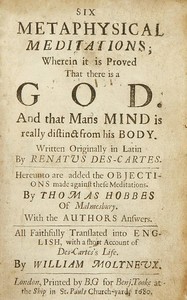
William Molyneux’s 1680 translation of Descartes’s Six Metaphysical Meditations presents itself not as a literary version but as a “Physico-Mathematical Argumentation” requiring “great strictness of Expression.” In his preface, Molyneux distinguishes this work from histories, plays, or romances, where a translator might take liberties with idiom and manner. Here, he argues, such freedom would endanger the sense and force of the arguments—comparing the task to translating Euclid. The volume also includes the objections of Thomas Hobbes and Descartes’s answers, making it a record of philosophical exchange as well as a demonstration of method.
The Translator’s Defense of Literal Rendering
Molyneux’s preface directly addresses the challenge of translating metaphysical reasoning. He observes that “meer Versions do alwayes carry with them this Property, that if not well done they may much disgrace, but if well, not much commend the doers.” Yet he insists that philosophical and mathematical texts demand a different standard: “Politeness of language might as well be expected in a Translation of Euclide as in this.” This claim is not merely defensive; it shapes the reader’s expectation of the prose that follows. The translation aims for precision over elegance, and Molyneux asks the reader to judge the work accordingly. The preface thus functions as a methodological statement, aligning the translator’s task with the philosopher’s commitment to clear and distinct ideas.
Existence Inseparable from Essence
In the meditation excerpt, Descartes argues that existence is not a contingent attribute of God but an inseparable property: “Existence is Inseparable from God, and therefore that he Really Exists.” He distinguishes this from mere thought imposing necessity, insisting that “the necessity of the thing it self … Determines me to think thus.” The argument is supported by an analogy with geometry: just as thinking of a triangle compels one to attribute to it certain properties (e.g., its angles sum to two right angles), so thinking of a perfect being compels one to attribute existence. Descartes also notes that he cannot imagine two or more Gods, and that God must have existed from eternity and will exist to eternity—claims he presents as self-evident once prejudice and sensory distractions are set aside.
Clear and Distinct Perception as the Criterion
Throughout the excerpt, Descartes returns to the principle that he is “fully perswaded of the Truth of those things only, which appear to me clearly and distinctly.” He acknowledges that some truths are obvious to everyone, while others require careful inquiry, but once perceived, both are equally certain. He illustrates this with a geometric example: the fact that in a right-angled triangle the square of the base equals the sum of the squares of the sides is no less certain than the more obvious fact that the base subtends the largest angle. This epistemic standard is applied to the idea of God: “unless I am overrun with Prejudice, or have my thoughts begirt on all sides with sensible Objects, I should acknowledge nothing before or easier then him.” The text thus ties the ontological argument to a broader method of clear and distinct perception.
Readers approaching this edition should attend to Molyneux’s prefatory remarks, which frame the translation as a deliberate choice of fidelity over fluency. The presence of Hobbes’s objections offers a contrasting voice, though only Descartes’s replies are included here. The meditations themselves proceed by a chain of reasoning that rewards careful reading; the geometric analogies are not decorative but structural. Those interested in the history of philosophical translation or the early reception of Cartesian thought will find this volume a valuable primary source.
That rain fell steady while Descartes and Hobbes traded objections across Molyneux’s spare pages, each reply demanding stricter language. By dusk, certainty felt less geometric, more like chance. I drifted to Venn’s old essay, The Logic of Chance, 3rd edition An Essay on the Foundations and Province of the Theory of Probability, With Especial Reference to Its Logical Bearings and Its — Key Ideas to Explore, and the rain kept falling, softer now.
Oliver Lewis
1 month agoDylan Williams
3 weeks agoCamila Green
1 month agoAva Martin
1 week agoRecord your reading impressions
A brief reflection can help important ideas stay with you longer.
Dylan Taylor
2 weeks ago