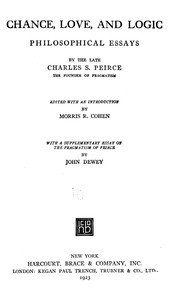
Chance, Love, and Logic: Philosophical Essays — Themes and Context
Edition facts
Chance, Love, and Logic: Philosophical Essays — Themes and Context can be approached with a clearer sense of reading commitment from its source measurements: 99,398 words, 7 hr 13 min estimated reading time, and 18 detected text sections.
The text analysis averages about 24.4 words per sentence, while the detected sections provide another way to judge how the source is divided.
Project Gutenberg metadata also associates the work with “Pragmatism,” connecting these edition facts with the source record’s subject description.
Calculated from edition completeness, EPUB availability, text structure and catalogue metadata. Not a user rating.
How this score is calculated
- Description quality20 pts
- Title & short description10 pts
- Source metadata20 pts
- Text length15 pts
- Chapters / structure15 pts
- EPUB file integrity20 pts
Total of 100 points, scaled to a 2.5-5.0 range. Editions with an empty description or a missing EPUB file are not scored.
Read the Text
rest in or aptitude for formal logical or mathematical considerations.
Despite these limitations, however, Peirce stands out as one of the great founders of modern scientific logic; and in the realm of general philosophy the development of some of his pregnant ideas has led to the pragmatism and radical empiricism of James, as well as to the mathematical idealism of Royce, and to the anti-nominalism which characterizes the philosophic movement known as Neo-Realism. At any rate, the work of James, Royce, and Russell, as well as that of logicians like Schroeder, brings us of the present generation into a better position to appreciate the significance of Peirce’s work, than were his contemporaries.
Peirce was by antecedents, training, and occupation a scientist. He was a son of Benjamin Peirce, the great Harvard mathematician, and his early environment, together with his training in the Lawrence Scientific School, justified his favorite claim that he was brought up in a laboratory. He made important contributions not only in mathematical logic but also in photometric astronomy, geodesy, and psychophysics, as well as in philology. For many years Peirce worked on the problems of geodesy, and his contribution to the subject, his researches on the pendulum, was at once recognized by European investigators in this field. The International Geodetic Congress, to which he was the first American representative, gave unusual attention to his paper, and men like Cellerier and Plantamour acknowledged their obligations to him.[1]
This and other scientific work involving fine measurement, with the correlative investigations into the theory of probable error, seem to have been a decisive influence in the development of Peirce’s philosophy of chance. Philosophers inexperienced in actual scientific measurement may naïvely accept as absolute truth such statements as “every particle of matter attracts every other particle directly as the product of their masses and inversely as the square of the distance,” or “when hydrogen and oxygen combine to form water the ratio of their weights is 1 : 8.” But to those who are actually engaged in measuring natural phenomena with instruments of precision, nature shows no such absolute constancy or simplicity. As every laboratory worker knows, no two observers, and no one observer in successive experiments, get absolutely identical results. To the men of the heroic period of science this was no difficulty. They held unquestioningly the Platonic faith that nature was created on simple geometric lines, and all the minute variations were attributable to the fault of the observer or the crudity of his instruments. This heroic faith was, and still is, a most powerful stimulus to scientific research and a protection against the incursions of supernaturalism. But few would defend it to-day in its explicit form, and there is little empirical evidence to show that while the observer and his instruments are always varying, the objects which he measures never deviate in the slightest from the simple law. Doubtless, as one becomes more expert in the manipulation of physical instruments, there is a noticeable diminution of the range of the personal “error,” but no amount of skill and no refinement of our instruments have ever succeeded in eliminating irregular, though small, variations. “Try to verify any law of nature and you will find that the more precise your observations, the more certain they will be to show irregular departure from the law.”[2] There is certainly nothing in our empirical information to prevent us from saying that all the so-called constants of nature are merely instances of variation between limits so near each other that their differences may be neglected for certain purposes. Moreover, the approach to constancy is observed only in mass phenomena, when we are dealing with very large numbers of particles; but social statistics also approach constant ratios when the numbers are very large. Hence, without denying discrepancies due solely to errors of observation, Peirce contends that “we must suppose far more minute discrepancies to exist owing to the imperfect cogency of the law itself, to a certain swerving of the facts from any definite formula.”[3]
It is usual to associate disbelief in absolute laws of nature with sentimental claims for freedom or theological miracles. It is, therefore, well to insist that Peirce’s attack is entirely in the interests of exact logic and a rational account of the physical universe. As a rigorous logician familiar with the actual procedures by which our knowledge of the various laws of nature is obtained, he could not admit that experience could prove their claim to absoluteness. All the physical laws actually known, like Boyle’s law or the law of gravitation, involve excessive simplification of the phenomenal course of events, and thus a large element of empirical inaccuracy. But a more positive objection against the traditional assumption of absolute or invariable laws of nature, is the fact that such assumption makes the regularities of the universe ultimate, and thus cuts us off from the possibility of ever explaining them or how there comes to be as much regularity in the universe as there is. But in ordinary affairs, the occurrence of any regularity is the very thing to be explained. Moreover, modern statistical mechanics and thermodynamics (theory of gases, entropy, etc.) suggest that the regularity in the universe is a matter of gradual growth; that the whole of physical nature is a growth from a chaos of diversity to a maximum of uniformity or entropy. A leading physicist of the 19th Century, Boltzmann, has suggested that the process of the whole physical universe is like that of a continuous shaking up of a hap-hazard or chance mixture of things, which thus gradually results in a progressively more uniform distribution. Since Duns Scotus, students of logic have known that every real entity has its individual character (its _haecceitas_ or _thisness_) which cannot be explained or deduced from that which is uniform. Every explanation, for example, of the moon’s path must take particular existences for granted. Such original or underived individuality and diversity is precisely what Peirce means by chance; and from this point of view chance is prior to law.
All that is necessary to visualize this is to suppose that there is an infinitesimal tendency in things to acquire habits, a tendency which is itself an accidental variation grown habitual. We shall then be on the road to explain the evolution and existence of the limited uniformities actually prevailing in the physical world.
A good deal of the foregoing may sound somewhat mythologic. But even if it were so it would have the merit of offering a rational alternative to the mechanical mythology according to which all the atoms in the universe are to-day precisely in the same condition in which they were on the day of creation, a mythology which is forced to regard all the empirical facts of spontaneity and novelty as illusory, or devoid of substantial truth.
The doctrine of the primacy of chance naturally suggests the primacy of mind. Just as law is a chance habit so is matter inert mind. The principal law of mind is that ideas literally spread themselves continuously and become more and more general or inclusive, so that people who form communities of any sort develop general ideas in common. When this continuous reaching-out of feeling becomes nurturing love, such, e.g., which parents have for their offspring or thinkers for their ideas, we have creative evolution.
James and Royce have called attention to the similarity between Peirce’s doctrine of tychistic-agapism (chance and love) and the creative evolution of Bergson. But while both philosophies aim to restore life and growth in their account of the nature of things, Peirce’s approach seems to me to have marked advantages, owing to its being in closer touch with modern physics. Bergson’s procedure is largely based on the contention that mechanics cannot explain certain empirical facts, such as the supposed identity of the vertebrate eye and the eye of the scallop. But the fact here is merely one of a certain resemblance of pattern, which may well be explained by the mechanical principles of convergent evolution. Peirce’s account involves no rejection of the possibility of mechanical explanations. Indeed, by carrying chance into the laws of mechanics he is enabled to elaborate a positive and highly suggestive theory of protoplasm to explain the facts of plasticity and habit.[4] Instead of postulating with Spencer and Bergson a continuous growth of diversity, Peirce allows for growth of habits both in diversity and in uniformity. The Spencerian mechanical philosophy reduces all diversity to mere spatial differences. There can be no substantial novelty; only new forms or combinations can arise in time. The creative evolution of Bergson though intended to support the claims of spontaneity is still like the Spencerian in assuming all evolution as proceeding from the simple to the complex. Peirce allows for diversity and specificity as part of the original character or endowment of things, which in the course of time may increase in some respects and diminish in others. Mind acquires the habit both of taking on, and also of laying aside, habits. Evolution may thus lead to homogeneity or uniformity as well as to greater heterogeneity.
Not only has Peirce a greater regard than even Bergson for the actual diversity and spontaneity of things, but he is in a much better position than any other modern philosopher to explain the order and coherence of the world. This he effects by uniting the medieval regard for the reality of universals with the modern scientific use of the concept of continuity. The unfortunate war between the pioneers of modern science and the adherents of the scholastic doctrine of substantial forms, has been one of the great misfortunes of human thought, in that it made absolute atomism and nominalism the professed _creed_ of physical science. Now, extreme nominalism, the insistence on the reality of the particular, leaves no room for the genuine reality of law. It leaves, as Hume had the courage to admit, nothing whereby the present can determine the future; so that anything is as likely to happen as not. From such a chaotic world, the _procedure_ of modern natural and mathematical science has saved us by the persistent use of the principle of continuity; and no one has indicated this more clearly than Peirce who was uniquely qualified to do so by being a close student both of Duns Scotus and of modern scientific methods.
It is instructive in this respect to contrast the views of Peirce and James. James, who so generously indicated his indebtedness to Peirce for his pragmatism, was also largely indebted to Peirce for his doctrine of radical empiricism.[5] The latter doctrine seeks to rescue the continuity and fluidity of experience from the traditional British empiricism or nominalism, which had resolved everything into a number of mutually exclusive mental states. It is curious, however, that while in his psychology James made extensive use of the principle of continuity, he could not free himself from British nominalism in his philosophy—witness the extreme individualism of his social philosophy or the equally extreme anthropomorphism of his religion. Certain of Peirce’s suggestions as to the use of continuity in social philosophy have been developed by Royce in his theory of social consciousness and the nature of the community;[6] but much remains to be worked out and we can but repeat Peirce’s own hope: “May some future student go over this ground again and have the leisure to give his results to the world.”
It is well to note, however, that after writing the papers included in this volume Peirce continued to be occupied with the issues here raised. This he most significantly indicated in the articles on logical topics contributed to Baldwin’s Dictionary of Philosophy.[7]
In these articles it is naturally the logical bearing of the principles of tychism (chance), synechism (continuity), and agapism (love) that is stressed. To use the Kantian terminology, almost native to Peirce, the regulative rather than the constitutive aspect of these principles is emphasized. Thus the doctrine of chance is not only what it was for James’ radical empiricism, a release from the blind necessity of a “block universe,” but also a method of keeping open a possible explanation of the genesis of the laws of nature and an interpretation of them in accordance with the theorems of probability, so fruitful in physical science as well as in practical life. So the doctrine of love is not only a cosmologic one, showing how chance feeling generates order or rational diversity through the habit of generality or continuity, but it also gives us the meaning of truth in social terms, in showing that the test as to whether any proposition is true postulates an indefinite number of co-operating investigators. On its logical side the doctrine of love (agapism) also recognized the important fact that general ideas have a certain attraction which makes us divine their nature even though we cannot clearly determine their precise meaning before developing their possible consequences.
Of the doctrine of continuity we are told expressly[8] that “synechism is not an ultimate absolute metaphysical doctrine. It is a regulative principle of logic,” seeking the thread of identity in diverse cases and avoiding hypotheses that this or that is ultimate and, therefore, inexplicable. (Examples of such hypotheses are: the existence of absolutely accurate or uniform laws of nature, the eternity and absolute likeness of all atoms, etc.) To be sure, the synechist cannot deny that there is an element of the inexplicable or ultimate, since it is directly forced upon him. But he cannot regard it as a source of explanation. The assumption of an inexplicability is a barrier on the road to science. “The form under which alone anything can be understood is the form of generality which is the same thing as continuity.”[9] This insistence on the generality of intelligible form is perfectly consistent with due emphases on the reality of the individual, which to a Scotist realist connotes an element of will or will-resistence, but in logical procedure means that the test of the truth or falsity of any proposition refers us to particular perceptions.[10] But as no multitude of individuals can exhaust the meaning of a continuum, which includes also organizing relations of order, the full meaning of a concept cannot be in any individual reaction, but is rather to be sought in the manner in which all such reactions contribute to the development of the concrete reasonableness of the whole evolutionary process. In scientific procedure this means that integrity of belief in general is more important than, because it is the condition of, particular true beliefs.
This insistence on the continuity so effectually used as a heuristic principle in natural and mathematical science, distinguishes the pragmatism of Peirce from that of his follower James. Prof. Dewey has developed this point authoritatively in the supplementary essay; but in view of the general ignorance as to the sources of pragmatism which prevails in this incurious age, some remarks on the actual historical origin of pragmatism may be in order.
There can be little doubt that Peirce was led to the formulation of the principle of pragmatism through the influence of Chauncey Wright.[11] Wright who had first hand acquaintance with creative scientific work in mathematics, physics, and botany was led by the study of Mill and Bain to reflect on the characteristics of scientific method. This reflection led him to draw a distinction between the use of popular scientific material, by men like Spencer, to construct a myth or picture of the world, and the scientific use of laws by men like Newton as means for extending our knowledge of phenomena. Gravitation as a general fact had interested metaphysicians long before Newton. What made Newton’s contribution scientific was the formulation of a mathematical law which has enabled us to deduce all the then known facts of the solar system and to anticipate or predict many more facts the existence of which would not otherwise be even suspected, e.g., the existence of the planet Neptune. Wright insists, therefore, that the principles of modern mathematical and physical science are the means through which nature is discovered, that scientific laws are the finders rather than merely the summaries of factual truths. This conception of the experimental scientist as translating general propositions into prescriptions for attaining new experimental truths, is the starting point of Peirce’s pragmatism. The latter is embodied in the principle that the meaning of a concept is to be found in “all the conceivable experimental phenomena which the affirmation or denial of the concept could imply.”[12]
In the earlier statement of the pragmatic maxim,[13] Peirce emphasized the consequences for conduct that follow from the acceptance or rejection of an idea; but the stoical maxim that the end of man is action did not appeal to him as much at sixty as it did at thirty.[14] Naturally also Peirce could not follow the development of pragmatism by Wm. James who, like almost all modern psychologists, was a thorough nominalist and always emphasized particular sensible experience.[15] It seemed to Peirce that such emphasis on particular experiences endangered the principle of continuity which in the hands of men like Weierstrass had reformed modern mathematics. For this reason he began to call his own doctrine pragmaticism, a sufficiently unattractive name, he thought, to save it from kidnappers and from popularity. He never, however, abandoned the principle of pragmatism, that the meaning of an idea is clarified (because constituted) by its conceivable experimental consequences. Indeed, if we want to clarify the meaning of the idea of pragmatism, let us apply the pragmatic test to it. What will be the effect of accepting it? Obviously it will be to develop certain general ideas or habits of looking at things.
Peirce’s pragmatism has, therefore, a decidedly intellectual cast. The meaning of an idea or proposition is found not by an intuition of it but by working out its implications. It admits that thought does not constitute reality. Categories can have no concrete being without action or immediate feeling. But thought is none the less an essential ingredient of reality; thought is “the melody running through the succession of our sensations.” Pragmatism, according to Peirce, seeks to define the rational purport, not the sensuous quality. It is interested not in the effect of our practical occupations or desires on our ideas, but in the function of ideas as guides of action. Whether a man is to pay damages in a certain lawsuit may depend, in fact, on a term in the Aristotelian logic such as proximate cause.
It is of interest to observe that though Peirce is an ardent admirer of Darwin’s method, his scientific caution makes him refuse to apply the analogy of biologic natural selection to the realm of ideas, in the wholesale and uncritical manner that has lately become fashionable. Natural selection may well favor the triumph of views which directly influence biologic survival. But the pleasure of entertaining congenial illusions may overbalance the inconvenience resulting from their deceptive character. Thus rhetorical appeals may long prevail over scientific evidence.
Charles S. Peirce, whom the preface places “in the forefront of the great seminal minds of recent times,” here challenges the notion that natural laws are fixed and absolute. In the excerpt on molecular speculation, he argues that uniformities “are precisely the sort of facts that need to be accounted for,” proposing instead that laws result from evolution and contain an element of spontaneity or chance. This editorial note traces how the opening, middle, and later excerpts guide a first reading of Peirce’s philosophical project.
The Opening: Setting the Problem of Law
The excerpt begins with a detailed discussion of the kinetic theory of gases and the difficulties of molecular speculation. Peirce notes that additional hypotheses are often required, leaving us “quite afloat.” He questions whether the fundamental laws of mechanics hold for single atoms and suggests atoms may move in more than three dimensions. This opening establishes a central tension: while science seeks simple laws, the complexity of phenomena makes such simplicity suspect. Peirce’s solution is to search for “a natural history of laws of nature” that would show what kinds of laws to expect. The reader is thus introduced to Peirce’s core problem—how to account for uniformity without assuming it is given.
The Middle: Chance as a Positive Factor
In the middle of the excerpt, Peirce directly addresses the origin of laws. He writes that “the only possible way of accounting for the laws of nature and for uniformity in general is to suppose them results of evolution.” This evolution implies that laws are not absolute and are not obeyed precisely; there is “an element of indeterminacy, spontaneity, or absolute chance in nature.” Peirce illustrates this with the analogy of a coin: heads and tails require no explanation, but always heads does. Law, he says, “is par excellence the thing that wants a reason.” This section is pivotal because it introduces chance not as a failure of knowledge but as a real feature of the world. The reader should note how Peirce uses this to critique Herbert Spencer’s mechanical evolution, calling it “illogical” for four specific reasons.
The Later Excerpts: Implications for Scientific Method
Later in the volume, Peirce develops the consequences of his evolutionary view for scientific inquiry. The excerpts show him arguing that hypotheses cannot be tried “haphazard” but require a guiding theory of what laws to expect. He warns that without such guidance, testing theories could take “half a century on the average” and that the number of possible theories “may go up into the trillions.” This practical concern ties his metaphysical claims to the methodology of science. Peirce’s emphasis on the need for a “natural history of laws” suggests that the scientist must study the history and variety of laws themselves, rather than assuming they are simple or given. The reader should observe how Peirce’s critique of simple laws leads to a positive research program.
The Supplementary Essay by John Dewey
The volume includes a supplementary essay by John Dewey on Peirce’s pragmatism. While the excerpts do not reproduce this essay, its presence frames the collection as a key document in the pragmatist tradition. Dewey’s contribution likely clarifies how Peirce’s ideas about chance and law connect to the broader pragmatist emphasis on the practical consequences of beliefs. For the first-time reader, this essay can serve as a guide to the significance of Peirce’s arguments, especially his rejection of fixed, a priori principles. The editorial apparatus—Cohen’s introduction and Dewey’s essay—thus provides a dual context: one historical, situating Peirce among his contemporaries, and one philosophical, interpreting his work for a new audience.
Reading the excerpts in sequence reveals a coherent argument: from the breakdown of simple mechanical laws, through the introduction of chance as a real factor, to a call for a new method of inquiry. The reader is advised to pay close attention to Peirce’s use of examples from physics and his critiques of Spencer, as these ground his abstract claims. The supplementary material by Cohen and Dewey offers valuable orientation, but the core of Peirce’s thought lies in his insistence that law itself must be explained, not assumed.
Reading Peirce’s notion that even the laws of nature drift and alter over time, I felt a quiet echo of an older strangeness. His patient willingness to let certainty dissolve reminded me, oddly, of how that old cosmic narrative treats the world as a patient becoming, not a fixed clock. I kept thinking of The sacred theory of the Earth, Volume 2 (of 2) — A Reader’s Guide, where the same unhurried wonder seems to breathe.
Grayson Hall
4 weeks agoAmelia Wilson
1 month agoAlexander Harris
1 week agoBenjamin Allen
1 week agoTake a moment to reflect on this book
Create a short personal record of your experience with this book.
Elijah Campbell
1 month ago