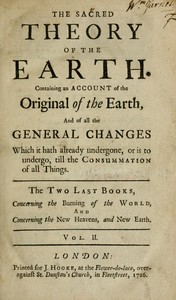
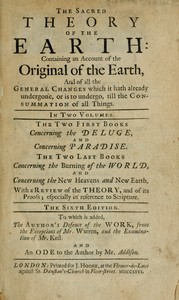
The sacred theory of the Earth, Volume 1 (of 2) — A Closer Reading

(2 User reviews)   592
In Category - Metaphysics
Burnet, Thomas, 1635?-1715 Project Gutenberg 2025 Not confirmed
Cosmology -- Early works to 1800; Warren, Erasmus, 1642?-1718. Geologia; Keill, John, 1671-1721. Examination of Dr. Burnet's theory of the earth; Creation -- Early works to 1800; Philosophy, Ancient -- Early works to 1800; Earth (Planet) -- Early works to 1800 Readers of public-domain and historical texts
Project Gutenberg digital edition en

Edition facts

Words 129,144
Reading time 562 min
Text sections 15

For The sacred theory of the Earth, Volume 1 (of 2) — A Closer Reading, the stored edition analysis reports 129,144 words, 9 hr 22 min estimated reading time, and 15 detected text sections.

The text analysis averages about 44.7 words per sentence, while the detected sections provide another way to judge how the source is divided.

Project Gutenberg metadata also associates the work with “Cosmology -- Early works to 1800,” connecting these edition facts with the source record’s subject description.

Thomas Burnet's 17th-century cosmogony argues that Earth's present rugged form is a fallen state, using scripture, ancient philosophy, and geological reasoning to reconstruct its original smooth shape and predict its fiery renewal.
Share
Editorial Edition Score 4.9/5

Calculated from edition completeness, EPUB availability, text structure and catalogue metadata. Not a user rating.

How this score is calculated
  • Description quality20 pts
  • Title & short description10 pts
  • Source metadata20 pts
  • Text length15 pts
  • Chapters / structure15 pts
  • EPUB file integrity20 pts

Total of 100 points, scaled to a 2.5-5.0 range. Editions with an empty description or a missing EPUB file are not scored.

Edition quality

Read the Text

n the following Treatise, which I willingly submit to your Majesty’s Judgment and Censure; being very well satisfied, that if I had sought a Patron in all the List of Kings, your Contemporaries, or in the Roll of your Nobles of either Order, I could not have found a more competent Judge in a Speculation of this Nature. Your Majesty’s Sagacity, and happy Genius for natural History, for Observations and Remarks upon the Earth, the Heavens, and the Sea, is a better Preparation for Inquiries of this kind, than all the dead Learning of the Schools.

SIR, This Theory, in the full Extent of it, is to reach to the last Period of the Earth, and the End of all Things; but this first Volume takes in only so much as is already past, from the Origin of the Earth, to this present Time and State of Nature. To describe in like manner the Changes and Revolutions of Nature that are to come, and see thorough all succeeding Ages, will require a steady and attentive Eye, and a Retreat from the Noise of the World; especially so to connect the Parts, and present them all under one View, that we may see, as in a Mirror, the several Faces of Nature, from first to last, throughout all the Circle of Successions.

YOUR Majesty having been pleas’d to give Encouragement to this Translation, I humbly present it to your gracious Acceptance. And ’tis our Interest, as well as Duty, in Disquisitions of this Nature, to address our selves to your Majesty, as the Defender of _Philosophick Liberties_, against those that would usurp upon the fundamental Privilege and Birthright of Mankind, _The free Use of Reason_. Your Majesty hath always appear’d the Royal Patron of Learning and the Sciences; and ’tis suitable to the Greatness of a Princely Spirit to favour and promote whatsoever tends to the Enlargement of human Knowledge, and the Improvement of human Nature. To be Good and Gracious, and a Lover of Knowledge, are, methinks, two of the most amiable Things in this World: And that your Majesty may always bear that Character in present and future Ages; and after a long and prosperous Reign enjoy a blessed Immortality, is the constant Prayer of

_Your MAJESTY’s Most Humble and Most Obedient Subject_,

PREFACE TO THE READER.

Having given an Account of this whole Work in the first Chapter, and of the Method of either Book, whereof this Volume consists, in their proper Places, there remains not much to be said here to the Reader. This Theory of the Earth may be called _Sacred_, because it is not the common Physiology of the Earth, or of the Bodies that compose it, but respects only the great Turns of Fate, and the Revolutions of our natural World; such as are taken notice of in the Sacred Writings, and are truly the Hinges upon which the Providence of this Earth moves; or whereby it opens and shuts the several successive Scenes whereof it is made up. This _English_ Edition is the same in Substance with the _Latin_, though, I confess, ’tis not so properly a Translation, as a new Composition upon the same Ground, there being several additional Chapters in it, and several new-moulded.

As every Science requires a peculiar Genius, so likewise there is a Genius peculiarly improper for every one: And as to Philosophy, which is the Contemplation of the Works of Nature, and the Providence that governs them, there is no Temper or Genius, in my Mind, so improper for it, as that which we call a _mean_ and _narrow Spirit_; and which the _Greeks_ call _Littleness of Soul_. This is a Defect in the first Make of some Mens Minds, which can scarce ever be corrected afterwards, either by Learning or Age. And as Souls that are made little and incapacious cannot enlarge their Thoughts to take in any great Compass of Times or Things; so what is beyond their Compass, or above their Reach, they are apt to look upon as fantastical, or at least would willingly have it pass for such in the World. Now as there is nothing so great, so large, so immense, as the Works of Nature, and the Methods of Providence, Men of this Complexion must needs be very unfit for the Contemplation of them. Who would set a purblind Man at the Top of the Mast to discover Land? Or upon an high Tower to draw a Landskip of the Country round about? For the same Reason, short-sighted Minds are unfit to make Philosophers, whose proper Business it is to discover and describe in comprehensive Theories the _Phænomena_ of the World, and the Causes of them.

This Original Disease of the Mind is seldom cur’d by Learning, which cures many others; like a Fault in the first _Stamina_ of the Body, it cannot easily be rectified afterwards. ’Tis a great Mistake to think that every sort of Learning makes a Man a competent Judge of Natural Speculations: We see unhappy Examples to the contrary amongst the Christian Fathers, and particularly in St. _Austin_, who was unquestionably a Man of Parts and Learning; but interposing in a Controversy where his Talent did not lie, shew’d his Zeal against the _Antipodes_ to very ill purpose, though he drew his Reasons partly from Scripture. And if within a few Years, or in the next Generation, it should prove as certain and demonstrable that the _Earth is mov’d_, as it is now, that there are _Antipodes_; those that have been zealous against it, and engag’d the Scripture in the Controversy, would have the same Reason to repent of their Forwardness, that St. _Austin_ would have now, if he was alive. ’Tis a dangerous thing to engage the Authority of Scripture in Disputes about the Natural World, in Opposition to Reason; lest Time, which brings all Things to Light, should discover that to be evidently false which we had made Scripture to assert: And I remember St. _Austin_, in his Exposition upon _Genesis_, hath laid down a Rule to this very purpose, though he had the Unhappiness, it seems, not to follow it always himself. The Reason also, which he gives there for his Rule, is very good and substantial: For, saith he[1], _if the Unbelievers or Philosophers shall certainly know us to be mistaken, and to err in those things that concern the Natural World, and see that we alledge our (Sacred) Books for such vain Opinions, how shall they believe those same Books when they tell them of the RESURRECTION of the Dead, and the World to come, if they find them to be fallaciously writ in such things as lie within their certain Knowledge?_

We are not to suppose that any Truth concerning the Natural World can be an Enemy to Religion; for Truth cannot be an Enemy to Truth, God is not divided against himself; and therefore we ought not upon that Account to condemn or censure what we have not examin’d or cannot disprove; as those, that are of this narrow Spirit we are speaking of, are very apt to do. Let every thing be try’d and examin’d in the first Place, whether it be _True_ or _False_; and if it be found false, ’tis then to be consider’d whether it be such a Falsity as is prejudicial to Religion or no. But for every new Theory that is propos’d, to be alarm’d, as if all Religion was falling about our Ears, is to make the World suspect that we are very ill assur’d of the Foundation it stands upon. Besides, do not all Men complain, even these as well as others, of the great ignorance of Mankind? how little we know, and how much is still unknown? and can we ever know more, unless something new be discover’d? It cannot be old when it comes first to light, when first invented, and first propos’d. If a Prince should complain of the Poorness of his Exchequer, and the Scarcity of Money in his Kingdom, would he be angry with his Merchants, if they brought him home a _Cargo_ of good Bullion, or a Mass of Gold out of a foreign Country? and give this Reason only for it, He would have no _new Silver_; neither should any be current in his Dominions but what had his own Stamp and Image upon it: How should this Prince or his People grow rich? To complain of Want, and yet refuse all offers of a Supply, looks very sullen, or very fantastical.

I might mention also upon this occasion another Genius and Disposition in Men, which often makes them improper for Philosophical Contemplations; not so much, it may be, from the Narrowness of their Spirit and Understanding, as because they will not take Time to extend them. I mean Men of Wit and Parts, but of short Thoughts and little Meditation, and that are apt to distrust every Thing for a Fancy or Fiction that is not the Dictate of Sense, or made out immediately to their Senses. Men of this Humour and Character call such Theories as these philosophick Romances, and think themselves witty in the Expression; they allow them to be pretty Amusements of the Mind, but without Truth or Reality. I am afraid if an Angel should write the Theory of the Earth, they would pass the same Judgment upon it; where there is Variety of Parts in a due Contexture, with something of surprizing Aptness in the Harmony and Correspondency of them, this they call a Romance; but such Romances must all Theories of Nature and of Providence be, and must have every Part of that Character with Advantage, if they be well represented. There is in them, as I may so say, a _Plot_ or _Mystery_ pursued thro’ the whole Work, and certain grand Issues or Events upon which the rest depend, or to which they are subordinate; but these Things we do not make or contrive our selves, but find and discover them, being made already by the great Author and Governor of the Universe: And when they are clearly discover’d, well digested, and well reason’d in every Part, there is, methinks, more of Beauty in such a Theory, at least a more masculine Beauty, than in any Poem or Romance; and that solid Truth that is at the Bottom gives a Satisfaction to the Mind, that it can never have from any Fiction how artificial soever it be.

To enter no further upon this Matter, ’tis enough to observe, that when we make Judgments and Censures upon general Presumptions and Prejudices, they are made rather from the Temper and Model of our own Spirits, than from Reason; and therefore, if we would neither impose upon our selves, nor others, we must lay aside that lazy and fallacious Method of censuring by the Lump, and must bring things close to the Test of _True_ or _False_, to explicit Proof and Evidence; and whosoever makes such Objections against an _Hypothesis_, hath a Right to be heard, let his Temper and Genius be what it will. Neither do we intend that any thing we have said here should be understood in another Sense.

To conclude, This Theory being writ with a sincere Intention to justify the Doctrines of the _Universal Deluge_, and of a _Paradisiacal_ State, and protect them from the Cavils of those that are no Well-wishers to sacred History, upon that Account it may reasonably expect fair Usage and Acceptance with all that are well-dispos’d; and it will also be, I think, a great Satisfaction to them to see those Pieces of most ancient History, which have been chiefly preserv’d in Scripture, confirm’d anew, and by another Light, that of Nature and Philosophy; and also freed from those Misconceptions or Misrepresentations, which made them sit uneasie upon the Spirits even of the best Men that took Time to think. _Lastly_, In things purely speculative, as these are, and no Ingredients of our Faith, it is free to differ from one another in our Opinions and Sentiments; and so I remember St. _Austin_ hath observ’d upon this very Subject of _Paradise_; wherefore as we desire to give no Offence our selves, so neither shall we take any at the Difference of Judgment in others; provided this Liberty be mutual, and that we all agree to study _Peace_, _Truth_, and a _good Life_.

Gen. ad lit. lib. 1. c. 19. Plerumque accidit ut aliquid de Terrâ de Cœlo, de cæteris hujus mundi elementis, _&c._ Cùm enim quenquam Christianorum in eâ re quam optimè nôrunt, errare deprehenderint, & vanam sententiam suam ex nostris libris asserere, quo pacto illis libris credituri sunt de Resurrectione Mortuorum, & spe vitæ æterne regnoque cœlorum, quando de bis rebus quas jam experiri vel indubitatis numeris percipere potuerunt, fallaciter putaverint esse conscriptos?

CONTENTS OF THE CHAPTERS.

_The Introduction: An Account of the whole Work, of the Extent and general Order of it._ ... Page 1

_A general Account of Noah’s Flood. A Computation what Quantity of Water would be necessary for the making of it; That the common Opinion and Explication of that Flood is not intelligible._ ... 10

_All Evasions concerning the Flood answer’d; That there was no Creation of Waters at the Deluge, and that it was not particular or national, but extended throughout the whole Earth. A Prelude and Preparation to the true Account and Explication of it. The Method of the first Book._ ... 25

_That the Earth and Mankind had an Original, and were not from Eternity; prov’d against Aristotle. The first Proposition of our Theory laid down, viz. That the Antediluvian Earth was of a different Form and Construction from the present. This is prov’d from divine Authority, and from the Nature and Form of the Chaos, out of which the Earth was made._ ... 47

_The second Proposition is laid down, viz. That The Face of the Earth before the Deluge was smooth, regular and uniform; without Mountains, and without a Sea. The Chaos out of which the World rose is fully examin’d, and all its Motions observ’d, and by what Steps it wrought it self into an habitable World. Some things in Antiquity relating to the first State of the Earth are interpreted, and some things in the sacred Writings. The divine Art and Geometry in the Construction of the first Earth is observ’d and celebrated._ ... 71

_The Dissolution of the first Earth: The Deluge ensuing thereupon. And the Form of the present Earth rising from the Ruins of the first._ ... 89

_That the Explication we have given of an universal Deluge is not an IDEA only, but an Account of what really came to pass in the Earth, and the true Explication of Noah’s Flood. An Examination of Tehom-Rabba, or the great Abyss, and that by it the Sea cannot be understood, nor the subterraneous Waters as they are at present. What the true Notion and Form of it was, collected from Moses and other sacred Writers. Observations on Deucalion’s Deluge._ ... 103

_The particular History of Noah’s Flood is explain’d in all the material Parts and Circumstances of it, according to the preceding Theory. Any seeming Difficulties remov’d, and the whole Section concluded with a Discourse how far the Deluge may be lookt upon as the Effect fect of an ordinary Providence, and how far of an extraordinary._ ... 129

_The second Part of this Discourse, proving the same Theory from the Effects and the present Form of the Earth. First, by a general Scheme of what is most remarkable in this Globe, and then by a more particular Induction; beginning with an Account of Subterraneous Cavities and Subterraneous Waters._ ... 146

_Concerning the Channel of the Sea and the Original of it; The Causes of its irregular Form and unequal Depths: As also of the Original of Islands, their Situation and other Properties._ ... 172

_Concerning the Mountains of the Earth, their Greatness and irregular Form, their Situation, Causes and Origin._ ... 188

_A short Review of what hath been already treated of, and in what manner. All Methods, whether philosophical or theological, that have been offer’d by others for the Explication of the Form of the Earth, are examin’d and refuted. A Conjecture concerning the other Planets, their Natural Form and State compar’d with ours; especially concerning Jupiter and Saturn._ ... 206

_The Introduction and Contents of the Second Book. The general State of the Primæval Earth, and of Paradise._ ... 235

_The great Change of the World since the Flood, from what it was in the first Ages. The Earth under its present Form could not be Paradisiacal, nor any Part of it._ ... 251

_The Original Differences of the Primitive Earth from the Present or Postdiluvian. The three Characters of Paradise, and the Golden Age, found in the Primitive Earth. A particular Explication of each Character._ ... 264

_A Digression concerning the Natural Causes of Longævity. That the Machine of an Animal consists of Springs, and which are the two principal. The Age of the Antediluvians to be computed by Solar, not Lunar Years._ ... 277

_Concerning the Waters of the Primitive Earth: What the State of the Regions of the Air was then, and how all Waters proceeded from them. How the Rivers arose, what was their Course, and how they ended. Several things in sacred Writ that confirm this Hydrography of the first Earth, especially the Postdiluvian Origin of the Rainbow._ ... 307

_A Recollection and Review of what hath been said concerning the Primitive Earth, with a more full Survey of the State of the First World, Natural and Civil, and the Comparison of it with the present World._ ... 329

_Concerning the Place of Paradise; It cannot be determin’d from the Theory only, nor from Scripture only; What the Sense of Antiquity was concerning it, as to the Jews and Heathens, and especially as to the Christian Fathers. That they generally plac’d it out of this Continent, in the Southern Hemisphere._ ... 345

_The Uses of this Theory for the Illustration of Antiquity; The Chaos of the Ancients explain’d; The Inhabitability of the Torrid Zone; The Change of the Poles of the World; The Doctrine of the Mundane Egg; How America was first peopled; How Paradise within the Circle of the Moon._ ... 363

_A general Objection against this Theory, viz. That if there had been such a Primitive Earth, as we pretend, the Fame of it would have sounded throughout all Antiquity. The Eastern and Western Learning consider’d, the most considerable Records of both are lost; what Footsteps remain relating to this Subject. The Jewish and Christian Learning consider’d, how far lost as to this Argument, and what Notes or Traditions remain. Lastly, How far the Sacred Writings bear witness to it. The Providential Conduct of Knowledge in the World. A Recapitulation and State of the Theory._ ... 379

_Concerning the AUTHOR of NATURE._ ... 401

Concerning NATURAL PROVIDENCE.

_Several Incroachments upon natural Providence, or Misrepresentations of it, and false Methods of Contemplation. A true Method propos’d, and a true Representation of the Universe. The Mundane Idea, and the universal System of Providence. Several subordinate Systems. That of our Earth and sublunary World. The Course and Periods of it. How much of this is already treated of, and what remains. Conclusion._ ... 432

THE THEORY OF THE EARTH. BOOK I. Concerning the Deluge, and the Dissolution of the EARTH.

CHAP. I. The INTRODUCTION.

_An Account of the whole Work; of the Extent and general Order of it._

Since I was first inclin’d to the Contemplation of Nature, and took Pleasure to trace out the Causes of Effects, and the Dependance of one thing upon another in the visible Creation, I had always, methought, a particular Curiosity to look back into the Sources and ORIGINAL of Things; and to view in my Mind, so far as I was able, the Beginning and Progress of a RISING WORLD.

Thomas Burnet opens his Sacred Theory of the Earth with a bold claim: the present Earth, with its mountains and oceans, is not the original creation but a ruin. The front matter includes a Latin ode by Joseph Addison, praising Burnet's vision of a world that 'floats in fragments' after the Deluge. Burnet's method is to reconcile scripture with natural philosophy, arguing that the Earth's history is divided into three distinct forms—original, present, and future—each shaped by divine catastrophe. The excerpts show him engaging directly with opponents, such as Erasmus Warren and John Keill, defending his theory against those who insist the Earth has always been as it is now.

The Earth as a Ruined World

Burnet repeatedly describes the Earth as bearing 'marks of fractions, ruins, and dissolutions.' He contrasts the 'regular and simple' first order of things with the 'deformity and incommodiousness' of the present globe. This is not merely poetic; it is a central argument. For Burnet, the physical evidence of broken mountains and deep seas proves that the Earth was once smooth and perfect. He cites St. Peter's distinction between the antediluvian and present heavens and earth (2 Peter 3:5-6) to support his claim that the world has undergone a fundamental change. The reader should note how Burnet weaves biblical authority with natural observation, treating both as complementary witnesses to a lost paradise.

The Deluge as a Geological Event

Burnet's theory hinges on the Deluge as a real, physical catastrophe that transformed the Earth's surface. He argues that if mountains had existed from the beginning, the Flood would be inexplicable—there would be no mechanism to cover them. Instead, he posits that the original Earth was a smooth shell over an abyss of water; when the shell cracked, the waters burst forth, creating the present irregular landscape. In the excerpts, he challenges his opponents to explain how mountains could have formed naturally, insisting that only a supernatural intervention can account for the 'channel of the sea' and other cavities. This section of the text is dense with mechanical reasoning, as Burnet attempts to make the biblical account physically plausible.

Engaging with Critics: Warren and Keill

The excerpts include a vigorous rebuttal to those who deny any change in the Earth's form. Burnet names Erasmus Warren and John Keill as opponents, accusing them of reviving the ancient error that 'the heavens and the earth were the same now that they had been from the beginning.' He compares them to Didymus of Alexandria, who rejected St. Peter's epistle because it contradicted his own views. Burnet's tone is combative; he lists four unanswerable objections to his critics' position, including the impossibility of explaining Paradise and the Deluge under their system. Readers should watch how Burnet uses both scriptural authority and logical argument to corner his adversaries, often appealing to the reader's judgment to decide between the two theories.

The Role of Ancient Philosophy and Scripture

Burnet draws heavily on ancient philosophy, particularly the idea of a primordial chaos and a subsequent ordering of the world. He references 'the Ancients' and their descriptions of Paradise, arguing that these traditions align with his theory of a smooth, paradisiacal Earth. At the same time, he insists that his system is grounded in Scripture, especially the prophetic books that speak of a future conflagration and a new heavens and earth. The excerpts show him moving between natural and theological arguments, treating both as parts of a single coherent system. For the first-time reader, it is helpful to see Burnet not as a scientist in the modern sense, but as a theologian-naturalist who believed that the book of nature and the book of scripture must agree, and that his theory was the key to that harmony.

Burnet's Sacred Theory rewards readers who approach it as a work of imaginative synthesis rather than a dry treatise. Pay attention to the diagrams referenced in the text (such as 'Fig. 2, p. 77'), which illustrate his conception of the Earth's original form. The Latin ode by Addison, though not essential, offers a contemporary literary response to Burnet's vision. As you read, note how Burnet balances reverence for scripture with a willingness to reinterpret it in light of natural evidence—a tension that makes this work a landmark in the history of both science and religion.

Reading Burnet’s account of a once-smooth Earth, now broken into hills and valleys, left me with a quiet ache for that lost order. It reminded me, oddly, of the gentle uncertainty in Chance, Love, and Logic: Philosophical Essays — Themes and Context—how Peirce’s fallibilism also softens the world, letting ragged edges remain part of the story, rather than a mistake to be repaired.

James Harris
4 weeks ago

Ella Rodriguez
2 weeks ago

5
5 out of 5 (2 User reviews )

Add a Review

Your Rating *
There are no comments for this eBook.

Reader reflection

What was your reading experience?

Capture what you thought, learned, and would like to remember.

Your progress 0 / 10
1

Which reading stage best describes you?

2

Was reading this book enjoyable?

3

Is this a title you would suggest to others?

4

How demanding did the text feel?

Related eBooks