1


The Problems of Philosophy — Context and Discussion
(0 User reviews)
215
Project Gutenberg
2004
Not confirmed
Knowledge, Theory of; Metaphysics; Philosophy -- Introductions
Readers of public-domain and historical texts
Project Gutenberg digital edition
en
Edition facts
Words
46,367
Reading time
202 min
Text sections
6
The catalog record for The Problems of Philosophy — Context and Discussion provides practical reading context through 46,367 words, 3 hr 22 min estimated reading time, and 6 detected text sections.
The text analysis averages about 27.7 words per sentence, while the detected sections provide another way to judge how the source is divided.
Project Gutenberg metadata also associates the work with “Knowledge, Theory of,” connecting these edition facts with the source record’s subject description.
Source:
Project Gutenberg record #5827
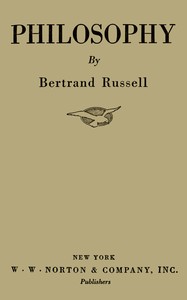
Bertrand Russell's 1912 introduction to philosophy focuses on epistemology and metaphysics, using everyday examples like a table to examine appearance, reality, and the limits of knowledge.
Read the complete public-domain text at its original source.
Read on Project GutenbergRussell opens The Problems of Philosophy with a deceptively simple question: 'Is there any knowledge in the world which is so certain that no reasonable man could doubt it?' From this starting point, he builds a sustained inquiry into the nature of perception, matter, and truth. The book is structured as a series of linked problems, each chapter addressing a distinct philosophical puzzle while advancing an overall argument for a realist, pluralist metaphysics.
Rather than offering a historical survey, Russell selects problems where he believes 'something positive and constructive' can be said. This editorial choice gives the work a focused, argument-driven character. The recurring image of a table—its color, shape, and texture—serves as a concrete anchor for abstract discussions of sense-data, physical objects, and the relation between appearance and reality.
From the Table to the World
Russell’s argumentative method depends on a single, vivid example that he returns to across multiple chapters: a table. In the opening chapter, he describes the table’s color as appearing different under varying light, its shape changing with perspective, and its texture varying with touch. These observations are not merely illustrative; they drive the central distinction between sense-data (the immediate objects of sensation) and physical objects (the inferred causes of those sensations).
By grounding abstract metaphysics in a familiar object, Russell makes the problem of perception tangible. The table becomes a test case for whether we can know anything beyond our own sensations. This structural device—using a single concrete instance to explore a general philosophical issue—recurs throughout the book, lending coherence to what might otherwise seem a disconnected set of topics.
Knowledge by Acquaintance and by Description
One of Russell’s most influential contributions in this work is the distinction between two kinds of knowledge: knowledge by acquaintance and knowledge by description. Acquaintance is direct, immediate awareness of sense-data, universals, and possibly the self. Description, by contrast, involves knowledge of objects through propositions that denote them—for example, knowing that 'the table' is the cause of certain sense-data.
This distinction structures the book’s epistemology. Russell argues that all knowledge ultimately rests on acquaintance, but that most of what we claim to know about the external world is actually descriptive. The movement between these two modes—from direct experience to inferential knowledge—mirrors the book’s larger trajectory from appearance to reality. Readers will notice how Russell repeatedly shifts from what is immediately given to what must be inferred, a pattern that reinforces his central philosophical method.
The Role of A Priori Principles
Russell devotes several chapters to a priori knowledge—truths known independently of experience, such as the laws of logic and arithmetic. He argues that these principles are not merely 'laws of thought' or mental constructions, but are facts about the world. For instance, the law of contradiction, he insists, 'is about things, and not merely about thoughts'. This claim is central to his realism: if a priori truths were only about how we think, they could not guarantee objective knowledge.
The structure of these chapters follows a pattern: Russell first presents a common philosophical view (e.g., Kant’s or the empiricists’), then raises objections, and finally offers his own alternative. This dialectical movement gives the book a clear, pedagogical rhythm. Readers should note how Russell uses simple examples—such as 'two and two are four'—to test complex theories, a technique that keeps the argument accessible without sacrificing rigor.
The Value of Philosophy
The final chapter, 'The Value of Philosophy', shifts from technical epistemology to a broader reflection on why philosophy matters. Russell argues that philosophy’s value lies not in definite answers but in the critical, questioning attitude it fosters. He contrasts the 'instinctive' certainties of daily life with the 'uncertainty' that philosophy introduces, claiming that this uncertainty is itself liberating.
This chapter serves as a coda to the book’s argumentative structure. Throughout the preceding chapters, Russell has systematically dismantled naive certainties about perception, matter, and knowledge. Here he justifies that process, presenting philosophy as an enlargement of the mind. The movement from specific problems to a general defense of the philosophical enterprise gives the book a satisfying arc, even as it leaves many questions open. Russell’s prose becomes more lyrical in this final section, offering a glimpse of the personal conviction behind the analytic argument.
Russell’s The Problems of Philosophy rewards a careful, sequential reading. Pay attention to how each chapter builds on the previous one, and to the recurring examples—especially the table—that tie abstract arguments to concrete experience. The book is best approached as a series of interconnected essays rather than a single continuous treatise. Readers unfamiliar with early analytic philosophy may find it helpful to read the chapters on appearance and reality and on knowledge by acquaintance first, as they establish the conceptual framework for the rest of the work.
I remember finishing The Problems of Philosophy and feeling oddly comforted by how much we can't know, how even a table slips beyond our grasp. That quiet acceptance stayed with me, like a familiar room. The Logic of Chance, 3rd edition An Essay on the Foundations and Province of the Theory of Probability, With Especial Reference to Its Logical Bearings and Its — Key Ideas to Explore wandered through similar territory, not demanding answers, just tracing where certainty fails and leaves us something gentler to hold.
There are no reviews for this eBook.
There are no comments for this eBook.
Reader reflection
What was your reading experience?
Capture what you thought, learned, and would like to remember.
Your progress
0
/
10
2
What was your overall reaction to the book?
3
Would you encourage someone else to read it?
4
Did the language feel accessible?
5
How would you describe its reading pace?
6
How useful were the ideas in this book?
7
How strong was your personal connection to the text?
8
How distinctive were its ideas or approach?
9
Which lesson or insight stayed with you?
10