1

Chance, Love, and Logic: Philosophical Essays — Themes and Context
(0 User reviews)
2382
Project Gutenberg
2021
Not confirmed
Pragmatism; Metaphysics; Science -- Philosophy; Peirce, Charles S. (Charles Sanders), 1839-1914 -- Bibliography
Readers of public-domain and historical texts
Project Gutenberg digital edition
en
Edition facts
Words
99,398
Reading time
433 min
Text sections
18
Chance, Love, and Logic: Philosophical Essays — Themes and Context can be approached with a clearer sense of reading commitment from its source measurements: 99,398 words, 7 hr 13 min estimated reading time, and 18 detected text sections.
The text analysis averages about 24.4 words per sentence, while the detected sections provide another way to judge how the source is divided.
Project Gutenberg metadata also associates the work with “Pragmatism,” connecting these edition facts with the source record’s subject description.
Source:
Project Gutenberg record #65274
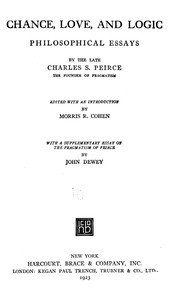
This edition collects Charles S. Peirce's essays on pragmatism, chance, and the logic of science, edited by Morris R. Cohen with a supplementary essay by John Dewey. The excerpts reveal Peirce's argument that laws of nature are evolutionary products, not absolute, and his critique of mechanical explanations.
Read the complete public-domain text at its original source.
Read on Project GutenbergCharles S. Peirce, whom the preface places “in the forefront of the great seminal minds of recent times,” here challenges the notion that natural laws are fixed and absolute. In the excerpt on molecular speculation, he argues that uniformities “are precisely the sort of facts that need to be accounted for,” proposing instead that laws result from evolution and contain an element of spontaneity or chance. This editorial note traces how the opening, middle, and later excerpts guide a first reading of Peirce’s philosophical project.
The Opening: Setting the Problem of Law
The excerpt begins with a detailed discussion of the kinetic theory of gases and the difficulties of molecular speculation. Peirce notes that additional hypotheses are often required, leaving us “quite afloat.” He questions whether the fundamental laws of mechanics hold for single atoms and suggests atoms may move in more than three dimensions. This opening establishes a central tension: while science seeks simple laws, the complexity of phenomena makes such simplicity suspect. Peirce’s solution is to search for “a natural history of laws of nature” that would show what kinds of laws to expect. The reader is thus introduced to Peirce’s core problem—how to account for uniformity without assuming it is given.
The Middle: Chance as a Positive Factor
In the middle of the excerpt, Peirce directly addresses the origin of laws. He writes that “the only possible way of accounting for the laws of nature and for uniformity in general is to suppose them results of evolution.” This evolution implies that laws are not absolute and are not obeyed precisely; there is “an element of indeterminacy, spontaneity, or absolute chance in nature.” Peirce illustrates this with the analogy of a coin: heads and tails require no explanation, but always heads does. Law, he says, “is par excellence the thing that wants a reason.” This section is pivotal because it introduces chance not as a failure of knowledge but as a real feature of the world. The reader should note how Peirce uses this to critique Herbert Spencer’s mechanical evolution, calling it “illogical” for four specific reasons.
The Later Excerpts: Implications for Scientific Method
Later in the volume, Peirce develops the consequences of his evolutionary view for scientific inquiry. The excerpts show him arguing that hypotheses cannot be tried “haphazard” but require a guiding theory of what laws to expect. He warns that without such guidance, testing theories could take “half a century on the average” and that the number of possible theories “may go up into the trillions.” This practical concern ties his metaphysical claims to the methodology of science. Peirce’s emphasis on the need for a “natural history of laws” suggests that the scientist must study the history and variety of laws themselves, rather than assuming they are simple or given. The reader should observe how Peirce’s critique of simple laws leads to a positive research program.
The Supplementary Essay by John Dewey
The volume includes a supplementary essay by John Dewey on Peirce’s pragmatism. While the excerpts do not reproduce this essay, its presence frames the collection as a key document in the pragmatist tradition. Dewey’s contribution likely clarifies how Peirce’s ideas about chance and law connect to the broader pragmatist emphasis on the practical consequences of beliefs. For the first-time reader, this essay can serve as a guide to the significance of Peirce’s arguments, especially his rejection of fixed, a priori principles. The editorial apparatus—Cohen’s introduction and Dewey’s essay—thus provides a dual context: one historical, situating Peirce among his contemporaries, and one philosophical, interpreting his work for a new audience.
Reading the excerpts in sequence reveals a coherent argument: from the breakdown of simple mechanical laws, through the introduction of chance as a real factor, to a call for a new method of inquiry. The reader is advised to pay close attention to Peirce’s use of examples from physics and his critiques of Spencer, as these ground his abstract claims. The supplementary material by Cohen and Dewey offers valuable orientation, but the core of Peirce’s thought lies in his insistence that law itself must be explained, not assumed.
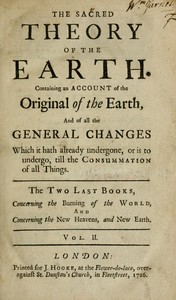
Reading Peirce’s notion that even the laws of nature drift and alter over time, I felt a quiet echo of an older strangeness. His patient willingness to let certainty dissolve reminded me, oddly, of how that old cosmic narrative treats the world as a patient becoming, not a fixed clock. I kept thinking of The sacred theory of the Earth, Volume 2 (of 2) — A Reader’s Guide, where the same unhurried wonder seems to breathe.
There are no reviews for this eBook.
There are no comments for this eBook.
Reader reflection
Take a moment to reflect on this book
Create a short personal record of your experience with this book.
Your progress
0
/
10
2
How much did you enjoy the reading experience?
3
Would you recommend this book to another reader?
4
How much effort did this book require?
5
Did the book deliver what you hoped for?
6
How strongly did the book affect you emotionally?
7
Would you read this book again?
8
How personally connected did you feel to the book?
9
What did this book teach you most?
10