1

Six metaphysical meditations — Edition Insights
(0 User reviews)
3176
Project Gutenberg
2023
Not confirmed
Knowledge, Theory of; Metaphysics; First philosophy; God -- Proof, Ontological; Methodology; Descartes, René, 1596-1650
Readers of public-domain and historical texts
Project Gutenberg digital edition
en
Edition facts
Words
37,137
Reading time
162 min
Text sections
29
The source record for Six metaphysical meditations — Edition Insights measures this digital text at 37,137 words, 2 hr 42 min estimated reading time, and 29 detected text sections.
The text analysis averages about 38.6 words per sentence, while the detected sections provide another way to judge how the source is divided.
Project Gutenberg metadata also associates the work with “Knowledge, Theory of,” connecting these edition facts with the source record’s subject description.
Source:
Project Gutenberg record #70091
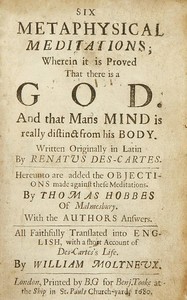
William Molyneux's 1680 translation of Descartes's Meditations, with Hobbes's objections and Descartes's replies. The translator's preface argues that philosophical argumentation demands strictness of expression, unlike history or romance. The text treats God's existence as inseparable from his essence, using geometric analogies.
Read the complete public-domain text at its original source.
Read on Project GutenbergWilliam Molyneux’s 1680 translation of Descartes’s Six Metaphysical Meditations presents itself not as a literary version but as a “Physico-Mathematical Argumentation” requiring “great strictness of Expression.” In his preface, Molyneux distinguishes this work from histories, plays, or romances, where a translator might take liberties with idiom and manner. Here, he argues, such freedom would endanger the sense and force of the arguments—comparing the task to translating Euclid. The volume also includes the objections of Thomas Hobbes and Descartes’s answers, making it a record of philosophical exchange as well as a demonstration of method.
The Translator’s Defense of Literal Rendering
Molyneux’s preface directly addresses the challenge of translating metaphysical reasoning. He observes that “meer Versions do alwayes carry with them this Property, that if not well done they may much disgrace, but if well, not much commend the doers.” Yet he insists that philosophical and mathematical texts demand a different standard: “Politeness of language might as well be expected in a Translation of Euclide as in this.” This claim is not merely defensive; it shapes the reader’s expectation of the prose that follows. The translation aims for precision over elegance, and Molyneux asks the reader to judge the work accordingly. The preface thus functions as a methodological statement, aligning the translator’s task with the philosopher’s commitment to clear and distinct ideas.
Existence Inseparable from Essence
In the meditation excerpt, Descartes argues that existence is not a contingent attribute of God but an inseparable property: “Existence is Inseparable from God, and therefore that he Really Exists.” He distinguishes this from mere thought imposing necessity, insisting that “the necessity of the thing it self … Determines me to think thus.” The argument is supported by an analogy with geometry: just as thinking of a triangle compels one to attribute to it certain properties (e.g., its angles sum to two right angles), so thinking of a perfect being compels one to attribute existence. Descartes also notes that he cannot imagine two or more Gods, and that God must have existed from eternity and will exist to eternity—claims he presents as self-evident once prejudice and sensory distractions are set aside.
Clear and Distinct Perception as the Criterion
Throughout the excerpt, Descartes returns to the principle that he is “fully perswaded of the Truth of those things only, which appear to me clearly and distinctly.” He acknowledges that some truths are obvious to everyone, while others require careful inquiry, but once perceived, both are equally certain. He illustrates this with a geometric example: the fact that in a right-angled triangle the square of the base equals the sum of the squares of the sides is no less certain than the more obvious fact that the base subtends the largest angle. This epistemic standard is applied to the idea of God: “unless I am overrun with Prejudice, or have my thoughts begirt on all sides with sensible Objects, I should acknowledge nothing before or easier then him.” The text thus ties the ontological argument to a broader method of clear and distinct perception.
Readers approaching this edition should attend to Molyneux’s prefatory remarks, which frame the translation as a deliberate choice of fidelity over fluency. The presence of Hobbes’s objections offers a contrasting voice, though only Descartes’s replies are included here. The meditations themselves proceed by a chain of reasoning that rewards careful reading; the geometric analogies are not decorative but structural. Those interested in the history of philosophical translation or the early reception of Cartesian thought will find this volume a valuable primary source.
That rain fell steady while Descartes and Hobbes traded objections across Molyneux’s spare pages, each reply demanding stricter language. By dusk, certainty felt less geometric, more like chance. I drifted to Venn’s old essay, The Logic of Chance, 3rd edition An Essay on the Foundations and Province of the Theory of Probability, With Especial Reference to Its Logical Bearings and Its — Key Ideas to Explore, and the rain kept falling, softer now.
There are no reviews for this eBook.
There are no comments for this eBook.
Reader reflection
Record your reading impressions
A brief reflection can help important ideas stay with you longer.
Your progress
0
/
10
2
Was reading this book enjoyable?
3
Would you recommend this book to another reader?
4
Did the language feel accessible?
5
How personally connected did you feel to the book?
6
Do you expect to return to this book?
7
What did you appreciate most?
8
How useful did the reading feel?
9
What did this book teach you most?
10