1

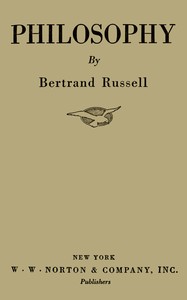
Philosophy — Key Ideas to Explore
(0 User reviews)
2616
Project Gutenberg
2024
Not confirmed
Philosophy; Psychology; Physics -- Philosophy
Readers of public-domain and historical texts
Project Gutenberg digital edition
en
Edition facts
Words
111,645
Reading time
486 min
Text sections
33
Before opening Philosophy — Key Ideas to Explore, the edition data offers a quick orientation: 111,645 words, 8 hr 6 min estimated reading time, and 33 detected text sections.
The text analysis averages about 22.9 words per sentence, while the detected sections provide another way to judge how the source is divided.
Project Gutenberg metadata also associates the work with “Philosophy,” connecting these edition facts with the source record’s subject description.
Source:
Project Gutenberg record #72981
Bertrand Russell's 1927 work examines philosophy through the lens of doubt, behaviorism, and physics, arguing that knowledge must be tentative and precise. The text moves from external observation to self-observation, challenging materialism and exploring the limits of science.
Read the complete public-domain text at its original source.
Read on Project GutenbergBertrand Russell opens Philosophy by refusing to define the subject, noting that any definition depends on the philosophy one adopts. Instead, he identifies philosophy with problems that raise doubts about ordinary knowledge, which he characterizes as cocksure, vague, and self-contradictory. The book then proceeds in four parts: man from without (behaviorist approach), the physical world (physics and perception), man from within (introspection), and the universe (metaphysics). The catalog subjects—Philosophy, Psychology, Physics—Philosophy—accurately reflect the scope, but the excerpts show that psychology is treated largely through behaviorist critique, not as a separate discipline.
The Behaviorist Challenge and Its Limits
Part I adopts an external, behaviorist perspective, examining learning, language, perception, and memory as observable processes. Russell notes that behaviorism defines knowledge without reference to inner states, but he later undermines this approach. In Part II, he argues that physics itself shows perception is subjective: two people cannot observe the same phenomenon except approximately. This, he claims, removes the a priori objection to self-observation and leads back to introspection as a reliable source of knowledge. The excerpts thus reveal a dialectical structure: the behaviorist method is tested and found insufficient, not because it is false, but because it cannot account for the data of physics.
Matter as a Convenient Formula
Russell’s discussion of physics in Part II is striking for its deflationary view of matter. Drawing on Whitehead and modern physics, he describes matter as a “convenient formula for describing what happens where it isn’t.” Electrons and protons are not persistent substances but centers from which energy radiates; the physicist’s talk of persistence is merely a useful description. This leads Russell to argue that materialism as a philosophy is “hardly tenable,” though a view that all events obey physical laws remains viable. The excerpts show that Russell is not endorsing a purely physicalist worldview but rather using physics to question traditional metaphysical categories.
Self-Observation and the Return to Descartes
Part III begins by recalling Descartes’ method of doubt and his reliance on self-observation as the foundation of certainty. Russell argues that the subjectivity of perception, established in Part II, makes self-observation the most reliable way to obtain knowledge—a reversal of the behaviorist stance. He notes that what happens in the brain is not what a physiologist sees when examining it, because that observation occurs in the physiologist’s brain. This move is characteristic of Russell’s approach: he uses scientific findings to challenge naive realism, then reintroduces introspection as a legitimate source of evidence. The excerpts do not reveal how far Russell carries this argument, but they establish a clear trajectory from external to internal evidence.
Readers should note that the excerpts cover only the beginnings of each part; the later chapters on ethics, truth, and man’s place in the universe are not sampled. The catalog subject “Ethics” appears only as a chapter title, so its treatment remains unknown. Russell’s prose is direct and argumentative, often using examples from physics and psychology to illustrate philosophical points. The book rewards attention to its structural shifts between perspectives, which are central to its method.
Bertrand Russell’s insistence on tentative knowledge has stayed with me since I first read him, that quiet ache of certainty slipping away. I sometimes think of Six metaphysical meditations — Edition Insights alongside his caution, as if they were old friends agreeing on doubt. Six metaphysical meditations — Edition Insights feels like a gentler echo of that same searching, minus the physics. I just set them side by side on the shelf.
There are no reviews for this eBook.
There are no comments for this eBook.
Reader reflection
What was your reading experience?
Capture what you thought, learned, and would like to remember.
Your progress
0
/
10
2
Did this book hold your interest?
3
How likely are you to recommend this book?
4
Did the language feel accessible?
5
Would you start a conversation about this book?
6
Which element worked best for you?
7
How would you describe its reading pace?
8
Did the book meet your expectations?
9
In one sentence, what did you learn?
10