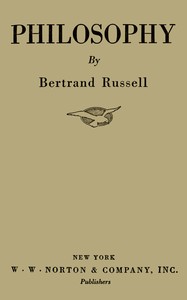
Philosophy — Key Ideas to Explore

(10 User reviews)   2564
In Category - Metaphysics
Russell, Bertrand, 1872-1970 Project Gutenberg 2024 Not confirmed
Philosophy; Psychology; Physics -- Philosophy Readers of public-domain and historical texts
Project Gutenberg digital edition en

Edition facts

Words 111,645
Reading time 486 min
Text sections 33

Before opening Philosophy — Key Ideas to Explore, the edition data offers a quick orientation: 111,645 words, 8 hr 6 min estimated reading time, and 33 detected text sections.

The text analysis averages about 22.9 words per sentence, while the detected sections provide another way to judge how the source is divided.

Project Gutenberg metadata also associates the work with “Philosophy,” connecting these edition facts with the source record’s subject description.

Bertrand Russell's 1927 work examines philosophy through the lens of doubt, behaviorism, and physics, arguing that knowledge must be tentative and precise. The text moves from external observation to self-observation, challenging materialism and exploring the limits of science.
Share
Editorial Edition Score 4.9/5

Calculated from edition completeness, EPUB availability, text structure and catalogue metadata. Not a user rating.

How this score is calculated
  • Description quality20 pts
  • Title & short description10 pts
  • Source metadata20 pts
  • Text length15 pts
  • Chapters / structure15 pts
  • EPUB file integrity20 pts

Total of 100 points, scaled to a 2.5-5.0 range. Editions with an empty description or a missing EPUB file are not scored.

Edition quality

Read the Text

he physical world. And it has the defect--as pragmatists have urged--that there seems no way of getting at “facts” and comparing them with our beliefs: all that we ever reach consists of other beliefs. I do not offer our present behaviouristic and pragmatic definition of “knowledge” as the only possible one, but I offer it as the one to which we are led if we wish to regard knowledge as something causally important, to be exemplified in our reactions to stimuli. This is the appropriate point of view when we are studying man from without, as we have been doing hitherto.

There is, however, within the behaviourist philosophy, one important addition to be made to our definition. We began this chapter with sensitivity, but we went on to the consideration of learned reactions, where the learning depended upon association. But there is another sort of learning--at least it is _prima facie_ another sort--which consists of increase of sensitivity. All sensitivity in animals and human beings must count as a sort of knowledge; that is to say, if an animal behaves, in the presence of a stimulus of a certain kind, as it would not behave in the absence of that stimulus then, in an important sense, it has “knowledge” as regards the stimulus. Now it appears that practice--_e.g._ in music--very greatly increases sensitivity. We learn to react differently to stimuli which only differ sightly; what is more, we learn to react to differences. A violin-player can react with great precision to an interval of a fifth; if the interval is very slightly greater or less, his behaviour in tuning is influenced by the difference from a fifth. And as we have already had occasion to notice, we become, through practice, increasingly sensitive to form. All this increased sensitivity must count as increase of knowledge.

But in saying this we are not saying anything inconsistent with our earlier definition of knowledge. Sensitivity is essential to choosing the right reaction in many cases. To take the cookery-book again; when it says “take a pinch of salt”, a good cook knows how much to take, which is an instance of sensitivity. Accurate scientific observation, which is of great practical importance, depends upon sensitivity. And so do many of our practical dealings with other people: if we cannot “feel” their moods, we shall be always getting at cross purposes.

The extent to which sensitivity is improved by practice is astonishing. Town-bred people do not know whether the weather is warm or cold until they read the weather reports in the paper. An entomologist perceives vastly more beetles in the course of a country walk than other people do. The subtlety with which connoisseurs can distinguish among wines and cigars is the despair of youths who wish to become men of the world. Whether this increase of sensitivity can be accounted for by the law of association, I do not know. In many cases, probably, it can, but I think sensitiveness to form, which is the essential element in the more difficult forms of abstract thought as well as in many other matters, cannot be regarded as derivative from the law of association, but is more analogous to the development of a new sense. I should therefore include improvement in sensitivity as an independent element in the advancement of knowledge. But I do so with some hesitation.

The above discussion does not pretend to cover the whole of the ground that has to be covered in discussing the definition of “knowledge”. There are other points of view, which are also necessary to a complete consideration of the question. But these must wait until, after considering the physical world, we come to the discussion of man as viewed from within.

THE STRUCTURE OF THE ATOM

In all that we have said hitherto on the subject of man from without, we have taken a common-sense view of the material world. We have not asked ourselves: what _is_ matter? Is there such a thing, or is the outside world composed of stuff of a different kind? And what light does a correct theory of the physical world throw upon the process of perception? These are questions which we must attempt to answer in the following chapters. And in doing so the science upon which we must depend is physics. Modern physics, however, is very abstract, and by no means easy to explain in simple language. I shall do my best, but the reader must not blame me too severely if, here and there, he finds some slight difficulty or obscurity. The physical world, both through the theory of relativity and through the most recent doctrines as to the structure of the atom, has become very different from the world of everyday life, and also from that of scientific materialism of the eighteenth-century variety. No philosophy can ignore the revolutionary changes in our physical ideas that the men of science have found necessary; indeed it may be said that all traditional philosophies have to be discarded, and we have to start afresh with as little respect as possible for the systems of the past. Our age has penetrated more deeply into the nature of things than any earlier age, and it would be a false modesty to over-estimate what can still be learned from the metaphysicians of the seventeenth, eighteenth and nineteenth centuries.

What physics has to say about matter, and the physical world generally, from the standpoint of the philosopher, comes under two main heads: first, the structure of the atom; secondly, the theory of relativity. The former was, until recently, the less revolutionary philosophically, though the more revolutionary in physics. Until 1925, theories of the structure of the atom were based upon the old conception of matter as indestructible substance, although this was already regarded as no more than a convenience. Now, owing chiefly to two German physicists, Heisenberg and Schrödinger, the last vestiges of the old solid atom have melted away, and matter has become as ghostly as anything in a spiritualist seance. But before tackling these newer views, it is necessary to understand the much simpler theory which they have displaced. This theory does not, except here and there, take account of the new doctrines on fundamentals that have been introduced by Einstein, and it is much easier to understand than relativity. It explains so much of the facts that, whatever may happen, it must remain a stepping-stone to a complete theory of the structure of the atom; indeed, the newer theories have grown directly out of it, and could hardly have arisen in any other way. We must therefore spend a little time in giving a bare outline, which is the less to be regretted as the theory is in itself fascinating.

The theory that matter consists of “atoms”, _i.e._ of little bits that cannot be divided, is due to the Greeks, but with them it was only a speculation. The evidence for what is called the atomic theory was derived from chemistry, and the theory itself, in its nineteenth-century form, was mainly due to Dalton. It was found that there were a number of “elements”, and that other substances were compounds of these elements. Compound substances were found to be composed of “molecules”, each molecule being composed of “atoms” of one substance combined with “atoms” of another or of the same. A molecule of water consists of two atoms of hydrogen and one atom of oxygen; they can be separated by electrolysis. It was supposed, until radio-activity was discovered, that atoms were indestructible and unchangeable. Substances which were not compounds were called “elements”. The Russian chemist Mendeleev discovered that the elements can be arranged in a series by means of progressive changes in their properties; in his time, there were gaps in this series, but most of them have since been filled by the discovery of new elements. If all the gaps were filled, there would be 92 elements; actually the number known is 87, or, including three about which there is still some doubt, 90. The place of an element in this series is called its “atomic number”. Hydrogen is the first, and has the atomic number 1; helium is the second, and has the atomic number 2; uranium is the last, and has the atomic number 92. Perhaps in the stars there are elements with higher atomic numbers, but so far none has been actually observed.

The discovery of radio-activity necessitated new views as to “atoms”. It was found that an atom of one radio-active element can break up into an atom of another element and an atom of helium, and that there is also another way in which it can change. It was found also that there can be different elements having the same place in the series; these are called “isotopes”. For example, when radium disintegrates it gives rise, in the end, to a kind of lead, but this is somewhat different from the lead found in lead-mines. A great many “elements” have been shown by Dr. F. W. Aston to be really mixtures of isotopes, which can be sorted out by ingenious methods. All this, but more especially the transmutation of elements in radio-activity, led to the conclusion that what had been called “atoms” were really complex structures, which could change into atoms of a different sort by losing a part. After various attempts to imagine the structure of an atom, physicists were led to accept the view of Sir Ernest Rutherford, which was further developed by Niels Bohr.

In this theory, which, in spite of recent developments, remains substantially correct, all matter is composed of two sorts of units, electrons and protons. All electrons are exactly alike, and all protons are exactly alike. All protons carry a certain amount of positive electricity, and all electrons carry an equal amount of negative electricity. But the mass of a proton is about 1835 times that of an electron: it takes 1835 electrons to weigh as much as one proton. Protons repel each other, and electrons repel each other, but an electron and a proton attract each other. Every atom is a structure consisting of electrons and protons. The hydrogen atom, which is the simplest, consists of one proton with one electron going round it as a planet goes round the sun. The electron may be lost, and the proton left alone; the atom is then positively electrified. But when it has its electron, it is, as a whole, electrically neutral, since the positive electricity of the proton is exactly balanced by the negative electricity of the electron.

The second element, helium, has already a much more complicated structure. It has a nucleus, consisting of four protons, and two electrons very close together, and in its normal state it has two planetary electrons going round the nucleus. But it may lose either or both of these, and it is then positively electrified.

All the latter elements consist, like helium, of a nucleus composed of protons and electrons, and a number of planetary electrons going round the nucleus. There are more protons than electrons in the nucleus, but the excess is balanced by the planetary electrons when the atom is unelectrified. The number of protons in the nucleus gives the “atomic weight” of the element: the excess of protons over electrons in the nucleus gives the “atomic number”, which is also the number of planetary electrons when the atom is unelectrified. Uranium, the last element, has 238 protons and 146 electrons in the nucleus, and when unelectrified it has 92 planetary electrons. The arrangement of the planetary electrons in atoms other than hydrogen is not accurately known, but it is clear that, in some sense, they form different rings, those in the outer rings being more easily lost than those nearer the nucleus.

I come now to what Bohr added to the theory of atoms as developed by Rutherford. This was a most curious discovery, introducing, in a new field, a certain type of discontinuity which was already known to be exhibited by some other natural processes. No adage had seemed more respectable in philosophy than “natura non facit saltum”, Nature makes no jumps. But if there is one thing more than another that the experience of a long life has taught me, it is that Latin tags always express falsehoods; and so it has proved in this case. Apparently Nature does make jumps, not only now and then, but whenever a body emits light, as well as on certain other occasions. The German physicist Planck was the first to demonstrate the necessity of jumps. He was considering how bodies radiate heat when they are warmer than their surroundings. Heat, as has long been known, consists of vibrations, which are distinguished by their “frequency”, _i.e._ by the number of vibrations per second. Planck showed that, for vibrations having a given frequency, not all amounts of energy are possible, but only those having to the frequency a ratio which is a certain quantity _h_ multiplied by 1 or 2 or 3 or some other whole number, in practice always a small whole number. The quantity _h_ is known as “Planck’s constant”; it has turned out to be involved practically everywhere where measurement is delicate enough to know whether it is involved or not. It is such a small quantity that, except where measurement can reach a very high degree of accuracy, the departure from continuity is not appreciable.[7]

[7] The dimensions of _h_ are those of “action”, _i.e._ energy multiplied by time, or moment of momentum, or mass multiplied by length multiplied by velocity. Its magnitude is about 6.55 × 10.27 erg secs.

Bohr’s great discovery was that this same quantity _h_ is involved in the orbits of the planetary electrons in atoms, and that it limits the possible orbits in ways for which nothing in Newtonian dynamics had prepared us, and for which so far, there is nothing in relativity-dynamics to account. According to Newtonian principles, an electron ought to be able to go round the nucleus in any circle with the nucleus in the centre, or in any ellipse with the nucleus in a focus; among possible orbits, it would select one or another according to its direction and velocity. But in fact only certain out of all these orbits occur. Those that occur are among those that are possible on Newtonian principles, but are only an infinitesimal selection from among these. It will simplify the explanation if we confine ourselves, as Bohr did at first, to circular orbits; moreover we will consider only the hydrogen atom, which has one planetary electron and a nucleus consisting of one proton. To define the circular orbits that are found to be possible, we proceed as follows: multiply the mass of the electron by the circumference of its orbit, and this again by the velocity of the electron; the result will always be _h_ or 2_h_, or 3_h_, or some other small exact multiple of _h_, where _h_, as before, is “Planck’s constant”. There is thus a smallest possible orbit, in which the above product is _h_; the radius of the next orbit, in which the above produce is 2_h_, will have a length four times this minimum; the next, nine times; the next, sixteen times; and so on through the “square numbers” (_i.e._ those got by multiplying a number by itself). Apparently no other circular orbits than these are possible in the hydrogen atom. Elliptic orbits are possible, and these again introduce exact multiples of _h_: but we need not, for our purposes, concern ourselves with them.

When a hydrogen atom is left to itself, if the electron is in the minimum orbit it will continue to rotate in that orbit so long as nothing from outside disturbs it; but if the electron is in any of the larger possible orbits, it may sooner or later jump suddenly to a smaller orbit, either the minimum or one of the intermediate possible orbits. So long as the electron does not change its orbit, the atom does not radiate energy, but when the electron jumps to a smaller orbit, the atom loses energy, which is radiated out in the form of a light-wave. This light-wave is always such that its energy divided by its frequency is exactly _h_. The atom may absorb energy from without, and it does so by the electron jumping to a larger orbit. It may then afterwards, when the external source of energy is removed, jump back to the smaller orbit; this is the cause of fluorescence, since, in doing so, the atom gives out energy in the form of light.

The same principles, with greater mathematical complications, apply to the other elements. There is, however, with some of the latest elements, a phenomenon which cannot have any analogue in hydrogen, and that is radio-activity. When an atom is radio-active, it emits rays of three kinds, called respectively α-rays, β-rays, and γ-rays. Of these, the γ-rays are analogous to light, but of much higher frequencies, or shorter wave-lengths; we need not further concern ourselves with them. The α-rays and β-rays, on the contrary, are important as our chief source of knowledge concerning the nuclei of atoms. It is found that the α-rays consist of helium nuclei, while the β-rays consist of electrons. Both come out of the nucleus, since the atom after radio-activity disruption is a different element from what it was before. But no one knows just why the nucleus disintegrates when it does, nor why, in a piece of radium, for example, some atoms break down while others do not.

The three principal sources of our knowledge concerning atoms have been the light they emit, X-rays and radio-activity. As everyone knows, when the light emitted by a glowing gas is passed through a prism, it is found to consist of well-defined lines of different colours, which are characteristic for each element, and constitute what is called its “spectrum”. The spectrum extends beyond the range of visible light, both into the infra-red and into the ultra-violet. In the latter direction, it extends right into the region of X-rays, which are only ultra-ultra-violet light. By means of crystals, it has been found possible to study X-ray spectra as exactly as those of ordinary light. The great merit of Bohr’s theory was that it explained why elements have the spectra they do have, which had, before, been a complete mystery. In the cases of hydrogen and positively electrified helium, the explanation, particularly as extended by the German physicist Sommerfeld, gave the most minute numerical agreement between theory and observation; in other cases, mathematical difficulties made this completeness impossible, but there was every reason to think that the same principles were adequate. This was the main reason for accepting Bohr’s theory; and certainly it was a very strong one. It was found that visible light enabled us to study the outer rings of planetary electrons, X-rays enabled us to study the inner rings, and radio-activity enabled us to study the nucleus. For the latter purpose, there are also other methods, more particularly Rutherford’s “bombardment”, which aims at breaking up nuclei by firing projectiles at them, and sometimes succeeds in making a hit in spite of the smallness of the target.

The theory of atomic structure that has just been outlined, like everything in theoretical physics, is capable of expression in mathematical formulæ; but like many things in theoretical physics, it is also capable of expression in the form of an imaginative picture. But here, as always, it is necessary to distinguish sharply between the mathematical symbols and the pictorial words. The symbols are pretty sure to be right, or nearly so; the imaginative picture, on the other hand, should not be taken too seriously. When we consider the nature of the evidence upon which the above theory of the atom is based, we can see that the attempt to make a picture of what goes on has led us to be far more concrete than we have any right to be. If we want to assert only what we have good reason to believe, we shall have to abandon the attempt to be concrete about what goes on in the atom, and say merely something like this: An atom with its electrons is a system characterised by certain integers, all small, and all capable of changing independently. These integers are the multiples of _h_ involved. When any of them changes to a smaller integer, energy of a definite amount is emitted, and its frequency will be obtained by dividing the energy of _h_. When any of the integers concerned changes to a larger integer, energy is absorbed, and again the amount absorbed is definite. But we cannot know what goes on when the atom is neither absorbing nor radiating energy, since then it has no effects in surrounding regions; consequently all evidence as to atoms is as to their changes, not as to their steady states.

Bertrand Russell opens Philosophy by refusing to define the subject, noting that any definition depends on the philosophy one adopts. Instead, he identifies philosophy with problems that raise doubts about ordinary knowledge, which he characterizes as cocksure, vague, and self-contradictory. The book then proceeds in four parts: man from without (behaviorist approach), the physical world (physics and perception), man from within (introspection), and the universe (metaphysics). The catalog subjects—Philosophy, Psychology, Physics—Philosophy—accurately reflect the scope, but the excerpts show that psychology is treated largely through behaviorist critique, not as a separate discipline.

The Behaviorist Challenge and Its Limits

Part I adopts an external, behaviorist perspective, examining learning, language, perception, and memory as observable processes. Russell notes that behaviorism defines knowledge without reference to inner states, but he later undermines this approach. In Part II, he argues that physics itself shows perception is subjective: two people cannot observe the same phenomenon except approximately. This, he claims, removes the a priori objection to self-observation and leads back to introspection as a reliable source of knowledge. The excerpts thus reveal a dialectical structure: the behaviorist method is tested and found insufficient, not because it is false, but because it cannot account for the data of physics.

Matter as a Convenient Formula

Russell’s discussion of physics in Part II is striking for its deflationary view of matter. Drawing on Whitehead and modern physics, he describes matter as a “convenient formula for describing what happens where it isn’t.” Electrons and protons are not persistent substances but centers from which energy radiates; the physicist’s talk of persistence is merely a useful description. This leads Russell to argue that materialism as a philosophy is “hardly tenable,” though a view that all events obey physical laws remains viable. The excerpts show that Russell is not endorsing a purely physicalist worldview but rather using physics to question traditional metaphysical categories.

Self-Observation and the Return to Descartes

Part III begins by recalling Descartes’ method of doubt and his reliance on self-observation as the foundation of certainty. Russell argues that the subjectivity of perception, established in Part II, makes self-observation the most reliable way to obtain knowledge—a reversal of the behaviorist stance. He notes that what happens in the brain is not what a physiologist sees when examining it, because that observation occurs in the physiologist’s brain. This move is characteristic of Russell’s approach: he uses scientific findings to challenge naive realism, then reintroduces introspection as a legitimate source of evidence. The excerpts do not reveal how far Russell carries this argument, but they establish a clear trajectory from external to internal evidence.

Readers should note that the excerpts cover only the beginnings of each part; the later chapters on ethics, truth, and man’s place in the universe are not sampled. The catalog subject “Ethics” appears only as a chapter title, so its treatment remains unknown. Russell’s prose is direct and argumentative, often using examples from physics and psychology to illustrate philosophical points. The book rewards attention to its structural shifts between perspectives, which are central to its method.

Bertrand Russell’s insistence on tentative knowledge has stayed with me since I first read him, that quiet ache of certainty slipping away. I sometimes think of Six metaphysical meditations — Edition Insights alongside his caution, as if they were old friends agreeing on doubt. Six metaphysical meditations — Edition Insights feels like a gentler echo of that same searching, minus the physics. I just set them side by side on the shelf.

David Campbell
1 month ago

Michael Campbell
2 weeks ago

James Green
1 week ago

David Garcia
1 week ago

Sebastian Anderson
2 weeks ago

5
5 out of 5 (10 User reviews )

Add a Review

Your Rating *
There are no comments for this eBook.

Reader reflection

What was your reading experience?

Capture what you thought, learned, and would like to remember.

Your progress 0 / 10
1

What is your current status with this title?

2

Did this book hold your interest?

3

How likely are you to recommend this book?

4

Did the language feel accessible?

Related eBooks